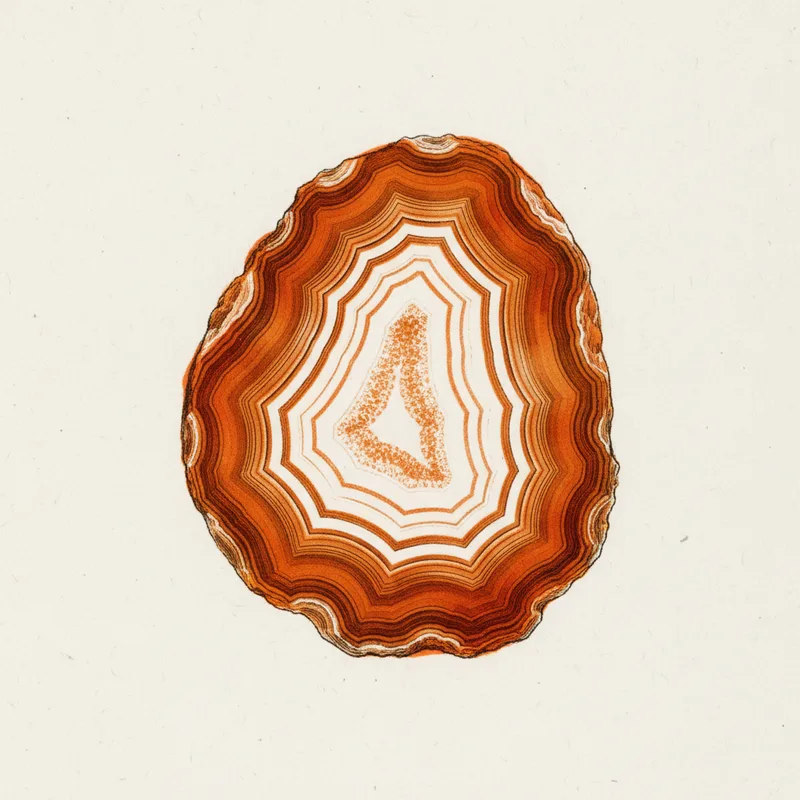
Agate
The Stabilizer
Affiliate links. We may earn a commission, at no cost to you.
Quick Facts
Formation & Origin
Agate is a banded variety of chalcedony, the microcrystalline form of quartz (SiO₂). Agate forms inside cavities in volcanic rock - primarily basalt. When lava solidifies, gas bubbles create hollow spaces. Over millennia, silica-rich groundwater seeps in, depositing microscopic layers of chalcedony on the cavity walls. Each layer represents a change in the fluid chemistry, producing the characteristic banding.
The process is extraordinarily slow - a typical agate nodule took millions of years to fill, layer by micrometer-thin layer. Variations in iron content, trace elements, and fluid pH create different colors in each band. Some agates never fully fill, leaving a central cavity lined with quartz crystals (a geode).
Special varieties form through unique processes. Moss agate contains filamentous inclusions of chlorite or iron oxide that resemble plant matter - they're mineral growths, not actual moss. Fire agate from Mexico and Arizona contains thin layers of iron oxide (limonite) over chalcedony that produce iridescent color play through thin-film interference.
Identification Guide
Agate is defined by its translucent, banded chalcedony composition. The banding distinguishes it from jasper (opaque, no banding) and carnelian (translucent, no banding, orange). At Mohs 7, it's hard with a waxy to vitreous luster and conchoidal fracture.
Hold agate up to a strong light - genuine agate's translucency and banding become visible even in darker specimens. The bands follow the contours of the original cavity, creating concentric patterns. In moss agate, the inclusions are three-dimensional - they appear at different depths within the translucent stone.
Spotting Fakes
The biggest issue in the agate market is dyeing. Brazilian agate is porous and absorbs dye easily - vivid blue, pink, purple, and green slices are almost always dyed. The telltale signs: unnaturally saturated colors, color concentrated in more porous bands, and the color rubbing off on wet cotton. Natural agate colors tend toward subtle earth tones. Dyed agate is not 'fake' (it's real agate), but the color is artificial. If the price seems too good for an extremely vivid color, it's dyed.
Some links in this post go to Amazon and Etsy. Crystal Almanac earns a commission from qualifying purchases at no extra cost to you. Tools recommended here are ones we would use ourselves to run the tests described - the recommendation comes first, the link is downstream of it.
Cultural & Metaphysical Traditions
Presented as cultural traditions, not scientific evidence
Named after the Achates River in Sicily where it was first described by the Greek philosopher Theophrastus around 300 BCE. Ancient civilizations worldwide used agate for amulets, seals, and jewelry. Islamic tradition values agate rings. Persian magicians believed agate could divert storms. Blue lace agate was only discovered in Namibia in the 1960s but has become one of the most popular varieties in the crystal wellness market.
Metaphysical and “healing” associations are cultural traditions, not medical advice or scientific fact. Crystals are not a substitute for professional medical care.
Where It's Found
Massive agate deposits, dyed and natural
Iconic banded Botswana agate, pink and gray
Moss agate, Montana agate, prized by collectors
Fire agate and crazy lace agate, vivid patterns
Price Guide
Good to Know
Scratch test: At hardness 7, Agate can scratch glass and steel. It's durable enough for any type of jewelry.
Global supply: Found in 4 notable locations worldwide, from Brazil to Mexico.
Heft test: Agate has average mineral density (2.60). It feels about as heavy as you'd expect from a stone its size.
Common Questions
What is the chemical formula of Agate?
The chemical formula of Agate is SiO₂.
What is Agate's Mohs hardness?
Agate has a Mohs hardness of 7 on the 1 to 10 Mohs scale, hard enough to scratch glass and stand up to daily wear.
Is Agate a mineral?
Yes. Agate is a naturally occurring mineral (Quartz Family (Chalcedony)) with a definite chemical composition and an ordered crystal structure.
Care & Safety
The water, salt, and sunlight questions people actually ask before cleansing or displaying agate, answered from its hardness (Mohs 7) and chemistry (SiO₂).
Can Agate go in water?
Yes. Agate is hard (Mohs 7) and chemically stable, so a rinse or a quick wash with mild soap is no problem, cleanse it in water freely if that is your practice. A long soak does nothing for it either way, so skip that, and dry the stone afterward.
Can Agate go in salt water?
Not recommended, even though agate itself is hard and not water-soluble. Salt is both corrosive and mildly abrasive: it can dull a polished surface, attack metal settings, and crystallize inside small fractures as the stone dries. A quick dip will not destroy agate, but rinse it with fresh water afterward and dry it. For routine cleaning, plain water is the kinder choice.
Sources & References
The mineralogical and gemological data on this page is drawn from and can be cross-checked against these external references.
- WikipediaAgate on Wikipedia
- WebmineralQuartz mineral data (Webmineral)
- Handbook of MineralogyQuartz (Handbook of Mineralogy, PDF)
Explore More
Quartz & Chalcedony
Virgo Season Crystals 2026: Stones for Clarity
How to Protect Crystals from Summer Heat and Sunlight
Best Calming Crystals for Anxiety and Stress
Mohs Hardness Scale
See where Agate sits on the scale
Crystal Care Guide
Water safety, sunlight, and handling tips
Save This Stone

Keep this agate reference handy. Save the card to a Pinterest board and the profile is one tap away.
Save to PinterestNewsletter
Something shiny, now and then
A stone worth knowing, or a fake worth spotting, every so often. No spam.