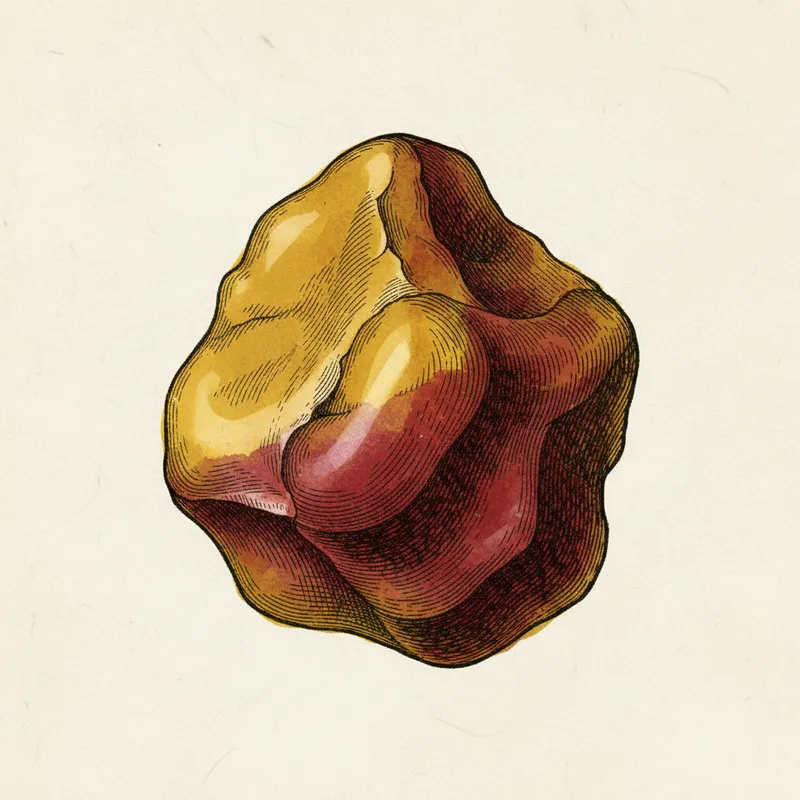
Mookaite
The Australian Sunset Stone
Affiliate links. We may earn a commission, at no cost to you.
Quick Facts
Formation & Origin
Mookaite is an Australian variety of jasper, an opaque microcrystalline form of quartz (SiO₂), known for its banded red, yellow, and cream coloring. Mookaite (also spelled mookite or moukite) is an Australian jasper variety found exclusively along Mooka Creek in the Kennedy Range of Western Australia. It formed as a silicified radiolarian mudstone - ancient marine sediment composed of the silica skeletons of radiolaria (microscopic ocean organisms) that was later cemented and altered by silica-rich groundwater.
The vivid colors come from various iron oxide and manganese concentrations within the silicified sediment: red and burgundy from hematite, yellow and mustard from goethite and limonite, cream from pure silica, and purple from manganese. Many specimens show dramatic multi-color patterns where different zones of mineral concentration meet.
The radiolarite host rock is approximately 120 million years old (Cretaceous period), deposited when the area was a shallow sea. The silicification that converted it to jasper/chalcedony occurred much later as groundwater percolated through the sediment.
Identification Guide
Mookaite is identified by its distinctive combination of warm, earthy colors - particularly the burgundy red, mustard yellow, and cream palette that resembles an Australian outback sunset. At hardness 7, it's durable and takes an excellent polish.
Distinguish from other jaspers (different color combinations and localities), carnelian (translucent, typically single-colored), and painted or dyed stones (mookaite's colors should extend through the stone, not just on the surface). The specific warm color palette and opaque, waxy texture are characteristic.
Spotting Fakes
Mookaite is affordable and distinctive enough that faking is rare. Dyed jasper or agate from other localities may be sold under the mookaite name - the specific warm color palette and Western Australian origin are the distinguishing factors. Genuine mookaite has a consistent waxy texture and the colors blend naturally rather than showing sharp dye boundaries.
Some links in this post go to Amazon and Etsy. Crystal Almanac earns a commission from qualifying purchases at no extra cost to you. Tools recommended here are ones we would use ourselves to run the tests described - the recommendation comes first, the link is downstream of it.
Cultural & Metaphysical Traditions
Presented as cultural traditions, not scientific evidence
Aboriginal Australian peoples have used materials from the Mooka Creek area for thousands of years. In the modern crystal market, mookaite is associated with adventure, vitality, and connection to the land. Its Australian origin and warm earth tones connect it to themes of grounding, ancestral wisdom, and the energy of ancient landscapes. It's sometimes called 'the Australian Mother Earth stone.'
Metaphysical and “healing” associations are cultural traditions, not medical advice or scientific fact. Crystals are not a substitute for professional medical care.
Where It's Found
The only source, named after the creek
Price Guide
Good to Know
Scratch test: At hardness 7, Mookaite can scratch glass and steel. It's durable enough for any type of jewelry.
Global supply: Found at only one location on Earth - Australia. Supply is inherently limited.
Heft test: Mookaite has average mineral density (2.65). It feels about as heavy as you'd expect from a stone its size.
Common Questions
What is the chemical formula of Mookaite?
The chemical formula of Mookaite is SiO₂.
What is Mookaite's Mohs hardness?
Mookaite has a Mohs hardness of 7 on the 1 to 10 Mohs scale, hard enough to scratch glass and stand up to daily wear.
Is Mookaite a mineral?
Yes. Mookaite is a naturally occurring mineral (Quartz Family (Chalcedony/Jasper)) with a definite chemical composition and an ordered crystal structure.
Care & Safety
The water, salt, and sunlight questions people actually ask before cleansing or displaying mookaite, answered from its hardness (Mohs 7) and chemistry (SiO₂).
Can Mookaite go in water?
Yes. Mookaite is hard (Mohs 7) and chemically stable, so a rinse or a quick wash with mild soap is no problem, cleanse it in water freely if that is your practice. A long soak does nothing for it either way, so skip that, and dry the stone afterward.
Can Mookaite go in salt water?
Not recommended, even though mookaite itself is hard and not water-soluble. Salt is both corrosive and mildly abrasive: it can dull a polished surface, attack metal settings, and crystallize inside small fractures as the stone dries. A quick dip will not destroy mookaite, but rinse it with fresh water afterward and dry it. For routine cleaning, plain water is the kinder choice.
Sources & References
The mineralogical and gemological data on this page is drawn from and can be cross-checked against these external references.
- WikipediaRadiolarite on Wikipedia
Explore More
Save This Stone

Keep this mookaite reference handy. Save the card to a Pinterest board and the profile is one tap away.
Save to PinterestNewsletter
Something shiny, now and then
A stone worth knowing, or a fake worth spotting, every so often. No spam.