Polychrome Jasper
The Desert Sunset Stone
Affiliate links. We may earn a commission, at no cost to you.
Quick Facts
Formation & Origin
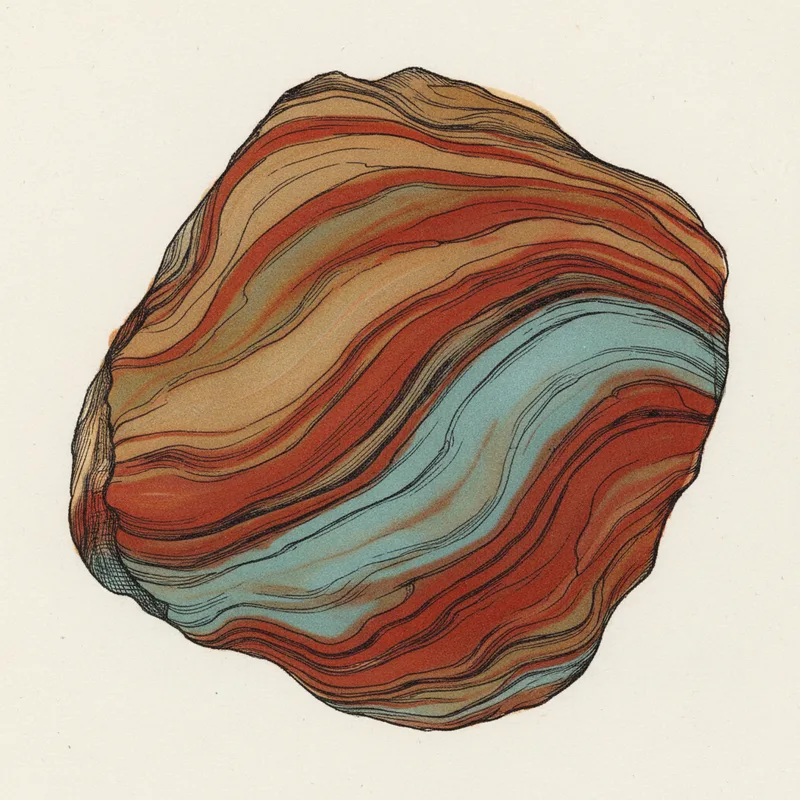
Polychrome jasper (also called desert jasper or royal savannah jasper) is a multicolored jasper from Madagascar discovered in the early 2000s. The name 'polychrome' means 'many colors,' and the stone lives up to it: swirling patterns of tan, brown, rust, cream, olive, and orange create landscapes that resemble aerial views of desert terrain.
The multiple colors come from varying concentrations and oxidation states of iron throughout the silica matrix. Different iron compounds produce the range: hematite (red), goethite (brown-yellow), limonite (yellow-brown), and chlorite (green). The swirling patterns result from flow structures in the original volcanic material combined with subsequent weathering and mineral infiltration.
Polychrome jasper is often found in free-form shapes that are polished to follow the stone's natural contours, producing organic, sculptural display pieces that highlight the flowing color patterns.
Identification Guide
Polychrome jasper is identified by its warm, multicolored swirling patterns in desert earth tones. The colors should blend smoothly rather than forming sharp boundaries. Hardness 6.5-7 and opaque chalcedony properties confirm jasper classification.
Distinguish from mookaite (Australian, different color palette, typically includes mauve), ocean jasper (orbicular patterns rather than flowing swirls), and picture jasper (landscape scenes rather than abstract swirls).
Spotting Fakes
Polychrome jasper is affordable and not commonly faked. The main concern is that generic multicolored jasper from other sources may be labeled as polychrome jasper, which properly refers only to the Madagascan material. Genuine polychrome jasper has a specific warm palette and flowing, organic patterns. Very bright or unnatural colors may indicate dyeing.
Some links in this post go to Amazon and Etsy. Crystal Almanac earns a commission from qualifying purchases at no extra cost to you. Tools recommended here are ones we would use ourselves to run the tests described - the recommendation comes first, the link is downstream of it.
Cultural & Metaphysical Traditions
Presented as cultural traditions, not scientific evidence
Polychrome jasper is associated with vitality, transformation, and embracing all aspects of your experience. The multiple colors are interpreted as representing the many facets of a whole person. Practitioners use it for grounding during periods of change, accessing creative energy, and finding passion for new endeavors.
Metaphysical and “healing” associations are cultural traditions, not medical advice or scientific fact. Crystals are not a substitute for professional medical care.
Where It's Found
Primary source, discovered ~2006-2008
Price Guide
Good to Know
Scratch test: At hardness 6.5, Polychrome Jasper resists scratching from a knife but can be scratched by quartz. Best for pendants and earrings rather than rings.
Global supply: Found at only one location on Earth - Madagascar. Supply is inherently limited.
Heft test: Polychrome Jasper has average mineral density (2.58-2.91). It feels about as heavy as you'd expect from a stone its size.
Common Questions
What is the chemical formula of Polychrome Jasper?
The chemical formula of Polychrome Jasper is SiO₂ (with multiple iron oxide inclusions).
What is Polychrome Jasper's Mohs hardness?
Polychrome Jasper has a Mohs hardness of 6.5 on the 1 to 10 Mohs scale, hard enough to scratch glass but softer than quartz.
Is Polychrome Jasper a mineral?
Yes. Polychrome Jasper is a naturally occurring mineral (Chalcedony (Quartz Family)) with a definite chemical composition and an ordered crystal structure.
Care & Safety
The water, salt, and sunlight questions people actually ask before cleansing or displaying polychrome jasper, answered from its hardness (Mohs 6.5) and chemistry (SiO₂ (with multiple iron oxide inclusions)).
Can Polychrome Jasper go in water?
Yes. Polychrome Jasper is not water-soluble and durable enough (Mohs 6.5), so a rinse or a quick wash with mild soap is no problem, cleanse it in water freely if that is your practice. A long soak does nothing for it either way, so skip that, and dry the stone afterward.
Can Polychrome Jasper go in salt water?
Not recommended, even though polychrome jasper itself is hard and not water-soluble. Salt is both corrosive and mildly abrasive: it can dull a polished surface, attack metal settings, and crystallize inside small fractures as the stone dries. A quick dip will not destroy polychrome jasper, but rinse it with fresh water afterward and dry it. For routine cleaning, plain water is the kinder choice.
Sources & References
The mineralogical and gemological data on this page is drawn from and can be cross-checked against these external references.
- WikipediaJasper on Wikipedia
Explore More
Save This Stone

Keep this polychrome jasper reference handy. Save the card to a Pinterest board and the profile is one tap away.
Save to PinterestNewsletter
Something shiny, now and then
A stone worth knowing, or a fake worth spotting, every so often. No spam.