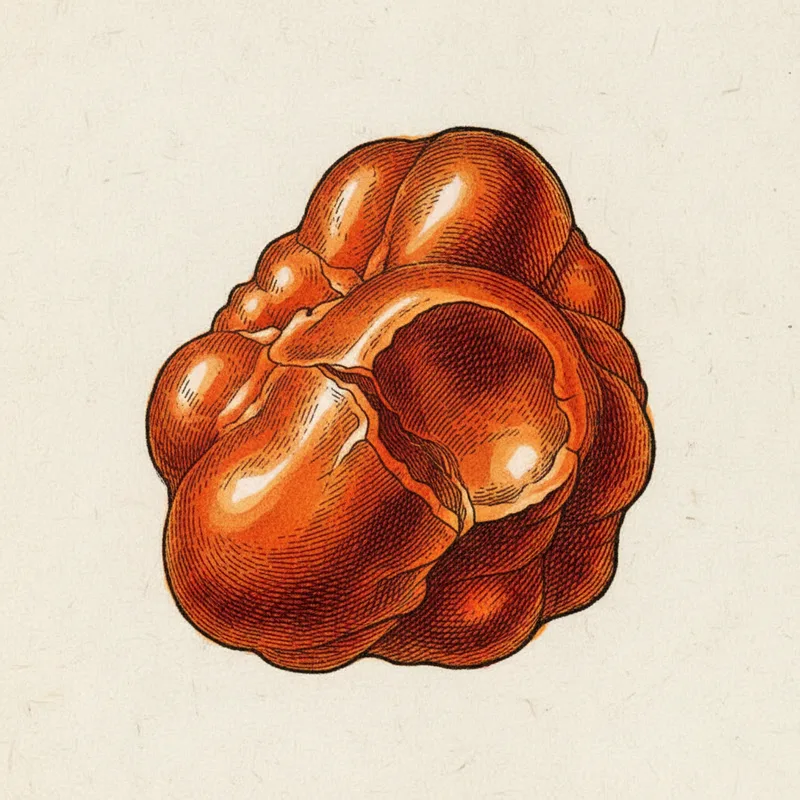
Carnelian
The Singer's Stone
Affiliate links. We may earn a commission, at no cost to you.
Quick Facts
Formation & Origin
Carnelian is a variety of chalcedony - microcrystalline quartz composed of tiny interlocking crystals invisible to the naked eye. It forms when silica-rich solutions deposit in cavities within volcanic rocks, building up layer by layer over thousands to millions of years.
The orange-red color comes from iron oxide (hematite) dispersed throughout the silica matrix. The concentration and oxidation state of the iron determines the intensity - from pale orange to deep brownish-red. Interestingly, many carnelian specimens are naturally pale and achieve their rich color through heat treatment, a practice that dates back to ancient times. Indian craftsmen have been heating chalcedony in clay pots over fires for at least 4,000 years to deepen the red.
This heat treatment works because it converts yellow iron hydroxide (goethite) inclusions to red iron oxide (hematite), intensifying the color. The process is so ancient and universal that the gem trade considers it a natural enhancement rather than a treatment requiring disclosure.
Identification Guide
Carnelian is identified by its translucent orange-red color and waxy luster. It differs from jasper (which is opaque), agate (which is banded), and sard (which is a darker, browner variety of the same mineral with no clear boundary between the two).
At Mohs 7, carnelian is hard and takes a good polish. It has no cleavage and breaks with a conchoidal fracture. When held up to light, genuine carnelian often shows a cloudy translucency with subtle color variations, while dyed imitations tend to show color concentrated along surface cracks.
Spotting Fakes
Hold the stone up to strong light: genuine carnelian shows a cloudy, slightly uneven translucency, while dyed agate (the most common substitute) shows clear banding with dye concentrated in the porous bands.
- Dyed material may also show color pooling around drill holes in beads.
- Glass imitations are uniform in color and may contain bubbles.
- Genuine carnelian feels cool to the touch and has a slightly waxy surface texture that glass lacks.
Some links in this post go to Amazon and Etsy. Crystal Almanac earns a commission from qualifying purchases at no extra cost to you. Tools recommended here are ones we would use ourselves to run the tests described - the recommendation comes first, the link is downstream of it.
Cultural & Metaphysical Traditions
Presented as cultural traditions, not scientific evidence
Ancient Egyptians called carnelian 'the setting sun' and placed it in tombs to protect the dead in the afterlife. The Prophet Muhammad is said to have worn a carnelian ring. Roman soldiers wore carnelian signets for courage in battle. In medieval Europe, it was believed to calm anger and protect against the evil eye. Modern practitioners associate it with creativity, confidence, and physical vitality.
Metaphysical and “healing” associations are cultural traditions, not medical advice or scientific fact. Crystals are not a substitute for professional medical care.
Where It's Found
Ancient source, heat-treated for deeper red since antiquity
Large quantities of agate-hosted carnelian
Fine quality, naturally deep orange-red
Rich orange specimens, growing modern source
Price Guide
Good to Know
Scratch test: At hardness 7, Carnelian can scratch glass and steel. It's durable enough for any type of jewelry.
Global supply: Found in 4 notable locations worldwide, from India to Madagascar.
Heft test: Carnelian has average mineral density (2.60). It feels about as heavy as you'd expect from a stone its size.
Common Questions
What is the chemical formula of Carnelian?
The chemical formula of Carnelian is SiO₂.
What is Carnelian's Mohs hardness?
Carnelian has a Mohs hardness of 7 on the 1 to 10 Mohs scale, hard enough to scratch glass and stand up to daily wear.
Is Carnelian a mineral?
Yes. Carnelian is a naturally occurring mineral (Quartz Family (Chalcedony)) with a definite chemical composition and an ordered crystal structure.
Care & Safety
The water, salt, and sunlight questions people actually ask before cleansing or displaying carnelian, answered from its hardness (Mohs 7) and chemistry (SiO₂).
Can Carnelian go in water?
Yes. Carnelian is hard (Mohs 7) and chemically stable, so a rinse or a quick wash with mild soap is no problem, cleanse it in water freely if that is your practice. A long soak does nothing for it either way, so skip that, and dry the stone afterward.
Can Carnelian go in salt water?
Not recommended, even though carnelian itself is hard and not water-soluble. Salt is both corrosive and mildly abrasive: it can dull a polished surface, attack metal settings, and crystallize inside small fractures as the stone dries. A quick dip will not destroy carnelian, but rinse it with fresh water afterward and dry it. For routine cleaning, plain water is the kinder choice.
Sources & References
The mineralogical and gemological data on this page is drawn from and can be cross-checked against these external references.
- WikipediaCarnelian on Wikipedia
- WebmineralQuartz mineral data (Webmineral)
- Handbook of MineralogyQuartz (Handbook of Mineralogy, PDF)
Related Minerals
Darker brown variety, same mineral
Banded chalcedony from same environments
Opaque chalcedony, related but different
Black and white banded chalcedony
Explore More
Quartz & Chalcedony
The Creative Collection
Ancient Egyptian architects and builders wore carnelian. Associated with bold creative action and the courage to present work publicly.
The Manifestation Collection
The stone of action. Where other manifestation stones help clarify the vision, carnelian provides the creative fire and courage to execute it.
The Confidence Collection
The courage stone of the ancient world. Roman soldiers carried it, Egyptian architects wore it, Islamic tradition honors it. Across four millennia, carnelian has been the stone people reach for before bold action.
The Beginner's Collection
Chalcedony - microcrystalline quartz that forms in massive nodules rather than crystal points. Compares with amethyst to show how the same SiO₂ formula produces wildly different textures.
Lion's Gate Portal 2026: Crystals for August 8
The Surprisingly Recent History of Crystal Healing
Leo Season Crystals 2026: Stones for Confidence
Mohs Hardness Scale
See where Carnelian sits on the scale
Crystal Care Guide
Water safety, sunlight, and handling tips
Save This Stone

Keep this carnelian reference handy. Save the card to a Pinterest board and the profile is one tap away.
Save to PinterestNewsletter
Something shiny, now and then
A stone worth knowing, or a fake worth spotting, every so often. No spam.