Grape Agate
The Dream Cluster
Affiliate links. We may earn a commission, at no cost to you.
Quick Facts
Formation & Origin
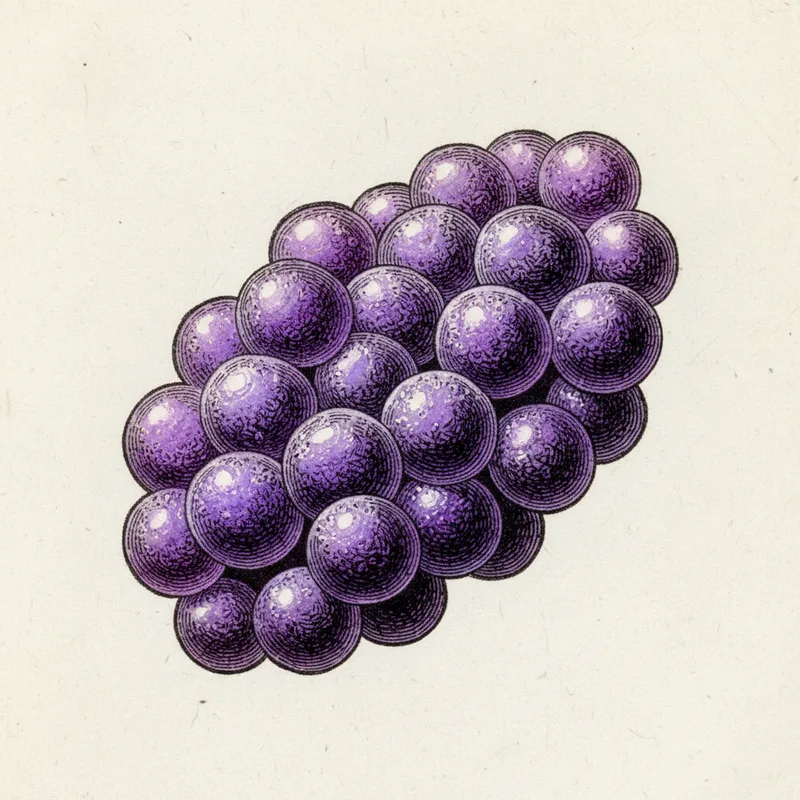
Grape agate is a botryoidal form of purple chalcedony that grows as clusters of tiny spheres resembling bunches of grapes. It formed in volcanic rock cavities on the island of Sulawesi, Indonesia, where silica-rich fluids deposited chalcedony in spherical aggregates.
Each 'grape' is a small sphere of concentrically layered chalcedony that grew outward from a nucleation point. The purple color comes from iron and manganese inclusions within the chalcedony. The spheres range from a few millimeters to about a centimeter in diameter, and clusters can be quite large.
Grape agate entered the mineral market around 2015-2016 and quickly became one of the most popular new mineral finds of the decade. Its immediate visual appeal (it genuinely looks like purple grapes), combined with affordable pricing, made it a social media sensation. The green variety is considerably rarer and more valuable.
Identification Guide
Grape agate is identified by its distinctive botryoidal clusters of purple chalcedony spheres. At hardness 7, it's durable. The grape-like form on volcanic matrix is unmistakable.
Distinguish from botryoidal amethyst (crystalline quartz surfaces rather than smooth chalcedony), purple smithsonite (zinc carbonate, fizzes in acid), and artificially colored chalcedony. Genuine grape agate's spheres have a natural, slightly variable size distribution.
Spotting Fakes
Grape agate is affordable enough that faking isn't common. Some material may be dyed to intensify the purple. Natural grape agate ranges from pale lavender to medium purple - anything extremely vivid should be examined. The green variety commands higher prices and could potentially be dyed purple material (check for dye in crevices). The spherical botryoidal form itself is natural and very difficult to replicate artificially.
Some links in this post go to Amazon and Etsy. Crystal Almanac earns a commission from qualifying purchases at no extra cost to you. Tools recommended here are ones we would use ourselves to run the tests described - the recommendation comes first, the link is downstream of it.
Cultural & Metaphysical Traditions
Presented as cultural traditions, not scientific evidence
Grape agate is too recently discovered (2015-2016) for traditional associations. Modern crystal practitioners have enthusiastically adopted it, associating the purple color with dream work, intuition, and psychic development. Its cluster form is interpreted as representing community and interconnection. The grape metaphor connects it to abundance and the harvest. It's become one of the most popular meditation stones among younger crystal enthusiasts.
Metaphysical and “healing” associations are cultural traditions, not medical advice or scientific fact. Crystals are not a substitute for professional medical care.
Where It's Found
The primary commercial source
Price Guide
Good to Know
Scratch test: At hardness 7, Grape Agate can scratch glass and steel. It's durable enough for any type of jewelry.
Global supply: Found at only one location on Earth - Indonesia. Supply is inherently limited.
Heft test: Grape Agate has average mineral density (2.60). It feels about as heavy as you'd expect from a stone its size.
Common Questions
What is the chemical formula of Grape Agate?
The chemical formula of Grape Agate is SiO₂.
What is Grape Agate's Mohs hardness?
Grape Agate has a Mohs hardness of 7 on the 1 to 10 Mohs scale, hard enough to scratch glass and stand up to daily wear.
Is Grape Agate a mineral?
Yes. Grape Agate is a naturally occurring mineral (Quartz Family (Chalcedony)) with a definite chemical composition and an ordered crystal structure.
Care & Safety
The water, salt, and sunlight questions people actually ask before cleansing or displaying grape agate, answered from its hardness (Mohs 7) and chemistry (SiO₂).
Can Grape Agate go in water?
Yes. Grape Agate is hard (Mohs 7) and chemically stable, so a rinse or a quick wash with mild soap is no problem, cleanse it in water freely if that is your practice. A long soak does nothing for it either way, so skip that, and dry the stone afterward.
Can Grape Agate go in salt water?
Not recommended, even though grape agate itself is hard and not water-soluble. Salt is both corrosive and mildly abrasive: it can dull a polished surface, attack metal settings, and crystallize inside small fractures as the stone dries. A quick dip will not destroy grape agate, but rinse it with fresh water afterward and dry it. For routine cleaning, plain water is the kinder choice.
Does Grape Agate fade in sunlight?
The purple form can. Purple grape agate is colored like amethyst, by irradiation-activated color centers around trace iron, and it can fade in prolonged exposure to direct sunlight. The blue-green form is colored by clay mineral inclusions instead and has no documented fading. Display purple specimens away from direct sun.
Sources & References
The mineralogical and gemological data on this page is drawn from and can be cross-checked against these external references.
- WikipediaGrape agate on Wikipedia
- WebmineralQuartz mineral data (Webmineral)
- Handbook of MineralogyQuartz (Handbook of Mineralogy, PDF)
Related Minerals
Purple quartz, crystalline vs chalcedony
The mineral family grape agate belongs to
Similar form in different colors
Can form similar botryoidal clusters
Explore More
Save This Stone

Keep this grape agate reference handy. Save the card to a Pinterest board and the profile is one tap away.
Save to PinterestNewsletter
Something shiny, now and then
A stone worth knowing, or a fake worth spotting, every so often. No spam.