Chalcedony
The Mother of Agates
Affiliate links. We may earn a commission, at no cost to you.
Quick Facts
Formation & Origin
Chalcedony is the umbrella term for all microcrystalline (crypto-crystalline) quartz - quartz composed of crystals too small to see individually without a microscope. It's not a single stone but an entire family that includes agate, carnelian, chrysoprase, bloodstone, jasper, onyx, and many others. Understanding chalcedony is understanding the foundation that connects dozens of popular gemstones.
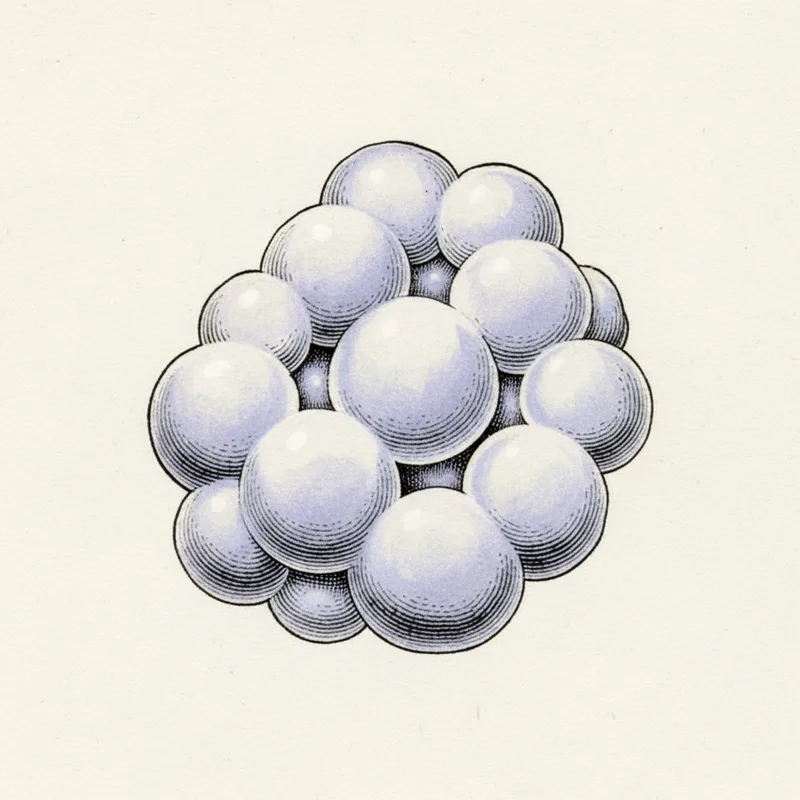
Chalcedony forms when silica-rich fluids deposit microscopic quartz fibers in cavities, fractures, and porous rocks. The fibers are too small to develop visible crystal faces, so chalcedony has a smooth, waxy appearance rather than the glassy faces of macrocrystalline quartz. The deposition happens at relatively low temperatures (below 200 degrees Celsius) from groundwater, making chalcedony one of the most common and widespread gem materials on Earth.
When chalcedony is banded, it's called agate. When it's red-orange, carnelian. When it's green from nickel, chrysoprase. When it's black, onyx. The base material - plain, unbanded chalcedony - is typically pale blue-gray, translucent, and waxy, and is sold under its own name as a distinct gem variety.
Identification Guide
Chalcedony in its plain form is identified by its translucent, waxy-to-vitreous luster, pale blue-gray to white color, and hardness of 7. It lacks the visible crystal faces of macrocrystalline quartz and the banding of agate.
Distinguish from opal (softer at 5.5-6, often shows play of color), glass (may have bubbles, different feel), and moonstone (feldspar, different optical effects). Chalcedony's combination of translucency, waxy luster, and hardness 7 is diagnostic.
Spotting Fakes
Plain chalcedony is common and affordable, so faking is rare. Dyed chalcedony is extremely common but is usually sold under varietal names (blue-dyed = 'blue agate,' green-dyed = 'green agate'). The main identification challenge with chalcedony is recognizing that many popular stones ARE chalcedony: carnelian, chrysoprase, bloodstone, agate, onyx, and jasper are all chalcedony varieties.
Some links in this post go to Amazon and Etsy. Crystal Almanac earns a commission from qualifying purchases at no extra cost to you. Tools recommended here are ones we would use ourselves to run the tests described - the recommendation comes first, the link is downstream of it.
Cultural & Metaphysical Traditions
Presented as cultural traditions, not scientific evidence
Chalcedony has been used for seals, cameos, and carved gems since Babylonian times - it carves cleanly due to its microcrystalline structure. Roman orators wore chalcedony to improve eloquence. In Islamic tradition, the Prophet Muhammad reportedly wore a chalcedony ring. Modern practitioners associate blue chalcedony with calm communication, reflection, and emotional balance.
Metaphysical and “healing” associations are cultural traditions, not medical advice or scientific fact. Crystals are not a substitute for professional medical care.
Where It's Found
Named after this historic trading center
Fine blue chalcedony (African blue)
Major source, all varieties
Historic source, massive production
Price Guide
Good to Know
Scratch test: At hardness 7, Chalcedony can scratch glass and steel. It's durable enough for any type of jewelry.
Global supply: Found in 4 notable locations worldwide, from Turkey to India.
Heft test: Chalcedony has average mineral density (2.60). It feels about as heavy as you'd expect from a stone its size.
Common Questions
What is the chemical formula of Chalcedony?
The chemical formula of Chalcedony is SiO₂.
What is Chalcedony's Mohs hardness?
Chalcedony has a Mohs hardness of 7 on the 1 to 10 Mohs scale, hard enough to scratch glass and stand up to daily wear.
Is Chalcedony a mineral?
Yes. Chalcedony is a naturally occurring mineral (Quartz Family (Microcrystalline)) with a definite chemical composition and an ordered crystal structure.
Care & Safety
The water, salt, and sunlight questions people actually ask before cleansing or displaying chalcedony, answered from its hardness (Mohs 7) and chemistry (SiO₂).
Can Chalcedony go in water?
Yes. Chalcedony is hard (Mohs 7) and chemically stable, so a rinse or a quick wash with mild soap is no problem, cleanse it in water freely if that is your practice. A long soak does nothing for it either way, so skip that, and dry the stone afterward.
Can Chalcedony go in salt water?
Not recommended, even though chalcedony itself is hard and not water-soluble. Salt is both corrosive and mildly abrasive: it can dull a polished surface, attack metal settings, and crystallize inside small fractures as the stone dries. A quick dip will not destroy chalcedony, but rinse it with fresh water afterward and dry it. For routine cleaning, plain water is the kinder choice.
Sources & References
The mineralogical and gemological data on this page is drawn from and can be cross-checked against these external references.
- WikipediaChalcedony on Wikipedia
- WebmineralQuartz mineral data (Webmineral)
- Handbook of MineralogyQuartz (Handbook of Mineralogy, PDF)
Explore More
Quartz & Chalcedony
Virgo Season Crystals 2026: Stones for Clarity
Lion's Gate Portal 2026: Crystals for August 8
Best Calming Crystals for Anxiety and Stress
Mohs Hardness Scale
See where Chalcedony sits on the scale
Crystal Care Guide
Water safety, sunlight, and handling tips
Save This Stone

Keep this chalcedony reference handy. Save the card to a Pinterest board and the profile is one tap away.
Save to PinterestNewsletter
Something shiny, now and then
A stone worth knowing, or a fake worth spotting, every so often. No spam.