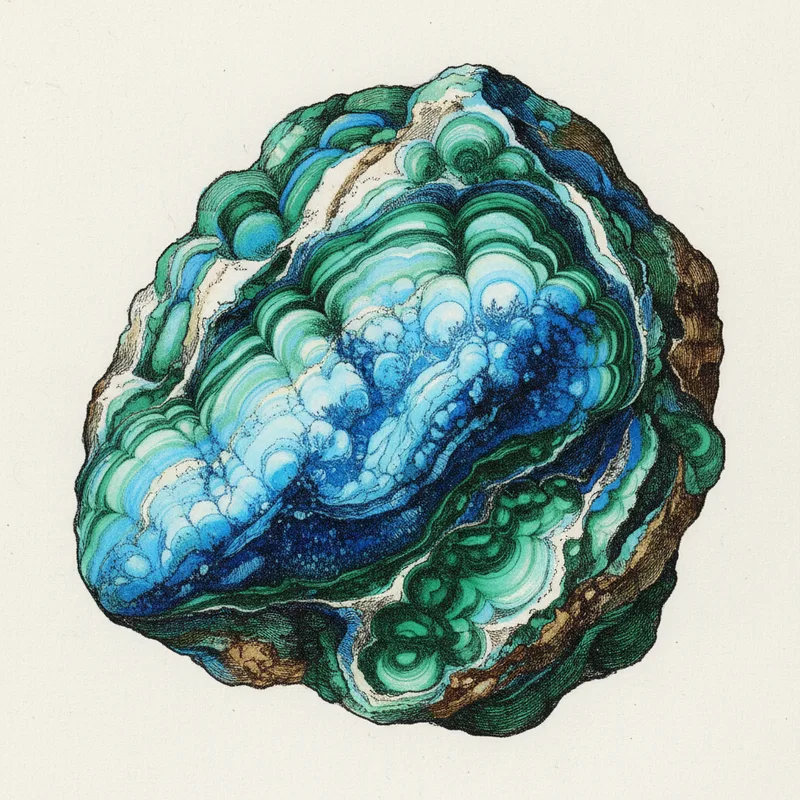
Eilat Stone
Israel stone of King Solomon mines
Affiliate links. We may earn a commission, at no cost to you.
Quick Facts
Formation & Origin
Eilat Stone is not one mineral but an intergrown assemblage of secondary copper minerals: malachite, azurite, chrysocolla, turquoise, and occasionally paratacamite. It formed in the oxidation zone of a Precambrian copper sulfide orebody in the Timna Valley, where groundwater and atmospheric oxygen slowly altered primary chalcocite and chalcopyrite into hydrated carbonates, silicates, and phosphates over tens of millions of years.
The distinctive banded blue-green appearance reflects this mixed secondary mineralogy. Bright green bands are malachite (copper carbonate), deeper blue zones are azurite, softer blue-green matrix is chrysocolla (copper silicate), and pale sky-blue nodes may be turquoise where phosphate-rich fluids were present. The proportions vary stone to stone, which is why no two Eilat Stone cabochons look alike.
The Timna Valley itself is one of the oldest continuously worked copper sites on Earth. Egyptian expeditions mined here from roughly 4000 BCE, followed by Edomite and early Israelite operations. The rock-cut shafts, slag heaps, and smelting camps remain visible today. Modern industrial mining began in 1955 and ceased in 1985 when economic copper reserves were exhausted. All Eilat Stone on today's market comes from pre-1985 stockpiles or legacy collector holdings, which is why supply is permanently finite.
Identification Guide
Eilat Stone shows characteristic irregular banding and swirling patterns in blue, green, and blue-green, often with dark copper-oxide veins running through the matrix. Hardness varies across a single specimen from roughly 3.5 where malachite dominates to 6 where chrysocolla or turquoise bands are present, averaging around 5. The stone takes a high polish but may show softer patches where azurite weathers.
Compared to single-mineral copper stones, Eilat Stone is more mottled and muted than bright Congo malachite, less uniformly blue than Arizona chrysocolla, and less vivid than Iranian turquoise. A streak test produces pale blue-green powder. Under magnification the intergrowth of different mineral grains is visible at the band boundaries, distinguishing it from dyed or reconstituted imitations that appear homogeneous.
Spotting Fakes
Eilat Stone is heavily counterfeited because authentic material has been out of production for 40 years. The three common fakes: dyed howlite (swab with acetone on a hidden spot, if color transfers it is dyed), reconstituted stone made from resin binder mixed with copper mineral powders (burns with acrid plastic smell under a hot needle test), and mislabeled generic chrysocolla-malachite from the Democratic Republic of Congo or Arizona sold as Eilat.
Genuine Eilat Stone should come with documented Timna Valley provenance from a reputable dealer. The color is more muted and mottled than bright-green Congo malachite, with visible intergrowth of multiple mineral species rather than a single dominant color. If offered cheap Eilat Stone below $30 per piece, it is almost certainly misidentified. Polished cabochons sold without origin paperwork at rock shows should be treated as generic copper ore, not authentic Eilat Stone.
Some links in this post go to Amazon and Etsy. Crystal Almanac earns a commission from qualifying purchases at no extra cost to you. Tools recommended here are ones we would use ourselves to run the tests described - the recommendation comes first, the link is downstream of it.
Cultural & Metaphysical Traditions
Presented as cultural traditions, not scientific evidence
Designated Israel's national stone, Eilat Stone is woven into biblical and Israelite heritage. The Timna Valley mines are popularly called King Solomon's Mines, though archaeological evidence shows copper extraction here predates Solomon by over two thousand years. Modern Israeli jewelers treat the stone as a symbol of national continuity and connection to the land. Crystal practitioners associate it with heart healing, emotional balance, and the integration of masculine and feminine energies represented by its blended blue and green.
Metaphysical and “healing” associations are cultural traditions, not medical advice or scientific fact. Crystals are not a substitute for professional medical care.
Where It's Found
Sole historical source, mining exhausted 1985
Same Precambrian orebody, legacy surface collection only
Pharaonic-era copper operations along the same geological belt
Price Guide
Good to Know
Scratch test: At hardness 5, Eilat Stone resists scratching from a knife but can be scratched by quartz. Best for pendants and earrings rather than rings.
Global supply: Found in 3 notable locations worldwide, from Israel to Egypt.
Heft test: Eilat Stone has average mineral density (2.65-3.80). It feels about as heavy as you'd expect from a stone its size.
Common Questions
What is the chemical formula of Eilat Stone?
The chemical formula of Eilat Stone is Variable (Cu silicate assemblage).
What is Eilat Stone's Mohs hardness?
Eilat Stone has a Mohs hardness of 5 on the 1 to 10 Mohs scale, which a steel knife will scratch.
Is Eilat Stone a mineral?
Not a single mineral. Eilat Stone is a mixture of more than one mineral rather than one mineral species.
Care & Safety
The water, salt, and sunlight questions people actually ask before cleansing or displaying eilat stone, answered from its hardness (Mohs 5) and chemistry (Variable (Cu silicate assemblage)).
Can Eilat Stone go in water?
Only briefly. A quick rinse under running water is fine for eilat stone, but do not let it soak or sit submerged. At Mohs 5 it is tough enough for a rinse but not for a long soak. Dry it thoroughly afterward. Important: eilat stone contains copper compounds. Never use it for gem elixirs or crystal-infused water, and wash your hands after handling it.
Can Eilat Stone go in salt water?
No. Eilat Stone can take a brief fresh-water rinse and nothing more, and salt water is harder on it both ways: corrosive while wet, then abrasive as the salt dries into crystals. Salt also accelerates corrosion of copper-bearing minerals like eilat stone. If it does meet salt water, rinse it with fresh water and dry it promptly.
Sources & References
The mineralogical and gemological data on this page is drawn from and can be cross-checked against these external references.
- WikipediaChrysocolla on Wikipedia
Save This Stone

Keep this eilat stone reference handy. Save the card to a Pinterest board and the profile is one tap away.
Save to PinterestNewsletter
Something shiny, now and then
A stone worth knowing, or a fake worth spotting, every so often. No spam.