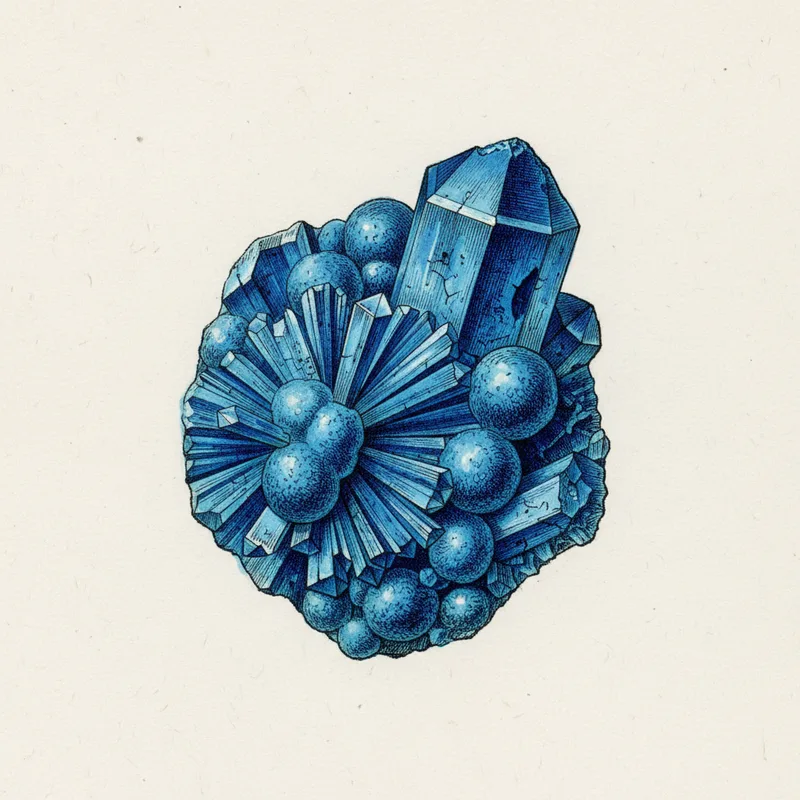
Azurite
The Stone of Heaven
Affiliate links. We may earn a commission, at no cost to you.
Quick Facts
Formation & Origin
Azurite is a secondary copper carbonate mineral that forms in the oxidation zone of copper ore deposits - the same environment that produces malachite. In fact, azurite and malachite are close chemical relatives, and azurite naturally converts to malachite over time through a process called pseudomorphism - the azurite's blue crystal shape is preserved but the chemistry gradually changes to green malachite.
This transformation means that azurite specimens with bright, unaltered blue color are more valuable and collectible than those showing green malachite replacement. The finest azurite crystals - deep blue, lustrous, well-formed prismatic crystals - come from Morocco and the legendary Tsumeb Mine in Namibia, which produced some of the most spectacular mineral specimens of any kind ever found before its closure.
Azurite was historically ground into pigment for blue paint. Before the invention of synthetic ultramarine, azurite blue was one of the few blue pigments available to European painters. Renaissance artists used it extensively, though it had the inconvenient tendency to slowly turn green (converting to malachite) over centuries.
Identification Guide
Azurite is identified by its intense, deep blue color - darker and more vivid than lapis lazuli or sodalite. It's soft (3.5 Mohs) and effervesces (fizzes) in dilute hydrochloric acid, confirming its carbonate composition. The light blue streak is diagnostic.
Distinguish from lapis lazuli (harder, contains pyrite, is a rock not a mineral), sodalite (harder, no acid reaction), and blue copper sulfate (water-soluble, not a stable mineral). Azurite commonly occurs with malachite - a specimen showing both deep blue and banded green is almost certainly azurite-malachite.
Spotting Fakes
Azurite is modestly priced in most forms, so faking is uncommon. The main concern is distinguishing it from the many other blue minerals and from dyed material. Genuine azurite's deep blue is distinctive - darker and more saturated than most substitutes. Sodalite is often sold as a budget alternative but is a completely different mineral (harder, no acid reaction, lighter blue). 'K2 stone' (white granite with blue azurite spots) is genuine but sometimes incorrectly labeled as other minerals.
Some links in this post go to Amazon and Etsy. Crystal Almanac earns a commission from qualifying purchases at no extra cost to you. Tools recommended here are ones we would use ourselves to run the tests described - the recommendation comes first, the link is downstream of it.
Cultural & Metaphysical Traditions
Presented as cultural traditions, not scientific evidence
Ancient Egyptians believed azurite enhanced psychic abilities and used it as a blue pigment for eye shadow and body paint. In Chinese traditional medicine, azurite was called 'the stone of heaven' and associated with developing insight and intuition. Mayan and Native American traditions also used azurite in ceremony. In medieval Europe, azurite pigment was used to paint the blue robes of the Virgin Mary before being largely replaced by the more stable (but more expensive) ultramarine from lapis lazuli. Modern practitioners associate it with intuition, mental clarity, and creative inspiration.
Metaphysical and “healing” associations are cultural traditions, not medical advice or scientific fact. Crystals are not a substitute for professional medical care.
Where It's Found
World-class crystal specimens, major modern source
Legendary locality, museum-grade specimens
Excellent azurite-malachite combinations
Historic copper mining district, fine specimens
Price Guide
Good to Know
Scratch test: At hardness 3.5, Azurite can be scratched with a copper coin. Handle gently and keep away from harder stones in your collection.
Global supply: Found in 4 notable locations worldwide, from Morocco to United States.
Heft test: Azurite has a specific gravity of 3.77 - noticeably heavier than quartz. You'll feel the density when you pick it up.
Common Questions
What is the chemical formula of Azurite?
The chemical formula of Azurite is Cu₃(CO₃)₂(OH)₂.
What is Azurite's Mohs hardness?
Azurite has a Mohs hardness of 3.5 on the 1 to 10 Mohs scale, soft enough to scratch with a copper coin.
Is Azurite a mineral?
Yes. Azurite is a naturally occurring mineral (Carbonate Group) with a definite chemical composition and an ordered crystal structure.
Care & Safety
The water, salt, and sunlight questions people actually ask before cleansing or displaying azurite, answered from its hardness (Mohs 3.5) and chemistry (Cu₃(CO₃)₂(OH)₂).
Can Azurite go in water?
Not recommended. Azurite can react with water, draw in moisture, or break down when it gets wet, so skip the rinse. Wipe it with a dry or barely damp cloth and dry it right away.
Can Azurite go in salt water?
No. Azurite is a copper carbonate that already degrades with plain water, and salt accelerates copper corrosion. Salt water exposure dulls the blue surface permanently. Keep azurite dry.
Sources & References
The mineralogical and gemological data on this page is drawn from and can be cross-checked against these external references.
- WikipediaAzurite on Wikipedia
- WebmineralAzurite mineral data (Webmineral)
- Handbook of MineralogyAzurite (Handbook of Mineralogy, PDF)
Explore More
Carbonate Minerals
The Creative Collection
Renaissance painters ground it into blue pigment. Literally the color of creative expression in medieval and Renaissance art.
How to Identify a Crystal by Its Mineral Group
Toxic Crystals: The Complete Safety Guide
Turquoise vs Chrysocolla: The Copper Mineral Mix-Up
Mohs Hardness Scale
See where Azurite sits on the scale
Crystal Care Guide
Water safety, sunlight, and handling tips
Save This Stone

Keep this azurite reference handy. Save the card to a Pinterest board and the profile is one tap away.
Save to PinterestNewsletter
Something shiny, now and then
A stone worth knowing, or a fake worth spotting, every so often. No spam.