Crazy Lace Agate
The Laughter Stone
Affiliate links. We may earn a commission, at no cost to you.
Quick Facts
Formation & Origin
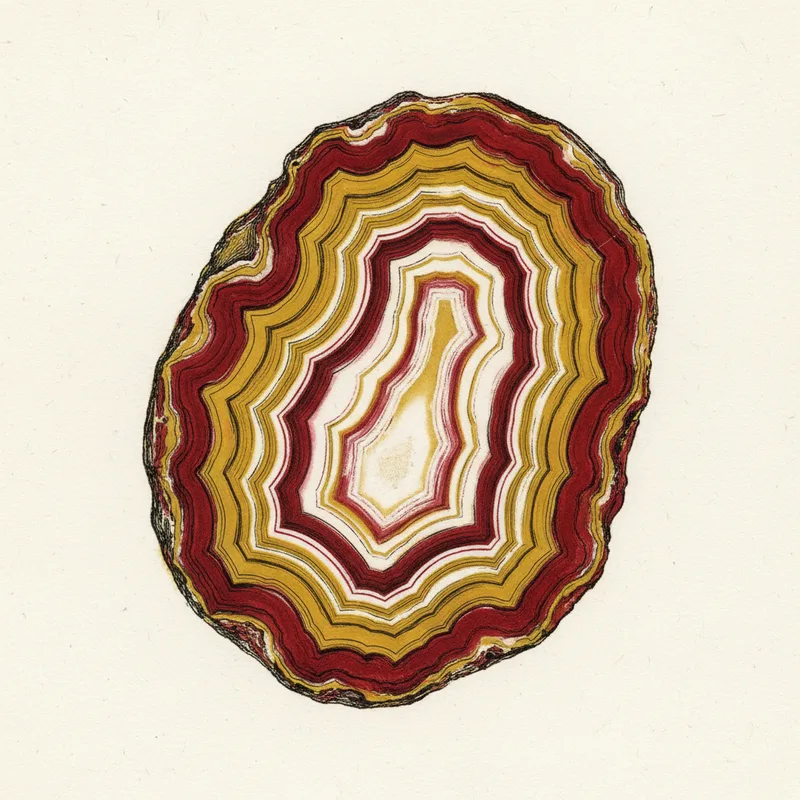
Crazy lace agate is a banded chalcedony characterized by intricate, swirling, twisting patterns of cream, red, yellow, orange, and brown bands that create an almost chaotic lace-like appearance. It formed approximately 65-90 million years ago in the Cretaceous period in what is now the Chihuahua region of Mexico.
The complex patterns form through the same general process as other agates - successive layers of silica deposited in volcanic rock cavities from circulating groundwater - but the specific conditions at this locality created unusually contorted, folded, and twisted banding. The bands followed irregular cavity walls and were deformed by tectonic activity during and after deposition, creating the 'crazy' patterns that give the stone its name.
The warm colors (reds, oranges, yellows) come from iron oxide in various oxidation states. The white and cream bands are pure or nearly pure chalcedony. The overall effect is extraordinarily intricate and no two specimens are alike.
Identification Guide
Crazy lace agate is identified by its elaborate swirling pattern of warm-colored bands (cream, yellow, orange, red, brown) in a chaotic, lace-like arrangement. At hardness 7, it's durable and takes an excellent polish.
Distinguish from blue lace agate (pale blue, less chaotic pattern), Laguna agate (tighter, more concentric banding), and banded jasper (opaque, less intricate patterns). Crazy lace agate's warm color palette and wild, almost baroque banding pattern are unique.
Spotting Fakes
Crazy lace agate's complex natural patterns are virtually impossible to replicate, so faking is not a significant concern. Some material may be enhanced with heat to intensify the red and orange tones (iron oxide responds to heat treatment). Dyed material is uncommon because the natural colors are already vivid. The main quality consideration is pattern complexity - the most intricate, colorful patterns command the highest prices.
Some links in this post go to Amazon and Etsy. Crystal Almanac earns a commission from qualifying purchases at no extra cost to you. Tools recommended here are ones we would use ourselves to run the tests described - the recommendation comes first, the link is downstream of it.
Cultural & Metaphysical Traditions
Presented as cultural traditions, not scientific evidence
Called the 'laughter stone' or 'happy lace' in the crystal market, crazy lace agate is associated with joy, optimism, and absorbing emotional pain. Mexican tradition connects it to celebration and fiestas. In modern crystal healing, it's considered a stone for overcoming depression, promoting self-acceptance, and finding joy in complexity. Its intricate patterns are interpreted as a reminder that beauty emerges from chaos.
Metaphysical and “healing” associations are cultural traditions, not medical advice or scientific fact. Crystals are not a substitute for professional medical care.
Where It's Found
The primary source, Cretaceous-age deposits
Price Guide
Good to Know
Scratch test: At hardness 7, Crazy Lace Agate can scratch glass and steel. It's durable enough for any type of jewelry.
Global supply: Found at only one location on Earth - Mexico. Supply is inherently limited.
Heft test: Crazy Lace Agate has average mineral density (2.60). It feels about as heavy as you'd expect from a stone its size.
Common Questions
What is the chemical formula of Crazy Lace Agate?
The chemical formula of Crazy Lace Agate is SiO₂.
What is Crazy Lace Agate's Mohs hardness?
Crazy Lace Agate has a Mohs hardness of 7 on the 1 to 10 Mohs scale, hard enough to scratch glass and stand up to daily wear.
Is Crazy Lace Agate a mineral?
Yes. Crazy Lace Agate is a naturally occurring mineral (Quartz Family (Chalcedony/Agate)) with a definite chemical composition and an ordered crystal structure.
Care & Safety
The water, salt, and sunlight questions people actually ask before cleansing or displaying crazy lace agate, answered from its hardness (Mohs 7) and chemistry (SiO₂).
Can Crazy Lace Agate go in water?
Yes. Crazy Lace Agate is hard (Mohs 7) and chemically stable, so a rinse or a quick wash with mild soap is no problem, cleanse it in water freely if that is your practice. A long soak does nothing for it either way, so skip that, and dry the stone afterward.
Can Crazy Lace Agate go in salt water?
Not recommended, even though crazy lace agate itself is hard and not water-soluble. Salt is both corrosive and mildly abrasive: it can dull a polished surface, attack metal settings, and crystallize inside small fractures as the stone dries. A quick dip will not destroy crazy lace agate, but rinse it with fresh water afterward and dry it. For routine cleaning, plain water is the kinder choice.
Sources & References
The mineralogical and gemological data on this page is drawn from and can be cross-checked against these external references.
- WikipediaAgate on Wikipedia
- WebmineralQuartz mineral data (Webmineral)
- Handbook of MineralogyQuartz (Handbook of Mineralogy, PDF)
Related Minerals
Similar lace banding, cool blue instead of warm
Mexican agate with tighter concentric banding
Another banded agate with distinct pattern
General banded chalcedony category
Explore More
Save This Stone

Keep this crazy lace agate reference handy. Save the card to a Pinterest board and the profile is one tap away.
Save to PinterestNewsletter
Something shiny, now and then
A stone worth knowing, or a fake worth spotting, every so often. No spam.