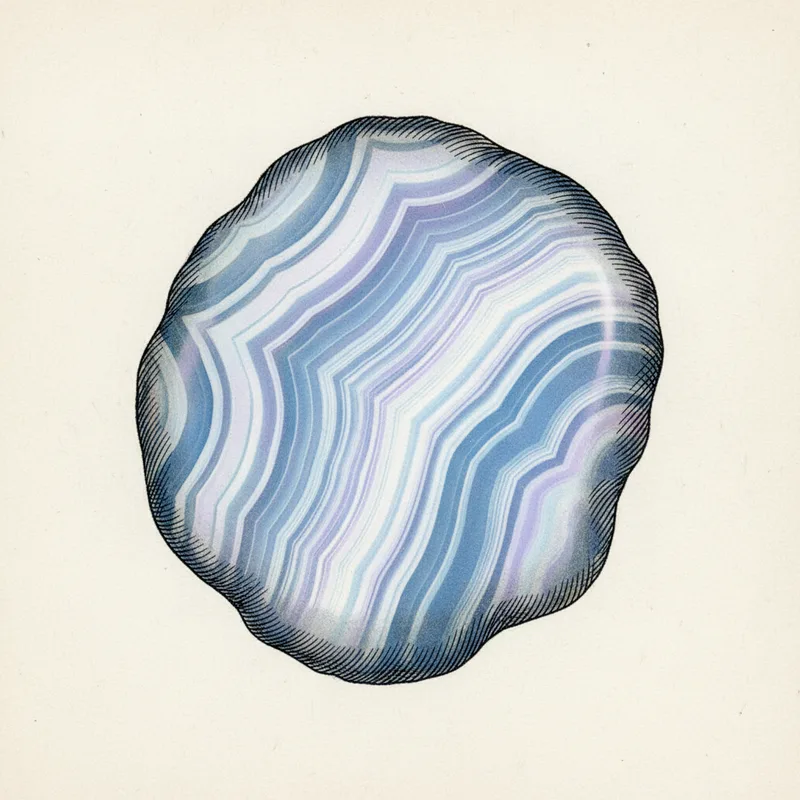
Blue Lace Agate
The Communication Stone
Affiliate links. We may earn a commission, at no cost to you.
Quick Facts
Formation & Origin
Blue lace agate is a variety of banded chalcedony distinguished by its delicate pale blue and white lace-like banding patterns. It formed in volcanic rock cavities where silica-rich fluids deposited successive layers of microcrystalline quartz. The blue color comes from the Rayleigh scattering of light by microscopic particles within the chalcedony - the same mechanism that makes the sky blue.
The primary deposit at Ysterputs Farm in Namibia produced most of the world's supply. This deposit formed in andesitic volcanic rocks where specific conditions of temperature, pressure, and fluid chemistry created the distinctive pale blue banding. The deposit has been heavily worked and high-quality material is becoming increasingly scarce.
The delicate, rhythmic banding in blue lace agate records oscillating conditions during formation - each band represents a change in the depositing fluid's chemistry, temperature, or flow rate. The lace-like appearance comes from wavy, undulating bands rather than the straight parallel bands of common agate.
Identification Guide
Blue lace agate is identified by its distinctive pale blue and white wavy banding pattern - no other common agate variety shows this specific color and pattern combination. At hardness 7, it's durable and takes a smooth polish.
Distinguish from blue chalcedony (uniform blue without banding), angelite (softer at 3.5, no banding), and blue-dyed agate (vivid blue rather than soft pale blue, dye visible in cracks). The gentle, natural pale blue color and wavy lace-like bands are diagnostic.
Spotting Fakes
Dyed agate in bright blue is commonly sold as blue lace agate - the giveaway is color intensity. Genuine blue lace agate is soft, pale, subtle blue. Anything vivid or bright blue is almost certainly dyed. Check for dye concentration in cracks and fractures. With genuine supply dwindling from the Namibian deposit, prices are rising and dyed substitutes are increasingly common. If the price seems too good for the quantity, question the source.
Some links in this post go to Amazon and Etsy. Crystal Almanac earns a commission from qualifying purchases at no extra cost to you. Tools recommended here are ones we would use ourselves to run the tests described - the recommendation comes first, the link is downstream of it.
Cultural & Metaphysical Traditions
Presented as cultural traditions, not scientific evidence
Blue lace agate is the quintessential throat chakra stone in modern crystal practice - associated with gentle communication, self-expression, and calming anxiety around speaking. Its pale blue color and soft energy make it popular for people who struggle with public speaking or difficult conversations. It has no ancient traditions (the deposit was only discovered in the 20th century). Some practitioners use it for cooling inflammation, drawing on its visual association with cool water.
Metaphysical and “healing” associations are cultural traditions, not medical advice or scientific fact. Crystals are not a substitute for professional medical care.
Where It's Found
Primary world source, largely depleted
Limited quantities, similar material
Price Guide
Good to Know
Scratch test: At hardness 7, Blue Lace Agate can scratch glass and steel. It's durable enough for any type of jewelry.
Global supply: Found in 2 notable locations worldwide, from Namibia to South Africa.
Heft test: Blue Lace Agate has average mineral density (2.60). It feels about as heavy as you'd expect from a stone its size.
Common Questions
What is the chemical formula of Blue Lace Agate?
The chemical formula of Blue Lace Agate is SiO₂.
What is Blue Lace Agate's Mohs hardness?
Blue Lace Agate has a Mohs hardness of 7 on the 1 to 10 Mohs scale, hard enough to scratch glass and stand up to daily wear.
Is Blue Lace Agate a mineral?
Yes. Blue Lace Agate is a naturally occurring mineral (Quartz Family (Chalcedony/Agate)) with a definite chemical composition and an ordered crystal structure.
Care & Safety
The water, salt, and sunlight questions people actually ask before cleansing or displaying blue lace agate, answered from its hardness (Mohs 7) and chemistry (SiO₂).
Can Blue Lace Agate go in water?
Yes. Blue Lace Agate is hard (Mohs 7) and chemically stable, so a rinse or a quick wash with mild soap is no problem, cleanse it in water freely if that is your practice. A long soak does nothing for it either way, so skip that, and dry the stone afterward.
Can Blue Lace Agate go in salt water?
Not recommended, even though blue lace agate itself is hard and not water-soluble. Salt is both corrosive and mildly abrasive: it can dull a polished surface, attack metal settings, and crystallize inside small fractures as the stone dries. A quick dip will not destroy blue lace agate, but rinse it with fresh water afterward and dry it. For routine cleaning, plain water is the kinder choice.
Sources & References
The mineralogical and gemological data on this page is drawn from and can be cross-checked against these external references.
- WikipediaAgate on Wikipedia
- WebmineralQuartz mineral data (Webmineral)
- Handbook of MineralogyQuartz (Handbook of Mineralogy, PDF)
Explore More
Quartz & Chalcedony
The Calming Collection
The quintessential throat-chakra stone. Practitioners use it for calming anxiety around speaking and communication.
The Communication Collection
The quintessential communication stone. Its soft blue color and gentle banding are associated with calm, clear self-expression.
The Sleep Collection
The quieting stone. Its delicate blue banding is visually soothing in a way few minerals match. Used specifically for the racing-mind quality of anxiety-related insomnia.
Best Calming Crystals for Anxiety and Stress
Red, White, and Blue Crystals: The Real Geology
Gemini Season Crystals 2026: Six Stones for Clarity
Mohs Hardness Scale
See where Blue Lace Agate sits on the scale
Crystal Care Guide
Water safety, sunlight, and handling tips
Save This Stone

Keep this blue lace agate reference handy. Save the card to a Pinterest board and the profile is one tap away.
Save to PinterestNewsletter
Something shiny, now and then
A stone worth knowing, or a fake worth spotting, every so often. No spam.