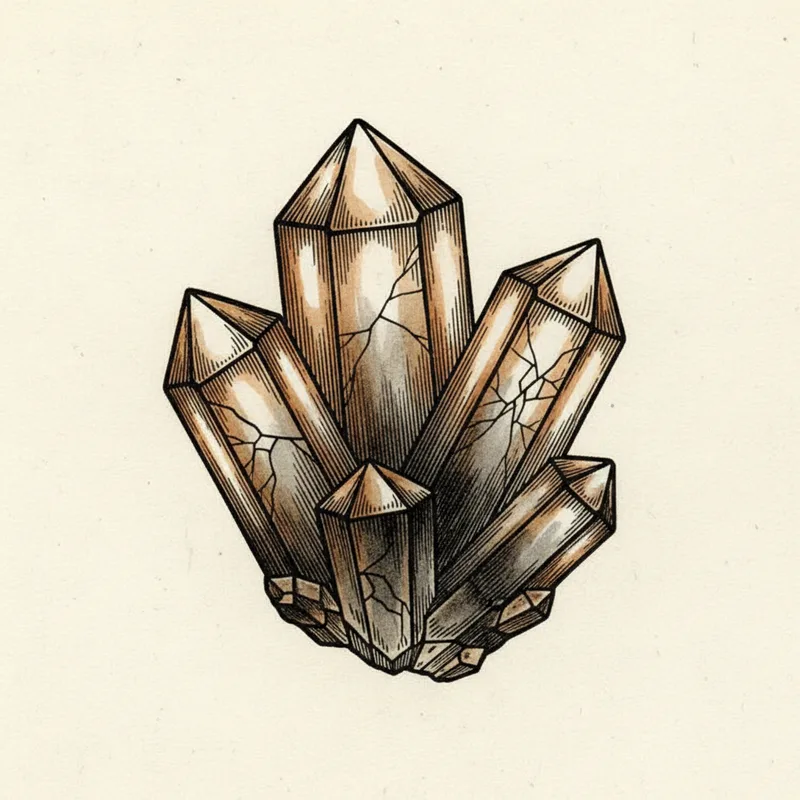
Smoky Quartz
The Grounding Stone
Affiliate links. We may earn a commission, at no cost to you.
Quick Facts
Formation & Origin
Smoky quartz is the brown to gray variety of quartz, the crystalline form of silicon dioxide (SiO₂), colored by natural irradiation of trace aluminum in its structure. Smoky quartz gets its color from one of the simplest mechanisms in mineralogy: natural radiation. When quartz contains trace amounts of aluminum substituting for silicon in its crystal lattice, exposure to natural gamma radiation from surrounding radioactive minerals (like potassium feldspar) displaces electrons, creating 'color centers' that absorb light and produce the brown to black color.
The deeper the color, the longer or more intense the radiation exposure. Very dark specimens (called morion) have been irradiated for millions of years. The color can be reversed by heating - smoky quartz heated to about 200-400 degrees Celsius returns to clear, as the displaced electrons return to their original positions.
Alpine smoky quartz crystals from Switzerland are among the finest in the world. They grew in fissures and cavities within granite over millions of years, with the surrounding potassium feldspar providing the natural radiation that colored them. Some alpine smoky quartz crystals exceed 300 kilograms.
Identification Guide
Smoky quartz shares all the physical properties of other quartz varieties - hexagonal prismatic habit, hardness 7, conchoidal fracture, no cleavage. The brown to black transparent color is the distinguishing feature.
Distinguish from brown tourmaline (different crystal shape, striations), brown topaz (higher specific gravity, perfect cleavage), and dark glass (bubbles, warm to touch). Smoky quartz often occurs alongside clear quartz and sometimes amazonite, especially in pegmatite environments. Like all quartz, it shows no double refraction.
Spotting Fakes
Most commercial smoky quartz is genuine, but some clear quartz is artificially irradiated to produce smoky color. Irradiated smoky quartz is physically identical to natural (the mechanism is the same, just accelerated), so detection requires advanced gemological testing. The market generally accepts irradiated smoky quartz without disclosure, though purist collectors prefer natural. Very dark, uniformly black 'morion' at low prices may be irradiated clear quartz. Natural morion is relatively uncommon.
Some links in this post go to Amazon and Etsy. Crystal Almanac earns a commission from qualifying purchases at no extra cost to you. Tools recommended here are ones we would use ourselves to run the tests described - the recommendation comes first, the link is downstream of it.
Cultural & Metaphysical Traditions
Presented as cultural traditions, not scientific evidence
In Scottish Highland culture, smoky quartz (called cairngorm) was set in the handles of traditional daggers (sgian-dubh) and brooches. It's the national gemstone of Scotland. Druids associated it with the power of the earth gods. In Chinese tradition, smoky quartz was carved into snuff bottles and decorative objects. Modern practitioners consider it the premier grounding stone - used for stress relief, overcoming negative emotions, and connecting to the physical world.
Metaphysical and “healing” associations are cultural traditions, not medical advice or scientific fact. Crystals are not a substitute for professional medical care.
Where It's Found
Large transparent crystals, commercially important
Historic alpine fissure crystals, museum quality
'Cairngorm' variety, national gemstone of Scotland
Fine specimens often with amazonite
Price Guide
Good to Know
Scratch test: At hardness 7, Smoky Quartz can scratch glass and steel. It's durable enough for any type of jewelry.
Global supply: Found in 4 notable locations worldwide, from Brazil to Colorado.
Heft test: Smoky Quartz has average mineral density (2.65). It feels about as heavy as you'd expect from a stone its size.
Common Questions
What is the chemical formula of Smoky Quartz?
The chemical formula of Smoky Quartz is SiO₂.
What is Smoky Quartz's Mohs hardness?
Smoky Quartz has a Mohs hardness of 7 on the 1 to 10 Mohs scale, hard enough to scratch glass and stand up to daily wear.
Is Smoky Quartz a mineral?
Yes. Smoky Quartz is a naturally occurring mineral (Quartz Family) with a definite chemical composition and an ordered crystal structure.
Care & Safety
The water, salt, and sunlight questions people actually ask before cleansing or displaying smoky quartz, answered from its hardness (Mohs 7) and chemistry (SiO₂).
Can Smoky Quartz go in water?
Yes. Smoky Quartz is hard (Mohs 7) and chemically stable, so a rinse or a quick wash with mild soap is no problem, cleanse it in water freely if that is your practice. A long soak does nothing for it either way, so skip that, and dry the stone afterward.
Can Smoky Quartz go in salt water?
Not recommended, even though smoky quartz itself is hard and not water-soluble. Salt is both corrosive and mildly abrasive: it can dull a polished surface, attack metal settings, and crystallize inside small fractures as the stone dries. A quick dip will not destroy smoky quartz, but rinse it with fresh water afterward and dry it. For routine cleaning, plain water is the kinder choice.
Does Smoky Quartz fade in sunlight?
Yes. Smoky quartz owes its color to irradiation-induced color centers, which fade when the stone is exposed to UV light or heated above roughly 200 °C. Prolonged direct sunlight slowly lightens it, and the change is permanent.
Sources & References
The mineralogical and gemological data on this page is drawn from and can be cross-checked against these external references.
- WikipediaSmoky quartz on Wikipedia
- WebmineralQuartz mineral data (Webmineral)
- Handbook of MineralogyQuartz (Handbook of Mineralogy, PDF)
Related Minerals
Same mineral without radiation-induced color
Same mineral, iron-colored instead of radiation-colored
Heated smoky or amethyst becomes citrine
Scottish variety name for yellowish smoky quartz
Explore More
Quartz & Chalcedony
The Calming Collection
Considered the premier grounding stone. Scottish Highlanders carried cairngorm (smoky quartz) for stability.
The Protection Collection
Scottish Highlanders set smoky quartz (cairngorm) in dagger handles and brooches for protection in battle and travel.
The Grounding Collection
Scotland's national gemstone. The Gaelic tradition of carrying cairngorm for grounding is centuries old.
The Sleep Collection
The premier grounding stone. Excess mental energy is dispersed by smoky quartz's earthing quality. Scottish Highlanders placed cairngorm in bedrooms for protected, stable rest.
The Healing Collection
Colored by natural radiation from surrounding granite. Used in Scottish healing traditions as a grounding stone during illness. Associated with clearing mental fog during recovery.
The Workplace Collection
The stress-clearing stone. Placed on desks to absorb and dissipate accumulated tension. Scotland's national gem, associated with the stable, grounded thinking that high-pressure work requires.
The Grief Collection
The transmutation stone. Associated with absorbing heavy energy and transforming it. Carried during grief for the steady, grounding quality that holds you present through waves of loss.
Virgo Season Crystals 2026: Stones for Clarity
How to Protect Crystals from Summer Heat and Sunlight
Best Calming Crystals for Anxiety and Stress
Mohs Hardness Scale
See where Smoky Quartz sits on the scale
Crystal Care Guide
Water safety, sunlight, and handling tips
Save This Stone

Keep this smoky quartz reference handy. Save the card to a Pinterest board and the profile is one tap away.
Save to PinterestNewsletter
Something shiny, now and then
A stone worth knowing, or a fake worth spotting, every so often. No spam.