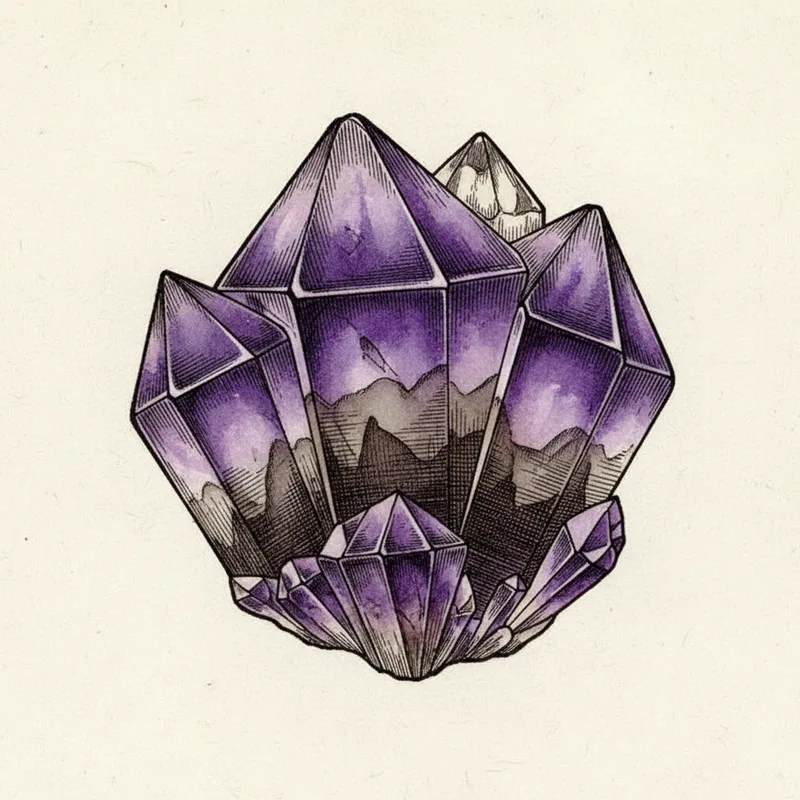
Brandberg Amethyst
Namibia three-in-one crystal
Affiliate links. We may earn a commission, at no cost to you.
Quick Facts
Formation & Origin
Brandberg Amethyst is a variety of quartz (SiO₂) from Namibia's Brandberg Massif, valued for specimens that combine amethyst, smoky, and clear quartz in a single crystal. Brandberg Amethyst formed in hydrothermal veins within the Brandberg Massif, a massive ring complex of granite that intruded into the Namibian crust approximately 130 million years ago during the breakup of Gondwana. As the Brandberg granite cooled from its initial magmatic temperatures above 700°C, it fractured extensively. Silica-rich hydrothermal fluids, heated to 200-400°C by the residual heat of the pluton, circulated through these fractures and began depositing quartz crystals in open cavities and veins.
The distinctive three-zone coloring that makes Brandberg Amethyst so prized reflects changing conditions during crystal growth. Clear quartz formed first from relatively pure silica solutions. As trace amounts of iron (Fe³⁺) entered the fluid and were incorporated into the quartz lattice, and natural gamma radiation from surrounding uranium-bearing minerals irradiated the growing crystal, the characteristic amethyst purple developed. Smoky zones formed where aluminum substituted for silicon in the crystal lattice and subsequent exposure to natural radiation created color centers. These shifts in trace element chemistry and radiation exposure over thousands of years produced crystals with distinct purple, smoky, and clear bands within a single specimen.
Some Brandberg crystals contain enhydro inclusions, tiny pockets of the original hydrothermal fluid trapped as the crystal grew around them. These water bubbles, sometimes visible as a moving air bubble within a fluid-filled cavity, represent samples of the actual mineralizing solution from 130 million years ago. The Brandberg Massif's arid desert environment has preserved these veins with minimal weathering, yielding exceptionally clear, well-terminated crystals.
Identification Guide
Brandberg Amethyst is recognized by its combination of purple amethyst, smoky quartz, and clear quartz zones within a single crystal point. The color transitions are typically smooth rather than sharply banded, giving crystals a painterly quality. Most specimens are well-terminated single points or small clusters, often with excellent clarity. Under magnification, look for the distinctive phantom growth zones, wispy internal veils, and possible enhydro inclusions (fluid-filled cavities with a visible air bubble that moves when the crystal is tilted).
Distinguish from standard amethyst (which lacks the multi-zone coloring), from ametrine (which shows purple and yellow zones, not smoky), and from Herkimer diamonds (which are doubly terminated clear quartz without the purple-smoky zonation). Authentic Brandberg material tends to have a characteristic slightly hazy, ethereal quality to the clear zones. The crystal form is typically prismatic with well-developed rhombohedral terminations.
Spotting Fakes
Be wary of heat-treated or irradiated quartz sold as Brandberg Amethyst. Genuine specimens show natural, gradual color zonation that follows the crystal's growth structure, visible under 10x magnification as concentric phantom layers. Artificially irradiated quartz often has overly uniform smoky coloring without natural growth patterns. Check that the purple zone has the soft, slightly reddish-purple tone typical of Brandberg material rather than the deep blue-purple of heated citrine-to-amethyst conversions. Genuine Brandberg crystals almost always have some natural surface features, minor chips, or small matrix attachment points. Perfectly pristine, large specimens at low prices warrant skepticism. Ask sellers for provenance, as legitimate Brandberg material is exclusively from Namibia. Standard amethyst from Brazil or Uruguay relabeled as "Brandberg" lacks the characteristic three-color zonation and enhydro potential. If the seller cannot distinguish the specimen from ordinary amethyst, it probably is ordinary amethyst.
Some links in this post go to Amazon and Etsy. Crystal Almanac earns a commission from qualifying purchases at no extra cost to you. Tools recommended here are ones we would use ourselves to run the tests described - the recommendation comes first, the link is downstream of it.
Cultural & Metaphysical Traditions
Presented as cultural traditions, not scientific evidence
In Namibian indigenous traditions, the Brandberg Massif (meaning "Fire Mountain" in Afrikaans) is known as Daureb and considered a sacred site. The San people created thousands of rock art paintings on its slopes over millennia. Crystals from this mountain carry particular significance in Southern African spiritual practice. In modern crystal healing traditions, Brandberg Amethyst is considered one of the most powerful meditation stones, combining the purported properties of amethyst (spiritual awareness), smoky quartz (grounding), and clear quartz (amplification) in a single crystal. Practitioners prize specimens with enhydro inclusions as carrying ancient Earth energy. The stone is widely used in contemporary practice for integration work, bringing together disparate aspects of the self.
Metaphysical and “healing” associations are cultural traditions, not medical advice or scientific fact. Crystals are not a substitute for professional medical care.
Where It's Found
The primary and essentially sole source, from hydrothermal veins in granite
Nearby locality producing similar multi-zone quartz specimens
Smaller deposits in surrounding granitic terrain
Price Guide
Good to Know
Scratch test: At hardness 7, Brandberg Amethyst can scratch glass and steel. It's durable enough for any type of jewelry.
Global supply: Found in 3 notable locations worldwide, from Namibia to Namibia.
Heft test: Brandberg Amethyst has average mineral density (2.65). It feels about as heavy as you'd expect from a stone its size.
Common Questions
What is the chemical formula of Brandberg Amethyst?
The chemical formula of Brandberg Amethyst is SiO₂.
What is Brandberg Amethyst's Mohs hardness?
Brandberg Amethyst has a Mohs hardness of 7 on the 1 to 10 Mohs scale, hard enough to scratch glass and stand up to daily wear.
Is Brandberg Amethyst a mineral?
Yes. Brandberg Amethyst is a naturally occurring mineral (Quartz Family) with a definite chemical composition and an ordered crystal structure.
Care & Safety
The water, salt, and sunlight questions people actually ask before cleansing or displaying brandberg amethyst, answered from its hardness (Mohs 7) and chemistry (SiO₂).
Can Brandberg Amethyst go in water?
Yes. Brandberg Amethyst is hard (Mohs 7) and chemically stable, so a rinse or a quick wash with mild soap is no problem, cleanse it in water freely if that is your practice. A long soak does nothing for it either way, so skip that, and dry the stone afterward.
Can Brandberg Amethyst go in salt water?
Not recommended, even though brandberg amethyst itself is hard and not water-soluble. Salt is both corrosive and mildly abrasive: it can dull a polished surface, attack metal settings, and crystallize inside small fractures as the stone dries. A quick dip will not destroy brandberg amethyst, but rinse it with fresh water afterward and dry it. For routine cleaning, plain water is the kinder choice.
Sources & References
The mineralogical and gemological data on this page is drawn from and can be cross-checked against these external references.
- WikipediaAmethyst on Wikipedia
- WebmineralQuartz mineral data (Webmineral)
- Handbook of MineralogyQuartz (Handbook of Mineralogy, PDF)
Explore More
Save This Stone

Keep this brandberg amethyst reference handy. Save the card to a Pinterest board and the profile is one tap away.
Save to PinterestNewsletter
Something shiny, now and then
A stone worth knowing, or a fake worth spotting, every so often. No spam.