Yooperlite
The Glowing Stones of Lake Superior
Affiliate links. We may earn a commission, at no cost to you.
Quick Facts
Formation & Origin
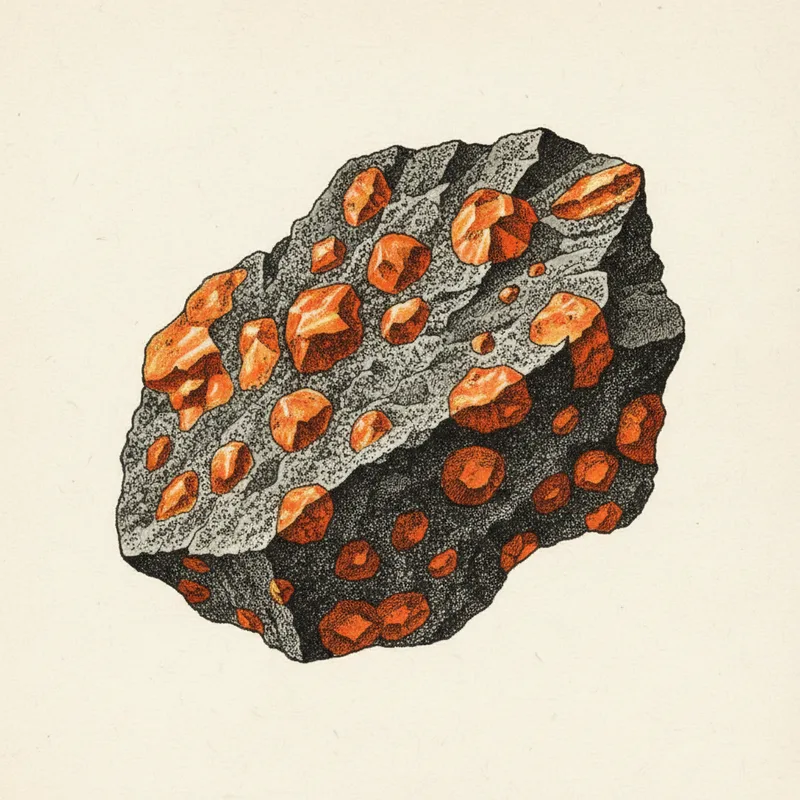
Yooperlite is not a mineral but a rock, a syenite rich in fluorescent sodalite that glows orange-yellow under ultraviolet light. Yooperlites are syenite rocks, a plutonic igneous rock compositionally similar to granite but with significantly less quartz. These particular syenites formed approximately 1.1 billion years ago during the Midcontinent Rift, a massive tectonic event that nearly split the North American continent in two. As magma intruded into the crust and cooled slowly at depths of several kilometers, temperatures dropping from roughly 900°C to 600°C over thousands of years, the melt crystallized into a coarse-grained assemblage of alkali feldspar, nepheline, and sodalite.
The sodalite component is what makes Yooperlites extraordinary. Sodalite (Na₈Al₆Si₆O₂₄Cl₂) crystallized within the cooling syenite as a feldspathoid mineral, filling spaces where the silica content was too low for feldspar to form. During crystallization, trace amounts of sulfur were incorporated into the sodalite's crystal lattice, substituting for chlorine in the mineral's cage-like structure. These sulfur impurities create what mineralogists call "hackmanite" behavior, producing vivid orange-yellow photoluminescence when exposed to shortwave ultraviolet light at around 365 nanometers.
Glacial action during the Pleistocene plucked these syenite boulders from their bedrock sources and deposited them along Lake Superior's shoreline. Waves and ice then tumbled and rounded them into the smooth cobbles found on beaches today. The fluorescent sodalite grains are invisible in daylight, making Yooperlites look like ordinary gray rocks until a UV flashlight reveals their hidden fire.
Identification Guide
In daylight, Yooperlites look like unremarkable gray to dark gray igneous cobbles with a medium to coarse grain size. The surface may show interlocking feldspar crystals and occasional dark minerals. They feel dense and solid in hand, heavier than sedimentary rocks of similar size. The defining test is UV light: under a 365nm shortwave UV flashlight, genuine Yooperlites display brilliant orange-yellow glowing patches and veins where sodalite grains are concentrated.
Distinguish from ordinary granite (which contains visible quartz and does not fluoresce orange), from fluorescent calcite (which glows pink or red, not orange, and is much softer at Mohs 3), and from willemite-bearing rocks (which fluoresce green, not orange). The coarse igneous texture combined with orange UV fluorescence is diagnostic. Some specimens show only faint fluorescence. The best pieces have dense, vein-like networks of glowing sodalite.
Spotting Fakes
The primary authentication tool is a quality 365nm UV flashlight. Genuine Yooperlites fluoresce orange-yellow in irregular, natural patterns following the sodalite grain distribution within the rock. Be wary of rocks painted with UV-reactive paint, which will show suspiciously uniform glowing areas and may feel tacky or show brush marks under magnification. Scratch the surface gently with a steel point. Paint will flake, while genuine fluorescent sodalite is embedded within the rock itself. Also check that the rock has a genuine coarse igneous texture. If it looks like a smooth river cobble of fine-grained sedimentary rock that happens to glow, it is likely treated. Genuine Yooperlites are always coarse-grained igneous rocks. Be cautious buying specimens online that only show UV photos, as the daylight appearance should match a typical syenite cobble.
Some links in this post go to Amazon and Etsy. Crystal Almanac earns a commission from qualifying purchases at no extra cost to you. Tools recommended here are ones we would use ourselves to run the tests described - the recommendation comes first, the link is downstream of it.
Cultural & Metaphysical Traditions
Presented as cultural traditions, not scientific evidence
As a recently discovered stone (2017), Yooperlites lack ancient traditions but have quickly become significant in modern crystal practice. Practitioners associate them with revealing hidden truths and inner light, drawing on the metaphor of an ordinary-looking stone that reveals brilliance under the right conditions. In Great Lakes regional culture, Yooperlites have become a symbol of the Upper Peninsula ("Yooper" being slang for UP residents), inspiring a new generation of rockhounds and nighttime beach hunts. Some modern practitioners use them in meditation focused on self-discovery and uncovering hidden potential.
Metaphysical and “healing” associations are cultural traditions, not medical advice or scientific fact. Crystals are not a substitute for professional medical care.
Where It's Found
Original discovery site, found by Erik Rintamaki in 2017
Rocky beaches yield fluorescent syenite cobbles
Similar fluorescent syenites reported along Canadian shoreline
Occasional finds among Midcontinent Rift-related igneous rocks
Price Guide
Good to Know
Scratch test: At hardness 5.75, Yooperlite resists scratching from a knife but can be scratched by quartz. Best for pendants and earrings rather than rings.
Global supply: Found in 4 notable locations worldwide, from United States to United States.
Heft test: Yooperlite has average mineral density (2.50-2.70). It feels about as heavy as you'd expect from a stone its size.
Common Questions
What is the chemical formula of Yooperlite?
The chemical formula of Yooperlite is Syenite matrix with sodalite Na₈(Al₆Si₆O₂₄)Cl₂.
What is Yooperlite's Mohs hardness?
Yooperlite has a Mohs hardness of 5.75 on the 1 to 10 Mohs scale, hard enough to scratch glass but softer than quartz.
Is Yooperlite a mineral?
Not quite. Yooperlite is a rock (a naturally occurring mixture of minerals), not a single mineral species.
Care & Safety
The water, salt, and sunlight questions people actually ask before cleansing or displaying yooperlite, answered from its hardness (Mohs 5.75) and chemistry (Syenite matrix with sodalite Na₈(Al₆Si₆O₂₄)Cl₂).
Can Yooperlite go in water?
Yes. Yooperlite is not water-soluble and durable enough (Mohs 5.75), so a rinse or a quick wash with mild soap is no problem, cleanse it in water freely if that is your practice. A long soak does nothing for it either way, so skip that, and dry the stone afterward.
Can Yooperlite go in salt water?
Not recommended, even though yooperlite itself is hard and not water-soluble. Salt is both corrosive and mildly abrasive: it can dull a polished surface, attack metal settings, and crystallize inside small fractures as the stone dries. A quick dip will not destroy yooperlite, but rinse it with fresh water afterward and dry it. For routine cleaning, plain water is the kinder choice.
Sources & References
The mineralogical and gemological data on this page is drawn from and can be cross-checked against these external references.
- WikipediaSyenite on Wikipedia
Related Minerals
The fluorescent mineral within Yooperlite
Sulfur-bearing sodalite variety, same fluorescence mechanism
Parent rock type, same igneous family
Explore More
Save This Stone

Keep this yooperlite reference handy. Save the card to a Pinterest board and the profile is one tap away.
Save to PinterestNewsletter
Something shiny, now and then
A stone worth knowing, or a fake worth spotting, every so often. No spam.