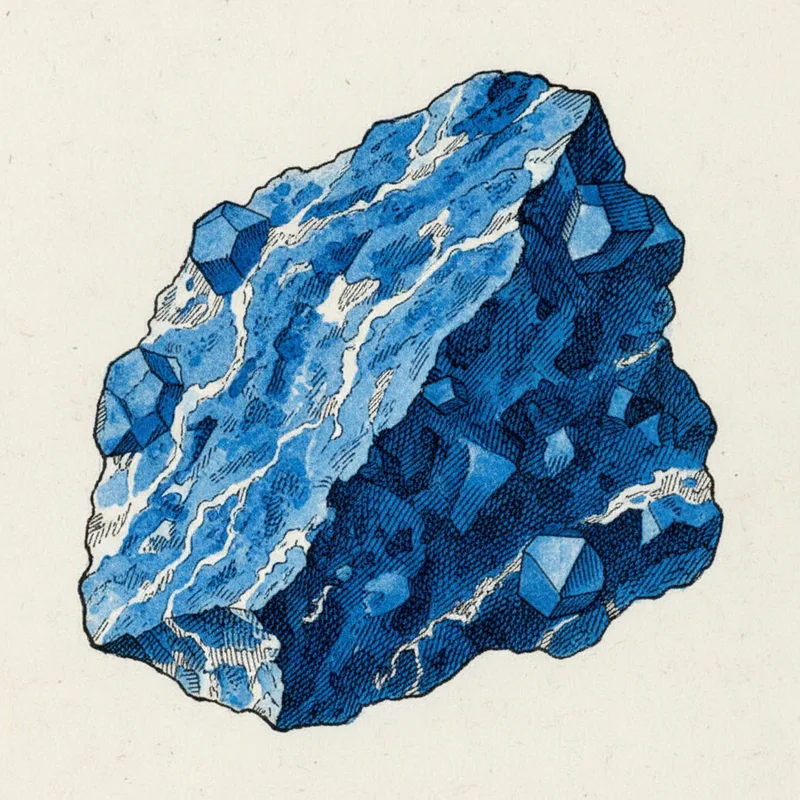
Sodalite
The Poet's Stone
Affiliate links. We may earn a commission, at no cost to you.
Quick Facts
Formation & Origin
Sodalite is a feldspathoid mineral, a sodium aluminum silicate chloride that crystallizes in silica-poor alkaline rocks in place of common feldspar. Sodalite forms in silica-poor igneous rocks - specifically nepheline syenites and related alkaline rocks. These unusual magma compositions are deficient in silica but rich in sodium and aluminum, which favors the crystallization of feldspathoids like sodalite instead of the more common feldspars.
The blue color comes from sulfur-bearing color centers within the crystal lattice - a mechanism similar to how lapis lazuli gets its color (lapis contains lazurite, which is chemically related to sodalite). The white veining commonly seen in sodalite specimens is calcite, which crystallized in fractures after the sodalite formed.
A remarkable variety called hackmanite shows tenebrescence - the ability to change color when exposed to UV light. Hackmanite from Myanmar and Afghanistan starts pale or colorless and turns vivid purple-violet under UV exposure, then slowly fades back. This reversible color change is caused by sulfur-related defects in the crystal structure and can be repeated indefinitely.
Identification Guide
Sodalite is most often confused with lapis lazuli, as both are opaque and blue. Key differences: sodalite lacks the golden pyrite flecks characteristic of lapis. Sodalite's blue tends toward a slightly more violet tone, while lapis is more purely blue. Sodalite also has a lower specific gravity (2.30 vs 2.70-2.90 for lapis), so it feels noticeably lighter.
At Mohs 5.5, sodalite can be scratched by a steel knife. It may fluoresce orange under UV light (a useful diagnostic). The white calcite veining, while not always present, is a good indicator when it is.
Spotting Fakes
The fastest tell is the pyrite check: no golden pyrite flecks means it's not lapis, which stops sellers pricing sodalite as the costlier stone.
- Dyed howlite in blue can imitate sodalite but lacks the slightly greasy luster and typically shows dye concentrated in cracks.
- Genuine sodalite has a natural, slightly uneven color distribution.
Sodalite is inexpensive enough that outright faking is rare; the main market confusion is with lapis lazuli.
Some links in this post go to Amazon and Etsy. Crystal Almanac earns a commission from qualifying purchases at no extra cost to you. Tools recommended here are ones we would use ourselves to run the tests described - the recommendation comes first, the link is downstream of it.
Cultural & Metaphysical Traditions
Presented as cultural traditions, not scientific evidence
Sodalite was relatively unknown until 1891, when large deposits were discovered in Ontario, Canada during a royal visit - it was subsequently used to decorate Marlborough House in London. Its late discovery means it lacks the ancient history of lapis lazuli, but modern crystal practitioners associate it with communication, logical thinking, and poetic expression - hence 'the poet's stone.'
Metaphysical and “healing” associations are cultural traditions, not medical advice or scientific fact. Crystals are not a substitute for professional medical care.
Where It's Found
Major commercial source, blue with white calcite
Deep blue massive specimens
Intense blue, sometimes gem-quality
Hackmanite variety that changes color in UV light
Price Guide
Good to Know
Scratch test: At hardness 5.5, Sodalite resists scratching from a knife but can be scratched by quartz. Best for pendants and earrings rather than rings.
Global supply: Found in 4 notable locations worldwide, from Canada to Myanmar.
Heft test: With a specific gravity of 2.30, Sodalite feels lighter than most minerals. This lightness can help identify it.
Common Questions
What is the chemical formula of Sodalite?
The chemical formula of Sodalite is Na₈(Al₆Si₆O₂₄)Cl₂.
What is Sodalite's Mohs hardness?
Sodalite has a Mohs hardness of 5.5 on the 1 to 10 Mohs scale, hard enough to scratch glass but softer than quartz.
Is Sodalite a mineral?
Yes. Sodalite is a naturally occurring mineral (Feldspathoid Group) with a definite chemical composition and an ordered crystal structure.
Care & Safety
The water, salt, and sunlight questions people actually ask before cleansing or displaying sodalite, answered from its hardness (Mohs 5.5) and chemistry (Na₈(Al₆Si₆O₂₄)Cl₂).
Can Sodalite go in water?
Yes. Sodalite is not water-soluble and durable enough (Mohs 5.5), so a rinse or a quick wash with mild soap is no problem, cleanse it in water freely if that is your practice. A long soak does nothing for it either way, so skip that, and dry the stone afterward.
Can Sodalite go in salt water?
Not recommended, even though sodalite itself is hard and not water-soluble. Salt is both corrosive and mildly abrasive: it can dull a polished surface, attack metal settings, and crystallize inside small fractures as the stone dries. A quick dip will not destroy sodalite, but rinse it with fresh water afterward and dry it. For routine cleaning, plain water is the kinder choice.
Sources & References
The mineralogical and gemological data on this page is drawn from and can be cross-checked against these external references.
- WikipediaSodalite on Wikipedia
- WebmineralSodalite mineral data (Webmineral)
- Handbook of MineralogySodalite (Handbook of Mineralogy, PDF)
Related Minerals
Contains related lazurite, more valuable
Sodalite group mineral, primary blue in lapis
Rare sodalite group mineral, vivid blue
Sodalite group mineral, gray to blue
Explore More
Feldspar Group
The Communication Collection
Called 'the poet's stone.' Associated with articulating complex ideas and finding the right words.
The Workplace Collection
The poet's stone. Deep blue with white calcite veining. Associated with logical thinking, accurate communication, and the ability to articulate complex ideas clearly.
Libra Season Crystals 2026: Stones for Balance
Virgo Season Crystals 2026: Stones for Clarity
September Birthstone: Sapphire and Its Many Colors
Mohs Hardness Scale
See where Sodalite sits on the scale
Crystal Care Guide
Water safety, sunlight, and handling tips
Save This Stone

Keep this sodalite reference handy. Save the card to a Pinterest board and the profile is one tap away.
Save to PinterestNewsletter
Something shiny, now and then
A stone worth knowing, or a fake worth spotting, every so often. No spam.