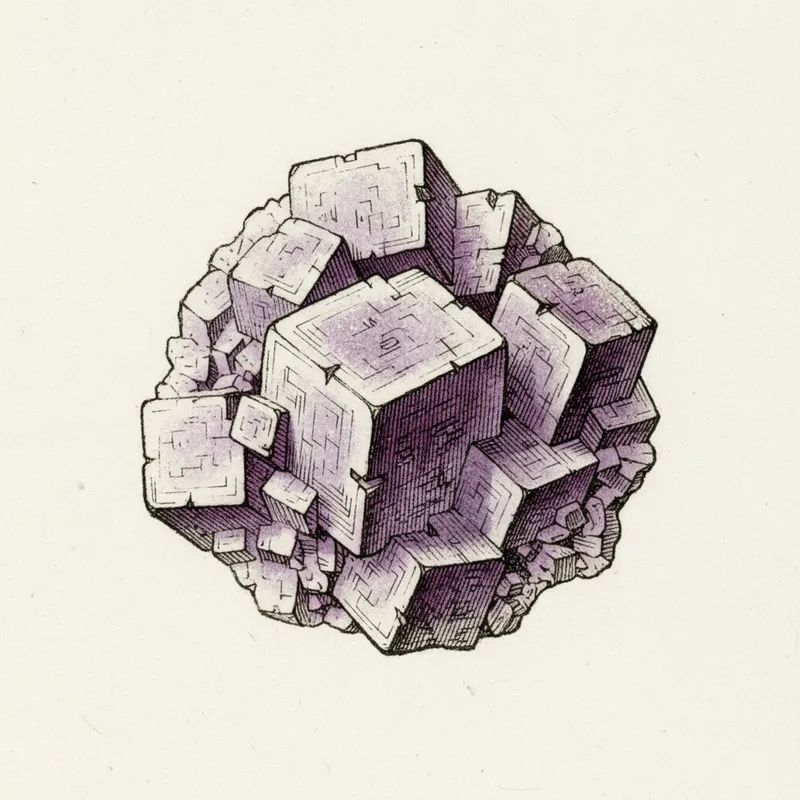
Hackmanite
The Color-Changing Sodalite
Affiliate links. We may earn a commission, at no cost to you.
Quick Facts
Formation & Origin
Hackmanite is a sulfur-rich variety of sodalite that exhibits tenebrescence (reversible photochromism). This means it changes color when exposed to UV light, then slowly fades back in visible light. The color change is caused by sulfur radical anions (S₂⁻) trapped within the sodalite crystal structure.
When UV light hits the crystal, it triggers electron transitions in the sulfur defects, producing a violet to pink color. In daylight, the process slowly reverses, and the crystal fades to white or pale lavender. This cycle can be repeated indefinitely without damaging the crystal.
Hackmanite forms in nepheline syenite and related alkaline igneous rocks, as well as in metamorphosed limestone (marble) contact zones. The best gem specimens from Afghanistan form in marble alongside lapis lazuli, ruby, and spinel, all products of the same geological event.
Identification Guide
The definitive test: expose the specimen to shortwave UV light and watch it turn violet or pink. Remove from UV and watch it slowly fade back to white or pale lavender. This tenebrescence is unique to hackmanite and a few other rare minerals.
Distinguish from sodalite (blue, lacks tenebrescence), fluorite (different crystal system), and kunzite (different color-change mechanism). Hackmanite also fluoresces strongly orange under longwave UV, which helps distinguish it from similar-looking minerals.
Spotting Fakes
Hackmanite's unique tenebrescence property makes it very difficult to fake. The UV color change is the definitive test. Some dealers sell pale sodalite as hackmanite, but without the color-change property, it's just sodalite. The best hackmanite from Afghanistan and Myanmar shows dramatic, rapid color change from near-colorless to deep violet. Weaker specimens may show only subtle changes.
Some links in this post go to Amazon and Etsy. Crystal Almanac earns a commission from qualifying purchases at no extra cost to you. Tools recommended here are ones we would use ourselves to run the tests described - the recommendation comes first, the link is downstream of it.
Cultural & Metaphysical Traditions
Presented as cultural traditions, not scientific evidence
Hackmanite's ability to change color with light exposure makes it a powerful symbol for adaptability and transformation in crystal healing. Practitioners associate it with accessing hidden knowledge, navigating between different states of consciousness, and finding beauty in impermanence. Its color-cycling nature is sometimes used as a meditation focus on the cyclical nature of experience.
Metaphysical and “healing” associations are cultural traditions, not medical advice or scientific fact. Crystals are not a substitute for professional medical care.
Where It's Found
Finest gem-quality specimens, intense tenebrescence
Exceptional transparent crystals
Classic locality, good tenebrescence
Named after Victor Hackman who studied these specimens
Price Guide
Good to Know
Scratch test: At hardness 5.5, Hackmanite resists scratching from a knife but can be scratched by quartz. Best for pendants and earrings rather than rings.
Global supply: Found in 4 notable locations worldwide, from Afghanistan to Greenland.
Heft test: With a specific gravity of 2.27-2.33, Hackmanite feels lighter than most minerals. This lightness can help identify it.
Common Questions
What is the chemical formula of Hackmanite?
The chemical formula of Hackmanite is Na₈(Al₆Si₆O₂₄)Cl₂ (with S²⁻).
What is Hackmanite's Mohs hardness?
Hackmanite has a Mohs hardness of 5.5 on the 1 to 10 Mohs scale, hard enough to scratch glass but softer than quartz.
Is Hackmanite a mineral?
Yes. Hackmanite is a naturally occurring mineral (Feldspathoid (Sodalite Group)) with a definite chemical composition and an ordered crystal structure.
Care & Safety
The water, salt, and sunlight questions people actually ask before cleansing or displaying hackmanite, answered from its hardness (Mohs 5.5) and chemistry (Na₈(Al₆Si₆O₂₄)Cl₂ (with S²⁻)).
Can Hackmanite go in water?
Yes. Hackmanite is not water-soluble and durable enough (Mohs 5.5), so a rinse or a quick wash with mild soap is no problem, cleanse it in water freely if that is your practice. A long soak does nothing for it either way, so skip that, and dry the stone afterward.
Can Hackmanite go in salt water?
Not recommended, even though hackmanite itself is hard and not water-soluble. Salt is both corrosive and mildly abrasive: it can dull a polished surface, attack metal settings, and crystallize inside small fractures as the stone dries. A quick dip will not destroy hackmanite, but rinse it with fresh water afterward and dry it. For routine cleaning, plain water is the kinder choice.
Does Hackmanite fade in sunlight?
It changes rather than fades. Hackmanite is tenebrescent: depending on the locality, its color either bleaches in sunlight and returns in the dark (Greenland, Quebec) or develops in sunlight and fades in the dark (Afghanistan, Myanmar). The change is reversible and not damage, and UV light drives it strongly.
Sources & References
The mineralogical and gemological data on this page is drawn from and can be cross-checked against these external references.
- WikipediaSodalite on Wikipedia
- WebmineralSodalite mineral data (Webmineral)
- Handbook of MineralogySodalite (Handbook of Mineralogy, PDF)
Related Minerals
Same mineral species, hackmanite is the tenebrescent variety
Fellow sodalite group member, primary mineral in lapis lazuli
Another tenebrescent sodalite group mineral
Explore More
Feldspar Group
The Meditation Collection
The color-changing sodalite. Shifts from violet to white and back, providing a literally transforming meditation focus. The impermanence of its color teaches present-moment awareness.
Virgo Season Crystals 2026: Stones for Clarity
Crystals That Fade in Sunlight (The Chemistry Explained)
Best Crystals for Work, Focus, and Your Desk
Mohs Hardness Scale
See where Hackmanite sits on the scale
Crystal Care Guide
Water safety, sunlight, and handling tips
Save This Stone

Keep this hackmanite reference handy. Save the card to a Pinterest board and the profile is one tap away.
Save to PinterestNewsletter
Something shiny, now and then
A stone worth knowing, or a fake worth spotting, every so often. No spam.