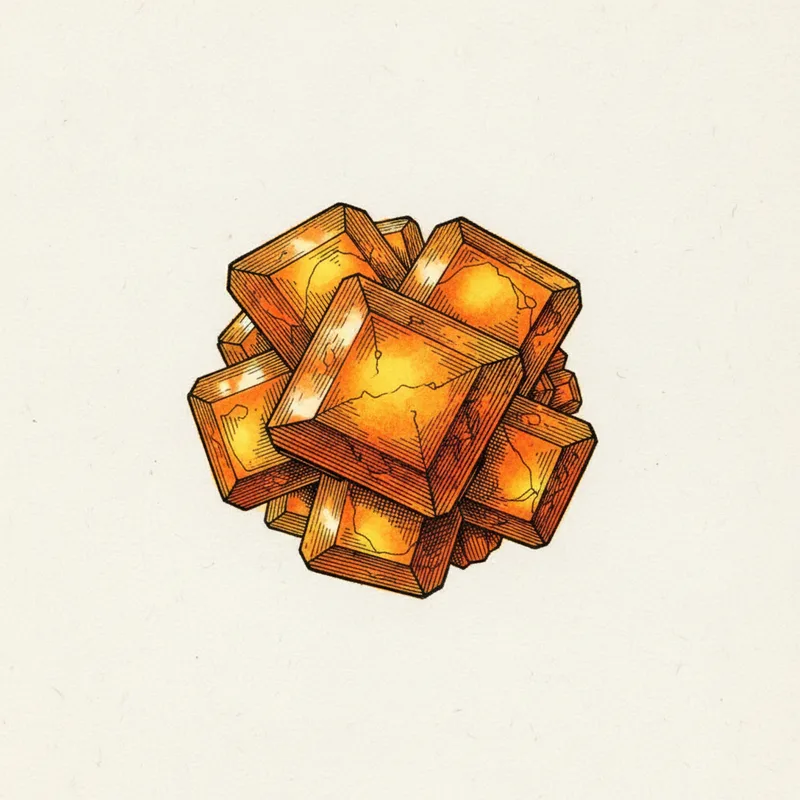
Wulfenite
The Painter's Stone
Affiliate links. We may earn a commission, at no cost to you.
Quick Facts
Formation & Origin
Wulfenite is a lead molybdate mineral that forms in the oxidized zone of lead ore deposits - the weathered near-surface area where primary sulfide minerals break down through interaction with air and water. When lead from galena and molybdenum from trace sources in the host rock dissolve and recombine in oxygen-rich conditions, wulfenite precipitates as brilliantly colored tabular crystals.
The thin, square, plate-like crystal habit is distinctive and visually striking - wulfenite crystals can be paper-thin yet display vivid orange, red, or yellow color with an almost diamond-like adamantine luster. The Red Cloud Mine in Arizona's Yuma County has produced some of the finest wulfenite specimens ever found - thick, vivid orange tabular crystals on matrix that are icons of American mineralogy.
Wulfenite is named after Franz Xavier von Wulfen, an 18th-century Austrian mineralogist. It's the state mineral of Arizona, where several classic localities have produced world-class specimens. SAFETY NOTE: Wulfenite contains lead. Handle with care and wash hands afterward.
Identification Guide
Wulfenite is identified by its distinctive thin tabular (plate-like) crystals, vivid orange-yellow-red color, adamantine luster, and high specific gravity (6.80 - very heavy for a non-metallic mineral). The square, flat crystal shape is essentially diagnostic.
Distinguish from crocoite (lead chromate - also bright orange but prismatic not tabular), vanadinite (lead vanadate - hexagonal prisms, different habit), and orange calcite (much lighter, fizzes in acid). Wulfenite's combination of tabular habit, adamantine luster, and extreme density is unique.
Spotting Fakes
Wulfenite crystals are fragile (hardness 3, perfect cleavage) and difficult to fake convincingly due to their distinctive thin tabular habit and adamantine luster. The main market concern is damage - many specimens have repaired or reattached crystals, which should be disclosed. Matrix specimens sometimes have crystals reset with glue after being damaged in collection. UV light can sometimes reveal glue repairs. For significant purchases, examine attachment points carefully.
Some links in this post go to Amazon and Etsy. Crystal Almanac earns a commission from qualifying purchases at no extra cost to you. Tools recommended here are ones we would use ourselves to run the tests described - the recommendation comes first, the link is downstream of it.
Cultural & Metaphysical Traditions
Presented as cultural traditions, not scientific evidence
Wulfenite has no extensive folk traditions - it's primarily a collector's mineral. In modern crystal practice, its vivid orange color connects it to creativity, artistic expression, and creative flow. Some practitioners call it the 'painter's stone' or 'artist's stone.' Its fragility is interpreted as a reminder to handle creative inspiration with care. NOTE: As a lead mineral, wulfenite should be handled responsibly and is not suitable for gem elixirs.
Metaphysical and “healing” associations are cultural traditions, not medical advice or scientific fact. Crystals are not a substitute for professional medical care.
Where It's Found
World-famous thick orange tabular crystals
Exceptional thin transparent orange blades
Fine yellow to orange specimens
Type locality, named after Austrian mineralogist
Price Guide
Good to Know
Scratch test: At hardness 3, Wulfenite can be scratched with a copper coin. Handle gently and keep away from harder stones in your collection.
Global supply: Found in 4 notable locations worldwide, from United States to Austria.
Heft test: With a specific gravity of 6.80, Wulfenite feels surprisingly heavy for its size. This weight is actually a useful identification tool.
Common Questions
What is the chemical formula of Wulfenite?
The chemical formula of Wulfenite is PbMoO₄.
What is Wulfenite's Mohs hardness?
Wulfenite has a Mohs hardness of 3 on the 1 to 10 Mohs scale, soft enough to scratch with a copper coin.
Is Wulfenite a mineral?
Yes. Wulfenite is a naturally occurring mineral (Molybdate Group) with a definite chemical composition and an ordered crystal structure.
Care & Safety
The water, salt, and sunlight questions people actually ask before cleansing or displaying wulfenite, answered from its hardness (Mohs 3) and chemistry (PbMoO₄).
Can Wulfenite go in water?
Not recommended. At Mohs 3, wulfenite is soft enough that water can slowly dull, etch, or wear down the surface, so a water cleanse does more harm than good here. Reach for a dry cloth instead. Important: wulfenite contains lead. Never use it for gem elixirs or crystal-infused water, and wash your hands after handling it.
Can Wulfenite go in salt water?
No. Wulfenite is best kept away from water altogether, and salt water is the harsher version of that problem: the dissolved salt is corrosive while the stone is wet, then leaves gritty crystals behind in cracks and crevices as it dries.
Sources & References
The mineralogical and gemological data on this page is drawn from and can be cross-checked against these external references.
- WikipediaWulfenite on Wikipedia
- WebmineralWulfenite mineral data (Webmineral)
- Handbook of MineralogyWulfenite (Handbook of Mineralogy, PDF)
Explore More
Borates, Tungstates & Rare Groups
The Creative Collection
Called 'the painter's stone.' Its vivid orange and thin tabular form are associated with artistic vision.
Toxic Crystals: The Complete Safety Guide
Best Crystals for Pregnancy and New Motherhood
Mohs Hardness Scale
See where Wulfenite sits on the scale
Crystal Care Guide
Water safety, sunlight, and handling tips
Save This Stone

Keep this wulfenite reference handy. Save the card to a Pinterest board and the profile is one tap away.
Save to PinterestNewsletter
Something shiny, now and then
A stone worth knowing, or a fake worth spotting, every so often. No spam.