Crocoite
The Saffron Crystal
Affiliate links. We may earn a commission, at no cost to you.
Quick Facts
Formation & Origin
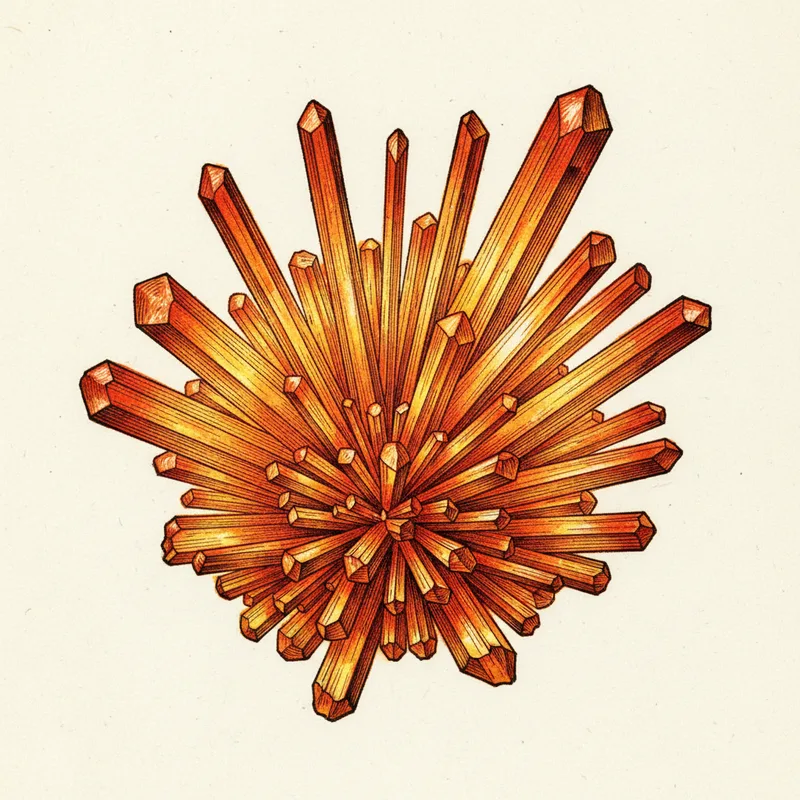
Crocoite is lead chromate - one of the most visually striking minerals in existence. Its vivid orange-red color, combined with elongated prismatic crystals that can reach several centimeters in length, makes it a crown jewel of mineral collecting.
Crocoite forms in the oxidized zone of lead ore deposits where chromium is available from nearby ultramafic rocks. Lead from galena dissolves and combines with chromate ions to precipitate crocoite in fractures and cavities. The specific conditions - lead and chromium in the same oxidizing environment - are uncommon, making crocoite a genuinely rare mineral.
The Dundas district of Tasmania produces crocoite specimens that are unrivaled anywhere in the world. Long, slender, brilliantly colored prismatic crystals on limonite matrix from the Adelaide Mine and Red Lead Mine are among the most valued and recognizable mineral specimens in any collection. Crocoite is the mineral emblem of Tasmania. SAFETY NOTE: Crocoite contains lead and hexavalent chromium. Handle with care and wash hands.
Identification Guide
Crocoite is identified by its unmistakable vivid orange-red color, elongated prismatic crystal habit, high density (5.99 - very heavy), and adamantine luster. No other common mineral combines this specific color with this crystal form.
Distinguish from wulfenite (tabular/flat crystals rather than prismatic), vanadinite (hexagonal crystals rather than monoclinic), and realgar (similar color but softer, different crystal form). Crocoite's long, slender prismatic crystals in vivid orange are essentially diagnostic.
Spotting Fakes
Crocoite is a serious collector mineral rarely encountered in the general crystal market, so faking for mass consumption doesn't occur. For significant specimens, provenance from Tasmania's Dundas district is the premium factor. Crocoite crystals are extremely fragile (hardness 2.5, brittle) and many specimens have repaired or reattached crystals - examine attachment points carefully. UV light and acetone can detect glue repairs.
Some links in this post go to Amazon and Etsy. Crystal Almanac earns a commission from qualifying purchases at no extra cost to you. Tools recommended here are ones we would use ourselves to run the tests described - the recommendation comes first, the link is downstream of it.
Cultural & Metaphysical Traditions
Presented as cultural traditions, not scientific evidence
Crocoite has no traditional metaphysical history - it's exclusively a collector's mineral. Some modern practitioners associate its vivid color with creative passion, vitality, and breakthrough energy. The stone's fragility is interpreted as a reminder that intense creative energy requires careful handling. NOTE: Due to its lead and chromium content, crocoite is strictly a display mineral. Never use for gem elixirs or carry loose in pockets.
Metaphysical and “healing” associations are cultural traditions, not medical advice or scientific fact. Crystals are not a substitute for professional medical care.
Where It's Found
World's finest specimens, the definitive locality
Original discovery locality (1766)
Minor occurrences
Some specimens
Price Guide
Good to Know
Scratch test: At hardness 2.5, Crocoite can be scratched with a fingernail. This is a display specimen, not a wearable stone.
Global supply: Found in 4 notable locations worldwide, from Australia to Philippines.
Heft test: With a specific gravity of 5.99, Crocoite feels surprisingly heavy for its size. This weight is actually a useful identification tool.
Common Questions
What is the chemical formula of Crocoite?
The chemical formula of Crocoite is PbCrO₄.
What is Crocoite's Mohs hardness?
Crocoite has a Mohs hardness of 2.5 on the 1 to 10 Mohs scale, soft enough to scratch with a fingernail.
Is Crocoite a mineral?
Yes. Crocoite is a naturally occurring mineral (Chromate Group) with a definite chemical composition and an ordered crystal structure.
Care & Safety
The water, salt, and sunlight questions people actually ask before cleansing or displaying crocoite, answered from its hardness (Mohs 2.5) and chemistry (PbCrO₄).
Can Crocoite go in water?
Not recommended. At Mohs 2.5, crocoite is soft enough that water can slowly dull, etch, or wear down the surface, so a water cleanse does more harm than good here. Reach for a dry cloth instead. Important: crocoite contains lead and hexavalent chromium. Never use it for gem elixirs or crystal-infused water, and wash your hands after handling it.
Can Crocoite go in salt water?
No. Crocoite is best kept away from water altogether, and salt water is the harsher version of that problem: the dissolved salt is corrosive while the stone is wet, then leaves gritty crystals behind in cracks and crevices as it dries.
Sources & References
The mineralogical and gemological data on this page is drawn from and can be cross-checked against these external references.
- WikipediaCrocoite on Wikipedia
- WebmineralCrocoite mineral data (Webmineral)
- Handbook of MineralogyCrocoite (Handbook of Mineralogy, PDF)
Related Minerals
Another vivid lead mineral, tabular vs prismatic
Lead vanadate, hexagonal crystals
Lead sulfide, the parent ore mineral
The chromium element that gives crocoite its color
Explore More
Save This Stone

Keep this crocoite reference handy. Save the card to a Pinterest board and the profile is one tap away.
Save to PinterestNewsletter
Something shiny, now and then
A stone worth knowing, or a fake worth spotting, every so often. No spam.