Wavellite
The Starburst Mineral
Affiliate links. We may earn a commission, at no cost to you.
Quick Facts
Formation & Origin
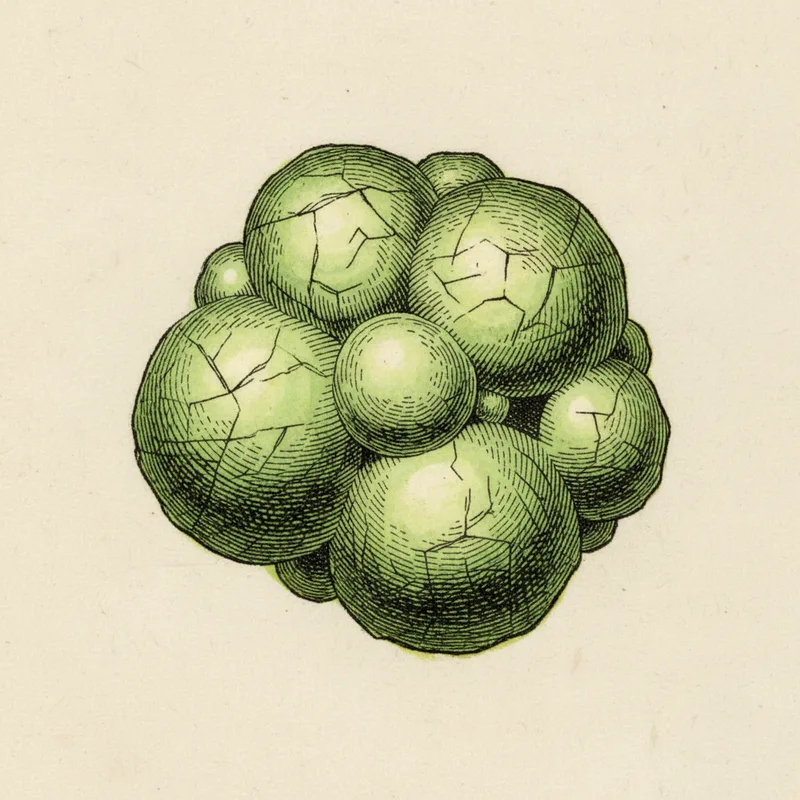
Wavellite is a hydrated aluminum phosphate mineral that typically grows as radiating crystal sprays forming starburst-like spheres. Wavellite forms as a secondary phosphate mineral in low-temperature hydrothermal environments, often in fractures within aluminous, phosphatic rocks. It's particularly common in areas where phosphate-rich groundwater interacts with aluminum-bearing rocks.
The most distinctive feature is its radial crystal habit. Wavellite grows in spherical aggregates where needle-like crystals radiate outward from a central point like starburst fireworks. When these spheres are cut in cross-section, they reveal the beautiful radial pattern that makes wavellite one of the most visually striking of all minerals.
Arkansas produces the world's finest wavellite from the Ouachita Mountains region, where phosphate-rich solutions percolated through Paleozoic sedimentary rocks. The green color comes from trace amounts of iron and vanadium.
Identification Guide
Wavellite's radial, starburst growth pattern is diagnostic. When hemispheres are broken or cut, the concentric and radiating structure is unmistakable. Green to yellow-green color, relatively low hardness (3.5), and association with phosphatic rocks are additional identifiers.
Distinguish from variscite (massive, lacks radial habit), malachite (botryoidal rather than radial, contains copper), and prehnite (different crystal system and habit). The radiating crystal pattern in cross-section is the most reliable identification feature.
Spotting Fakes
Wavellite is not commonly faked. The radial crystal structure is too complex and distinctive to replicate easily. The main issue is quality and provenance. The finest specimens from Arkansas show vivid green color with well-defined radial patterns. Less impressive specimens may be pale or have poorly defined radiating structures. Sellers sometimes enhance green color, so very vivid specimens should be examined carefully.
Some links in this post go to Amazon and Etsy. Crystal Almanac earns a commission from qualifying purchases at no extra cost to you. Tools recommended here are ones we would use ourselves to run the tests described - the recommendation comes first, the link is downstream of it.
Cultural & Metaphysical Traditions
Presented as cultural traditions, not scientific evidence
Wavellite's radial growth pattern has made it a symbol of expanding awareness and seeing the big picture in crystal healing. Practitioners use it for gaining perspective on complex situations, understanding interconnections, and overcoming tunnel vision. The starburst pattern is sometimes used as a focus for meditation on radiating positive energy outward.
Metaphysical and “healing” associations are cultural traditions, not medical advice or scientific fact. Crystals are not a substitute for professional medical care.
Where It's Found
World's finest radial clusters, classic green specimens
Excellent specimens from tin mines
Type locality where wavellite was first described
Good quality phosphate specimens
Price Guide
Good to Know
Scratch test: At hardness 3.5, Wavellite can be scratched with a copper coin. Handle gently and keep away from harder stones in your collection.
Global supply: Found in 4 notable locations worldwide, from United States to Australia.
Heft test: With a specific gravity of 2.36, Wavellite feels lighter than most minerals. This lightness can help identify it.
Common Questions
What is the chemical formula of Wavellite?
The chemical formula of Wavellite is Al₃(PO₄)₂(OH,F)₃·5H₂O.
What is Wavellite's Mohs hardness?
Wavellite has a Mohs hardness of 3.5 on the 1 to 10 Mohs scale, soft enough to scratch with a copper coin.
Is Wavellite a mineral?
Yes. Wavellite is a naturally occurring mineral (Phosphate Mineral) with a definite chemical composition and an ordered crystal structure.
Care & Safety
The water, salt, and sunlight questions people actually ask before cleansing or displaying wavellite, answered from its hardness (Mohs 3.5) and chemistry (Al₃(PO₄)₂(OH,F)₃·5H₂O).
Can Wavellite go in water?
Only briefly. A quick rinse under running water is fine for wavellite, but do not let it soak or sit submerged. At Mohs 3.5 it is tough enough for a rinse but not for a long soak. Dry it thoroughly afterward.
Can Wavellite go in salt water?
No. Wavellite can take a brief fresh-water rinse and nothing more, and salt water is harder on it both ways: corrosive while wet, then abrasive as the salt dries into crystals. If it does meet salt water, rinse it with fresh water and dry it promptly.
Sources & References
The mineralogical and gemological data on this page is drawn from and can be cross-checked against these external references.
- WikipediaWavellite on Wikipedia
- WebmineralWavellite mineral data (Webmineral)
- Handbook of MineralogyWavellite (Handbook of Mineralogy, PDF)
Explore More
Save This Stone

Keep this wavellite reference handy. Save the card to a Pinterest board and the profile is one tap away.
Save to PinterestNewsletter
Something shiny, now and then
A stone worth knowing, or a fake worth spotting, every so often. No spam.