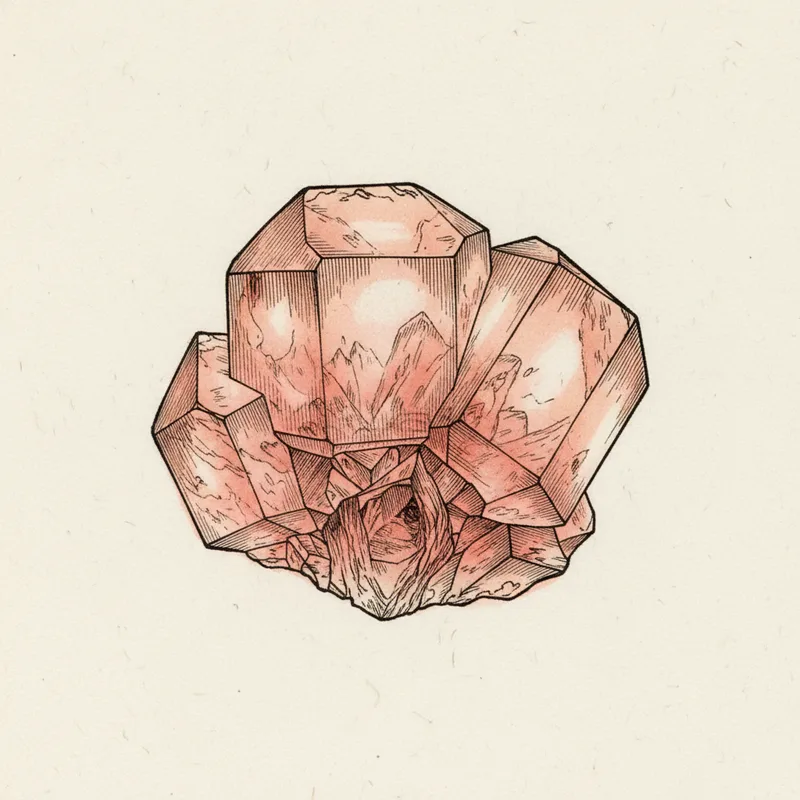
Strawberry Calcite
The Blushing Calcite
Affiliate links. We may earn a commission, at no cost to you.
Quick Facts
Formation & Origin
Strawberry calcite is a pink variety of calcite, the calcium carbonate mineral (CaCO₃), colored by fine inclusions of iron oxide. Strawberry calcite forms in sedimentary and low-temperature hydrothermal environments where calcium carbonate precipitates from supersaturated solutions containing dissolved iron. The pink to red coloring comes from microscopic hematite (Fe₂O₃) particles dispersed throughout the calcite during crystallization. The iron oxide inclusions are too small to see individually but collectively tint the entire crystal mass.
The intensity of the strawberry color depends on the concentration of hematite inclusions. Specimens with higher iron content show deeper reds, while lower concentrations produce pale salmon or blush pink. Some specimens show color zoning where iron availability changed during growth, creating bands of deeper and lighter pink.
Large commercial deposits form in limestone cavities and hydrothermal veins where iron-bearing groundwater interacts with carbonate-rich environments. Mexico's volcanic geology provides ideal conditions, with iron from weathered volcanic rocks entering carbonate systems to produce the distinctive pink material.
Identification Guide
Strawberry calcite is identified by its warm pink-to-salmon color combined with calcite's characteristic properties: hardness 3 (scratched by a copper coin), perfect rhombohedral cleavage in three directions at 75°, and vigorous fizzing with dilute hydrochloric acid. The cleavage and acid reaction distinguish it from pink quartz varieties (harder, no fizz, no cleavage).
Distinguish from mangano calcite (softer pink, no red tones, colored by manganese not iron), rhodochrosite (harder pink, banded, MnCO₃), and pink halite (soluble in water, cubic cleavage). Strawberry calcite's warm, iron-tinted pink with visible translucency and calcite cleavage is distinctive.
Spotting Fakes
Strawberry calcite is inexpensive enough that deliberate faking is uncommon. The main concern is dyed calcite: white or pale calcite soaked in red dye. Check for color concentrating in fractures and grain boundaries, which indicates dyeing. Natural strawberry calcite shows uniform color distribution because the hematite inclusions formed during crystallization. The acid test (fizzes with vinegar or dilute HCl) confirms it is calcite rather than dyed glass or resin.
Some links in this post go to Amazon and Etsy. Crystal Almanac earns a commission from qualifying purchases at no extra cost to you. Tools recommended here are ones we would use ourselves to run the tests described - the recommendation comes first, the link is downstream of it.
Cultural & Metaphysical Traditions
Presented as cultural traditions, not scientific evidence
Crystal practitioners associate strawberry calcite with emotional warmth, gentle motivation, and finding joy in daily tasks. Its blend of calcite's amplifying properties with the warm energy of iron oxide makes it a popular choice for heart-centered work. The strawberry color connects it to sweetness, pleasure, and appreciation of life's simple gifts.
Metaphysical and “healing” associations are cultural traditions, not medical advice or scientific fact. Crystals are not a substitute for professional medical care.
Where It's Found
Primary commercial source, large masses
Salmon-pink specimens with good translucency
Occasional finds alongside other calcite varieties
Deeper red-pink material
Price Guide
Good to Know
Scratch test: At hardness 3, Strawberry Calcite can be scratched with a copper coin. Handle gently and keep away from harder stones in your collection.
Global supply: Found in 4 notable locations worldwide, from Mexico to Pakistan.
Heft test: Strawberry Calcite has average mineral density (2.71). It feels about as heavy as you'd expect from a stone its size.
Common Questions
What is the chemical formula of Strawberry Calcite?
The chemical formula of Strawberry Calcite is CaCO₃.
What is Strawberry Calcite's Mohs hardness?
Strawberry Calcite has a Mohs hardness of 3 on the 1 to 10 Mohs scale, soft enough to scratch with a copper coin.
Is Strawberry Calcite a mineral?
Yes. Strawberry Calcite is a naturally occurring mineral (Carbonate Mineral) with a definite chemical composition and an ordered crystal structure.
Care & Safety
The water, salt, and sunlight questions people actually ask before cleansing or displaying strawberry calcite, answered from its hardness (Mohs 3) and chemistry (CaCO₃).
Can Strawberry Calcite go in water?
Not recommended. At Mohs 3, strawberry calcite is soft enough that water can slowly dull, etch, or wear down the surface, so a water cleanse does more harm than good here. Reach for a dry cloth instead.
Can Strawberry Calcite go in salt water?
No. Strawberry Calcite is best kept away from water altogether, and salt water is the harsher version of that problem: the dissolved salt is corrosive while the stone is wet, then leaves gritty crystals behind in cracks and crevices as it dries.
Sources & References
The mineralogical and gemological data on this page is drawn from and can be cross-checked against these external references.
- WikipediaCalcite on Wikipedia
- WebmineralCalcite mineral data (Webmineral)
- Handbook of MineralogyCalcite (Handbook of Mineralogy, PDF)
Explore More
Save This Stone

Keep this strawberry calcite reference handy. Save the card to a Pinterest board and the profile is one tap away.
Save to PinterestNewsletter
Something shiny, now and then
A stone worth knowing, or a fake worth spotting, every so often. No spam.