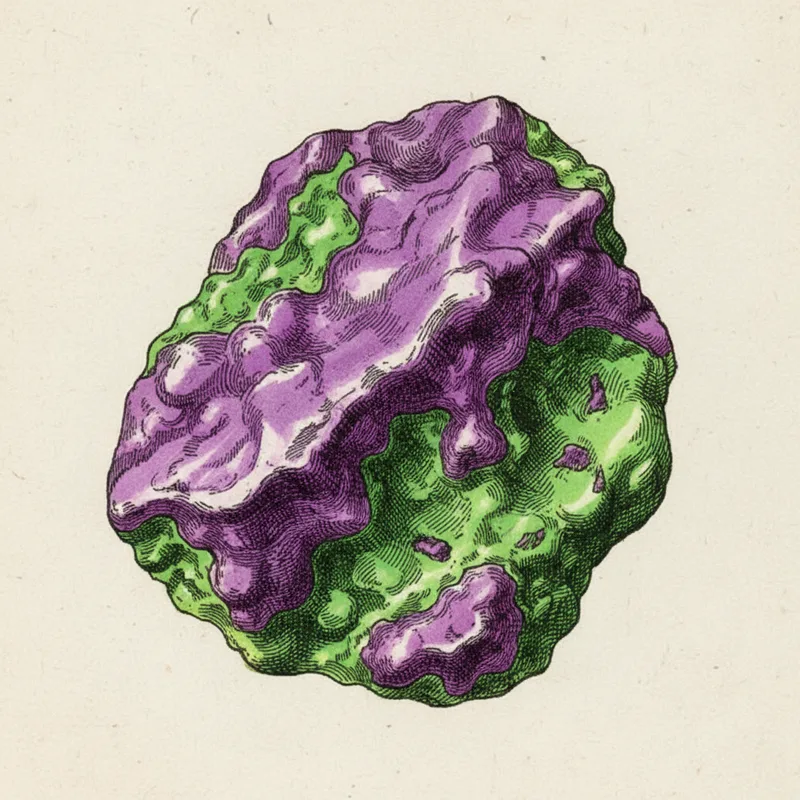
Stichtite
Purple Fire in Serpentine
Affiliate links. We may earn a commission, at no cost to you.
Quick Facts
Formation & Origin
Stichtite is a hydrated magnesium-chromium carbonate (Mg₆Cr₂(OH)₁₆CO₃·4H₂O), a soft purple mineral that forms by the alteration of chromium-bearing serpentinite. Stichtite forms as a secondary mineral through the chemical weathering of chromite-bearing serpentinite. The process begins with ultramafic rocks, primarily peridotite composed of olivine and pyroxene, that have already undergone serpentinization at temperatures between 200 and 500 degrees Celsius. During serpentinization, the original silicate minerals react with water to produce serpentine group minerals, and any chromium-bearing spinel (chromite, FeCr₂O₄) is left as a residual phase within the new serpentine matrix.
As carbonate-rich groundwater percolates through the serpentinite at much lower, near-surface temperatures (below 100 degrees Celsius), it attacks the exposed chromite grains. The chromium is released as Cr³⁺ ions and combined with magnesium from the surrounding serpentine, carbonate from the groundwater, and hydroxyl groups to precipitate stichtite. The vivid purple to lilac-pink color comes directly from the Cr³⁺ in octahedral coordination within the mineral's layered hydroxide structure, the same chromophore responsible for the color of ruby and emerald, but in a completely different crystal architecture.
Stichtite belongs to the hydrotalcite supergroup, a family of layered double hydroxides with positively charged brucite-like sheets separated by interlayers of carbonate anions and water molecules. This layered structure makes the mineral extremely soft (1.5 to 2 on the Mohs scale) and gives it a greasy, waxy feel. When stichtite occurs intermixed with its green serpentine host rock, the combination is marketed as "atlantisite," a striking purple-and-green ornamental stone found almost exclusively in Tasmania.
Identification Guide
Stichtite is recognizable by its vivid purple to lilac-pink color, waxy to pearly luster, and extreme softness. It can be scratched easily with a fingernail. The mineral typically occurs as fibrous masses, botryoidal crusts, or foliated aggregates within green serpentine host rock. When cut or polished as part of atlantisite, the contrast between vivid purple stichtite and deep green serpentine is unmistakable.
Distinguish from sugilite, which is much harder (5.5 to 6.5) and has a vitreous luster. Purple lepidolite mica is also soft but has a distinctly micaceous, platy habit and peels into thin sheets. Charoite has a fibrous, chatoyant appearance and is considerably harder (5 to 6). The combination of extreme softness, waxy feel, purple color, and association with serpentine is diagnostic for stichtite.
Spotting Fakes
True stichtite is rarely faked because it is not widely known enough to justify counterfeiting. However, dyed magnesite or howlite in purple shades can be misrepresented. Genuine stichtite is extremely soft, easily scratched with a fingernail, which immediately rules out any dyed hard mineral. If sold as atlantisite, verify the green host is actual serpentine (waxy feel, Mohs 3 to 4) rather than dyed matrix. Under magnification, real stichtite shows a fibrous or foliated microstructure. Plastic or resin imitations will feel warm to the touch and may show mold lines or uniform color without natural variation.
Some links in this post go to Amazon and Etsy. Crystal Almanac earns a commission from qualifying purchases at no extra cost to you. Tools recommended here are ones we would use ourselves to run the tests described - the recommendation comes first, the link is downstream of it.
Cultural & Metaphysical Traditions
Presented as cultural traditions, not scientific evidence
Aboriginal Tasmanian traditions associate the purple-and-green atlantisite combination with the land's spiritual energy. In modern crystal practice, stichtite is considered a stone of emotional resilience and compassion. Crystal healers place it on the heart chakra to encourage forgiveness and emotional release. The combination of stichtite with serpentine in atlantisite is said to unite the heart and crown chakras, bridging emotional and spiritual awareness. Named after Robert Carl Sticht, a metallurgist and mine manager at Tasmania's Mt. Lyell Mining Company in 1910.
Metaphysical and “healing” associations are cultural traditions, not medical advice or scientific fact. Crystals are not a substitute for professional medical care.
Where It's Found
Type locality at Dundas, near Mt. Lyell mine. Finest specimens worldwide
Large deposits in ancient serpentinized ultramafics
Found alongside chromite in serpentinite intrusions
Occasional vivid purple specimens from serpentinite bodies
Small but well-formed crusts in serpentinized peridotite
Price Guide
Good to Know
Scratch test: At hardness 1.5, Stichtite can be scratched with a fingernail. This is a display specimen, not a wearable stone.
Global supply: Found in 5 notable locations worldwide, from Australia to Morocco.
Heft test: With a specific gravity of 2.16-2.22, Stichtite feels lighter than most minerals. This lightness can help identify it.
Common Questions
What is the chemical formula of Stichtite?
The chemical formula of Stichtite is Mg₆Cr₂(OH)₁₆CO₃·4H₂O.
What is Stichtite's Mohs hardness?
Stichtite has a Mohs hardness of 1.5 on the 1 to 10 Mohs scale, soft enough to scratch with a fingernail.
Is Stichtite a mineral?
Yes. Stichtite is a naturally occurring mineral (Carbonate Mineral) with a definite chemical composition and an ordered crystal structure.
Care & Safety
The water, salt, and sunlight questions people actually ask before cleansing or displaying stichtite, answered from its hardness (Mohs 1.5) and chemistry (Mg₆Cr₂(OH)₁₆CO₃·4H₂O).
Can Stichtite go in water?
Not recommended. At Mohs 1.5, stichtite is soft enough that water can slowly dull, etch, or wear down the surface, so a water cleanse does more harm than good here. Reach for a dry cloth instead.
Can Stichtite go in salt water?
No. Stichtite is best kept away from water altogether, and salt water is the harsher version of that problem: the dissolved salt is corrosive while the stone is wet, then leaves gritty crystals behind in cracks and crevices as it dries.
Sources & References
The mineralogical and gemological data on this page is drawn from and can be cross-checked against these external references.
- WikipediaStichtite on Wikipedia
- WebmineralStichtite mineral data (Webmineral)
- Handbook of MineralogyStichtite (Handbook of Mineralogy, PDF)
Related Minerals
Host rock, forms atlantisite combo
Source of chromium for stichtite formation
Similar purple color, much harder silicate
Explore More
Save This Stone

Keep this stichtite reference handy. Save the card to a Pinterest board and the profile is one tap away.
Save to PinterestNewsletter
Something shiny, now and then
A stone worth knowing, or a fake worth spotting, every so often. No spam.