Spirit Quartz
The Fairy Quartz
Affiliate links. We may earn a commission, at no cost to you.
Quick Facts
Formation & Origin
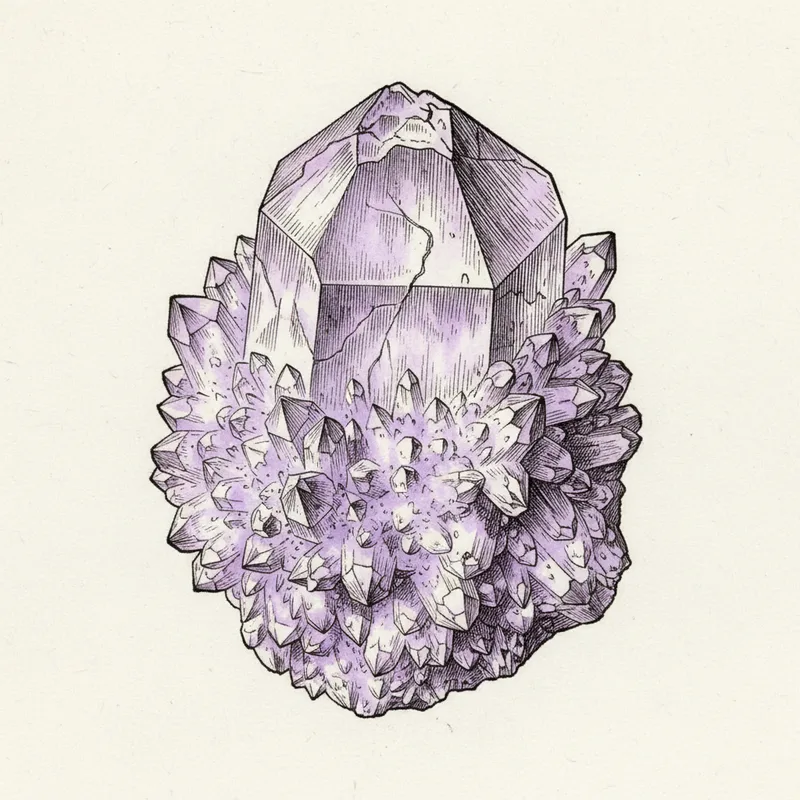
Spirit quartz is a unique variety of quartz found at a single deposit in South Africa's Mpumalanga Province. Its defining feature is a central crystal point encrusted with hundreds of tiny secondary crystal terminations growing outward from all faces - giving the crystal a sparkly, druzy coating that catches light from every angle.
The formation process involves two stages. First, a primary quartz crystal grows under normal conditions. Then, a second generation of silica-rich fluid deposits tiny quartz crystals over the surfaces of the original crystal. The result is a crystal that appears to be wearing a coat of smaller crystals - hence the folk name 'cactus quartz' (the tiny points resemble cactus spines).
Spirit quartz occurs in several color varieties matching the standard quartz colors: amethyst spirit quartz (purple, most popular and valuable), citrine spirit quartz (golden), white spirit quartz, and smoky spirit quartz. The amethyst variety's purple color comes from iron impurities and natural radiation, same as regular amethyst.
Identification Guide
Spirit quartz is unmistakable - the central crystal point covered in tiny secondary terminations is unique. No other quartz variety shows this specific growth habit. At hardness 7, it's standard quartz hardness.
Distinguish from druzy quartz (tiny crystals lining a cavity, not coating a larger crystal), cactus quartz (same thing, just a different name), and cathedral quartz (stepped growth, not encrusted). If a quartz crystal looks like it's covered in tiny sparkling points growing outward from its faces, it's spirit quartz.
Spotting Fakes
Spirit quartz from South Africa is the only genuine article. Some sellers market heavily included or druzy-coated quartz from other localities as 'spirit quartz,' but the specific growth habit - secondary terminations coating all faces of a primary crystal - is unique to the Mpumalanga deposit. Dyed spirit quartz exists (vibrant unnatural colors applied to white spirit quartz). Natural amethyst spirit quartz has the characteristic pale-to-medium purple of natural amethyst, not vivid artificial purple.
Some links in this post go to Amazon and Etsy. Crystal Almanac earns a commission from qualifying purchases at no extra cost to you. Tools recommended here are ones we would use ourselves to run the tests described - the recommendation comes first, the link is downstream of it.
Cultural & Metaphysical Traditions
Presented as cultural traditions, not scientific evidence
Spirit quartz was unknown to the gem and mineral market before the late 1990s when the South African deposit was commercialized. In Zulu tradition, crystals from this region are associated with ancestor spirits. The name 'spirit quartz' was coined for the Western crystal market, connecting the stone's ethereal appearance to spiritual communication. Modern practitioners associate it with community, harmony, and aligning personal energy with group intentions.
Metaphysical and “healing” associations are cultural traditions, not medical advice or scientific fact. Crystals are not a substitute for professional medical care.
Where It's Found
The only known source of true spirit quartz
Price Guide
Good to Know
Scratch test: At hardness 7, Spirit Quartz can scratch glass and steel. It's durable enough for any type of jewelry.
Global supply: Found at only one location on Earth - South Africa. Supply is inherently limited.
Heft test: Spirit Quartz has average mineral density (2.65). It feels about as heavy as you'd expect from a stone its size.
Common Questions
What is the chemical formula of Spirit Quartz?
The chemical formula of Spirit Quartz is SiO₂.
What is Spirit Quartz's Mohs hardness?
Spirit Quartz has a Mohs hardness of 7 on the 1 to 10 Mohs scale, hard enough to scratch glass and stand up to daily wear.
Is Spirit Quartz a mineral?
Yes. Spirit Quartz is a naturally occurring mineral (Quartz Family) with a definite chemical composition and an ordered crystal structure.
Care & Safety
The water, salt, and sunlight questions people actually ask before cleansing or displaying spirit quartz, answered from its hardness (Mohs 7) and chemistry (SiO₂).
Can Spirit Quartz go in water?
Yes. Spirit Quartz is hard (Mohs 7) and chemically stable, so a rinse or a quick wash with mild soap is no problem, cleanse it in water freely if that is your practice. A long soak does nothing for it either way, so skip that, and dry the stone afterward.
Can Spirit Quartz go in salt water?
Not recommended, even though spirit quartz itself is hard and not water-soluble. Salt is both corrosive and mildly abrasive: it can dull a polished surface, attack metal settings, and crystallize inside small fractures as the stone dries. A quick dip will not destroy spirit quartz, but rinse it with fresh water afterward and dry it. For routine cleaning, plain water is the kinder choice.
Does Spirit Quartz fade in sunlight?
Yes, it can. Most spirit quartz is amethyst-colored, and amethyst's purple color centers fade with prolonged exposure to strong sunlight. Display it away from direct sun to keep the druzy coating saturated.
Sources & References
The mineralogical and gemological data on this page is drawn from and can be cross-checked against these external references.
- WikipediaQuartz on Wikipedia
- WebmineralQuartz mineral data (Webmineral)
- Handbook of MineralogyQuartz (Handbook of Mineralogy, PDF)
Related Minerals
Same quartz variety, standard crystal form
Golden quartz, also found as spirit quartz
Similar tiny crystals, different growth pattern
Same mineral without secondary crystal coating
Explore More
Save This Stone
.%20Meaning%2C%20properties%20%26%20how%20to%20spot%20fakes%20at%20Crystal%20Almanac.)
Keep this spirit quartz reference handy. Save the card to a Pinterest board and the profile is one tap away.
Save to PinterestNewsletter
Something shiny, now and then
A stone worth knowing, or a fake worth spotting, every so often. No spam.