Serandite
Rare Sodium Manganese Calcium Silicate
Affiliate links. We may earn a commission, at no cost to you.
Quick Facts
Formation & Origin
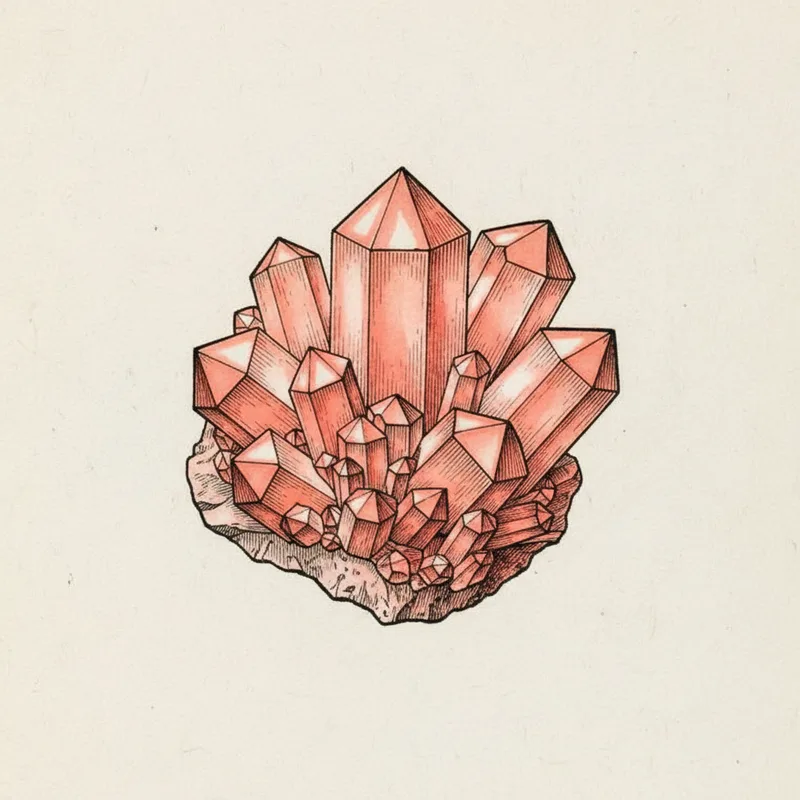
Serandite is a rare sodium manganese calcium silicate mineral related to the wollastonite group, prized by collectors for its salmon-pink to peach crystals. Serandite forms in alkaline pegmatites and miarolitic cavities of nepheline syenite intrusions. These are rare igneous bodies where silica-undersaturated magmas concentrate sodium, manganese, and volatile elements into late-stage pegmatitic fluids. The Poudrette quarry at Mont Saint-Hilaire in Quebec is the world's primary and essentially only significant source of collector-grade serandite. This unusual alkaline intrusion has produced over 360 documented mineral species, making it one of the richest mineralogical localities on Earth. Serandite there crystallizes as pink prismatic crystals, often in druzy clusters, associated with analcime, aegirine, and catapleiite in late-stage cavities. The characteristic pink color comes from Mn²⁺ in the crystal structure, with deeper salmon tones in crystals richer in manganese relative to calcium. The species was named after J.M. Serand, a French mineral collector, by French mineralogist Alfred Lacroix in 1931 from original material collected on Los Islands off Guinea.
Identification Guide
Serandite is immediately recognizable by its pink to salmon-pink color in prismatic crystals, often transparent at the tips and translucent through the body. The triclinic crystal system produces elongated bladed or prismatic forms with pinacoidal terminations. A key diagnostic property is bright salmon-pink fluorescence under longwave ultraviolet light, which no common pink mineral substitute shares. Specific gravity of 3.29-3.34 is noticeably heavy for a pink silicate. Hardness of 4.5-5 is modest, softer than feldspar. Vitreous to pearly luster on cleavage surfaces, with good cleavage parallel to the length of the crystals. The streak is white to pale pink. Most quality specimens are matrix pieces with serandite crystals nestled in druzy associations with clear analcime, black aegirine needles, and tabular white catapleiite.
Spotting Fakes
Rhodonite is the most common confusion since both are pink manganese silicates often sold through the same dealer networks. Rhodonite lacks serandite's bright longwave UV fluorescence entirely, and a simple blacklight test settles the question instantly. Rhodonite also typically shows characteristic black manganese-oxide veining that serandite does not exhibit. Pink calcite can resemble serandite in color but is far softer at Mohs 3 and effervesces vigorously in dilute hydrochloric acid, where serandite is acid-inert. Glass imitations lack crystalline form entirely and show gas bubbles under magnification. The most important authentication factor is provenance. Genuine serandite comes almost exclusively from the Poudrette quarry at Mont Saint-Hilaire, and reputable specimens arrive with locality documentation naming the quarry and collection date. Material offered as serandite without Mont Saint-Hilaire provenance should be treated with skepticism, since the mineral is not produced in significant quantity from any other deposit.
Some links in this post go to Amazon and Etsy. Crystal Almanac earns a commission from qualifying purchases at no extra cost to you. Tools recommended here are ones we would use ourselves to run the tests described - the recommendation comes first, the link is downstream of it.
Cultural & Metaphysical Traditions
Presented as cultural traditions, not scientific evidence
Serandite remains obscure in mainstream metaphysical practice due to its extreme rarity and collector-only distribution. Within the small community of collectors who use Mont Saint-Hilaire minerals for energy work, serandite is associated with heart-opening and emotional warmth, drawing on its salmon-pink color and gentle fluorescence. Some modern practitioners frame it as a stone of creative collaboration, reflecting the unusual diversity of minerals that crystallize together at its source locality.
Metaphysical and “healing” associations are cultural traditions, not medical advice or scientific fact. Crystals are not a substitute for professional medical care.
Where It's Found
World's primary source, producing all significant pink prismatic crystals from this alkaline intrusion that hosts over 360 mineral species
Original type locality where J.M. Serand collected specimens, though modern production is negligible
Minor occurrences in alkaline intrusions, rarely produces collector-grade material
Price Guide
Good to Know
Scratch test: At hardness 5, Serandite resists scratching from a knife but can be scratched by quartz. Best for pendants and earrings rather than rings.
Global supply: Found in 3 notable locations worldwide, from Poudrette Quarry, Mont Saint-Hilaire to Kola Peninsula.
Heft test: Serandite has average mineral density (3.29-3.34). It feels about as heavy as you'd expect from a stone its size.
Common Questions
What is the chemical formula of Serandite?
The chemical formula of Serandite is Na(Mn,Ca)₂Si₃O₈(OH).
What is Serandite's Mohs hardness?
Serandite has a Mohs hardness of 5 on the 1 to 10 Mohs scale, which a steel knife will scratch.
Is Serandite a mineral?
Yes. Serandite is a naturally occurring mineral (Silicate (Wollastonite Group Relative)) with a definite chemical composition and an ordered crystal structure.
Care & Safety
The water, salt, and sunlight questions people actually ask before cleansing or displaying serandite, answered from its hardness (Mohs 5) and chemistry (Na(Mn,Ca)₂Si₃O₈(OH)).
Can Serandite go in water?
Only briefly. A quick rinse under running water is fine for serandite, but do not let it soak or sit submerged. At Mohs 5 it is tough enough for a rinse but not for a long soak. Dry it thoroughly afterward.
Can Serandite go in salt water?
No. Serandite can take a brief fresh-water rinse and nothing more, and salt water is harder on it both ways: corrosive while wet, then abrasive as the salt dries into crystals. If it does meet salt water, rinse it with fresh water and dry it promptly.
Sources & References
The mineralogical and gemological data on this page is drawn from and can be cross-checked against these external references.
- WikipediaSerandite on Wikipedia
- WebmineralSerandite mineral data (Webmineral)
- Handbook of MineralogySerandite (Handbook of Mineralogy, PDF)
Related Minerals
Structurally similar sodium calcium silicate, forms in comparable alkaline environments
Pink manganese silicate often confused with serandite
Common associated mineral in Mont Saint-Hilaire matrix specimens
Black pyroxene that co-crystallizes with serandite at the Poudrette quarry
Tabular zirconium silicate found together with serandite in alkaline cavities
Save This Stone

Keep this serandite reference handy. Save the card to a Pinterest board and the profile is one tap away.
Save to PinterestNewsletter
Something shiny, now and then
A stone worth knowing, or a fake worth spotting, every so often. No spam.