Larimar
The Dolphin Stone
Affiliate links. We may earn a commission, at no cost to you.
Quick Facts
Formation & Origin
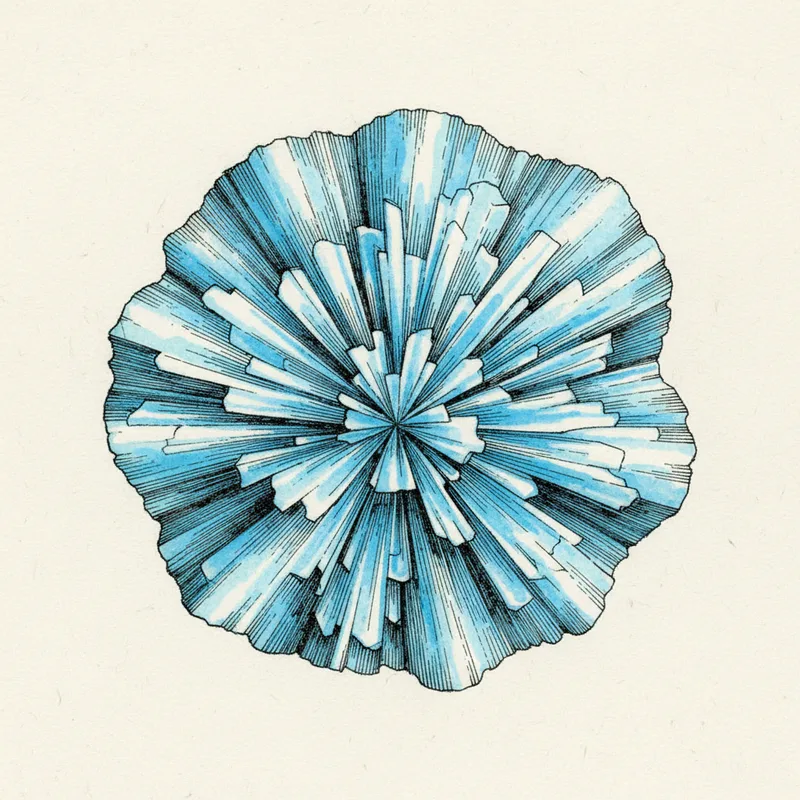
Larimar is a blue variety of the mineral pectolite, found in only one location on Earth - the mountainous Barahona Province of the Dominican Republic. While pectolite itself is a relatively common mineral (typically white to gray), the blue variety colored by copper substitution is unique to this single locality.
Larimar formed within volcanic rock - specifically in cavities and fractures within basaltic andesite flows. Hot, copper-bearing hydrothermal fluids deposited pectolite in these spaces, and the copper incorporated into the crystal structure produced the distinctive blue color. The deeper the blue, the higher the copper content.
The stone was officially 'discovered' in 1974 by Miguel Mendez and Peace Corps volunteer Norman Rilling, though local indigenous Taino people had known about blue stones in the region long before. Mendez named it by combining his daughter's name (Larissa) with the Spanish word for sea (mar). Mining is done by hand in small, artisanal operations in steep mountain terrain.
Identification Guide
Larimar is identified by its distinctive Caribbean blue color with white marbling patterns - it genuinely looks like tropical water seen from above. At hardness 4.5-5, it's moderately soft. The white patterns are areas of lower copper content within the pectolite.
Distinguish from turquoise (different veining pattern, different blue tone, harder), blue chalcedony (no white marbling), and hemimorphite (different crystal structure, often more green). Larimar's white swirled patterns within the blue are its most distinctive visual feature.
Spotting Fakes
Fake larimar exists but is less common than fake turquoise or moldavite because larimar isn't as expensive. The most common substitutes are dyed blue marble (too uniform, different texture) and blue-dyed pottery or ceramic. Genuine larimar has a distinctive silky luster and the white patterns are three-dimensional (visible at different depths within the stone). Color intensity fades with prolonged sunlight exposure, so store larimar away from windows.
Some links in this post go to Amazon and Etsy. Crystal Almanac earns a commission from qualifying purchases at no extra cost to you. Tools recommended here are ones we would use ourselves to run the tests described - the recommendation comes first, the link is downstream of it.
Cultural & Metaphysical Traditions
Presented as cultural traditions, not scientific evidence
Edgar Cayce, the early 20th-century mystic, reportedly predicted that a blue stone with healing powers would be found on a Caribbean island - larimar enthusiasts consider this a prophecy fulfilled, though the attribution is debated. In Dominican folk tradition, larimar represents the island's connection to the sea. Modern practitioners associate it with calm communication, emotional release, and connection to ocean energy. It has become the Dominican Republic's national gemstone.
Metaphysical and “healing” associations are cultural traditions, not medical advice or scientific fact. Crystals are not a substitute for professional medical care.
Where It's Found
The only known source in the world
Price Guide
Good to Know
Scratch test: At hardness 5, Larimar resists scratching from a knife but can be scratched by quartz. Best for pendants and earrings rather than rings.
Global supply: Found at only one location on Earth - Dominican Republic. Supply is inherently limited.
Heft test: Larimar has average mineral density (2.84). It feels about as heavy as you'd expect from a stone its size.
Common Questions
What is the chemical formula of Larimar?
The chemical formula of Larimar is NaCa₂Si₃O₈(OH).
What is Larimar's Mohs hardness?
Larimar has a Mohs hardness of 5 on the 1 to 10 Mohs scale, which a steel knife will scratch.
Is Larimar a mineral?
Yes. Larimar is a naturally occurring mineral (Pectolite variety) with a definite chemical composition and an ordered crystal structure.
Care & Safety
The water, salt, and sunlight questions people actually ask before cleansing or displaying larimar, answered from its hardness (Mohs 5) and chemistry (NaCa₂Si₃O₈(OH)).
Can Larimar go in water?
Only briefly. A quick rinse under running water is fine for larimar, but do not let it soak or sit submerged. At Mohs 5 it is tough enough for a rinse but not for a long soak. Dry it thoroughly afterward.
Can Larimar go in salt water?
No. Larimar can take a brief fresh-water rinse and nothing more, and salt water is harder on it both ways: corrosive while wet, then abrasive as the salt dries into crystals. If it does meet salt water, rinse it with fresh water and dry it promptly.
Does Larimar fade in sunlight?
Yes. Larimar's blue is photosensitive and fades with time if the stone gets too much light and heat. Wear it freely, but store it away from direct sunlight between wearings to keep the Caribbean blue saturated.
Sources & References
The mineralogical and gemological data on this page is drawn from and can be cross-checked against these external references.
- WikipediaLarimar on Wikipedia
- WebmineralPectolite mineral data (Webmineral)
- Handbook of MineralogyPectolite (Handbook of Mineralogy, PDF)
Explore More
Other Silicates & Gems
The Communication Collection
Dominican Republic's stone. Associated with calm expression and translating spiritual insight into words.
Cancer Season Crystals 2026: Stones for Intuition
Gemini Season Crystals 2026: Six Stones for Clarity
How to Start a Crystal Collection on Any Budget
Mohs Hardness Scale
See where Larimar sits on the scale
Crystal Care Guide
Water safety, sunlight, and handling tips
Save This Stone

Keep this larimar reference handy. Save the card to a Pinterest board and the profile is one tap away.
Save to PinterestNewsletter
Something shiny, now and then
A stone worth knowing, or a fake worth spotting, every so often. No spam.