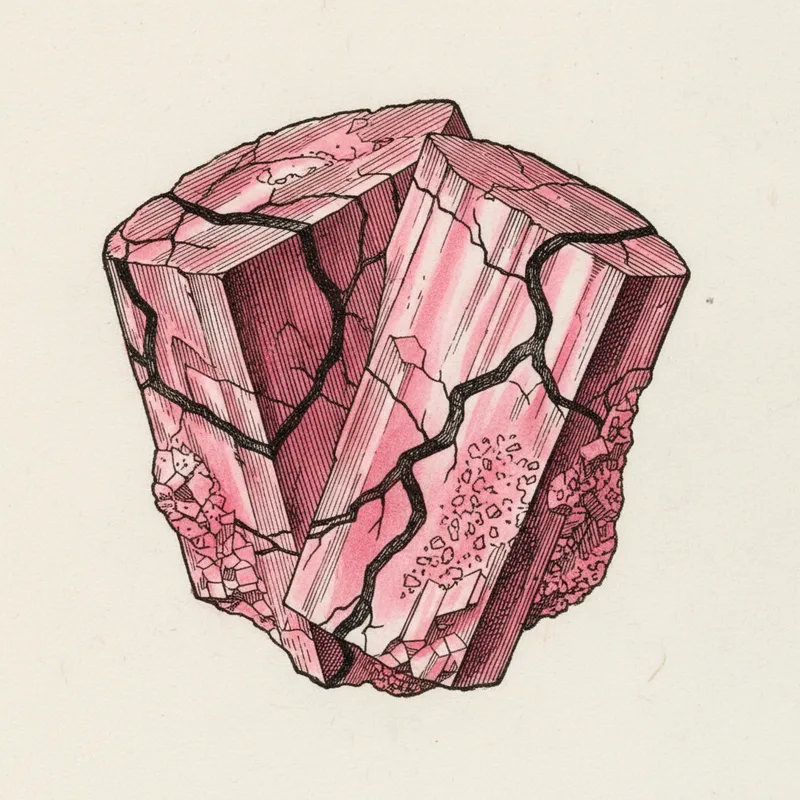
Rhodonite
The Rescue Stone
Affiliate links. We may earn a commission, at no cost to you.
Quick Facts
Formation & Origin
Rhodonite is a manganese inosilicate (chain silicate) mineral, manganese silicate (MnSiO₃), known for its rose-pink color and black manganese-oxide veining. Rhodonite forms in manganese-rich metamorphic and metasomatic environments - where hot, chemically active fluids alter existing rocks containing manganese. The pink color comes directly from the manganese content, and the characteristic black veining is manganese oxide that formed along fractures during or after the rhodonite's crystallization.
The finest gem-quality rhodonite - transparent, facetable crystals - comes from the Broken Hill deposit in Australia, where extreme metamorphic conditions created a unique zinc-lead-silver ore body that happens to contain pockets of exceptional rhodonite. These transparent crystals are among the rarest collector gems in the world.
Massive (non-crystalline) rhodonite with decorative black veining is far more common and has been used ornamentally for centuries. The Ural Mountains of Russia produced enormous quantities in the 18th and 19th centuries, and rhodonite was named the national stone of Russia.
Identification Guide
Rhodonite is identified by its distinctive pink color combined with black manganese oxide veining - no other common mineral shows this exact combination. At Mohs 6, it's moderately hard. The main confusion is with rhodochrosite, which is also pink but softer (3.5-4), often banded rather than veined, and effervesces in acid (rhodonite does not).
Transparent rhodonite crystals show strong pleochroism - appearing different shades of pink and yellow from different angles. Massive rhodonite has a slightly granular fracture and a vitreous to pearly luster on fresh surfaces.
Spotting Fakes
Rhodonite is affordable enough that faking is uncommon. The main issue is confusion with rhodochrosite (softer, banded, acid-reactive) and thulite (a pink zoisite that lacks the black veining). Dyed howlite or magnesite in pink can imitate rhodonite but lacks the characteristic dark veining pattern and feels lighter. Genuine rhodonite's black veining is irregular and organic-looking, not painted or uniform.
Some links in this post go to Amazon and Etsy. Crystal Almanac earns a commission from qualifying purchases at no extra cost to you. Tools recommended here are ones we would use ourselves to run the tests described - the recommendation comes first, the link is downstream of it.
Cultural & Metaphysical Traditions
Presented as cultural traditions, not scientific evidence
Russian folklore held that rhodonite could protect travelers and was placed in infants' cradles for protection. It earned the name 'rescue stone' from its traditional association with emotional healing and crisis recovery. Eagles were said to carry rhodonite to their nests. Modern practitioners associate it with compassion, forgiveness, and emotional balance.
Metaphysical and “healing” associations are cultural traditions, not medical advice or scientific fact. Crystals are not a substitute for professional medical care.
Where It's Found
Gem-grade transparent crystals, extremely rare
Historic source, ornamental grade with black veining
Vivid pink specimens, popular in lapidary
Fine pink massive material
Price Guide
Good to Know
Scratch test: At hardness 6, Rhodonite resists scratching from a knife but can be scratched by quartz. Best for pendants and earrings rather than rings.
Global supply: Found in 4 notable locations worldwide, from Australia to Brazil.
Heft test: Rhodonite has a specific gravity of 3.57 - noticeably heavier than quartz. You'll feel the density when you pick it up.
Common Questions
What is the chemical formula of Rhodonite?
The chemical formula of Rhodonite is MnSiO₃.
What is Rhodonite's Mohs hardness?
Rhodonite has a Mohs hardness of 6 on the 1 to 10 Mohs scale, hard enough to scratch glass but softer than quartz.
Is Rhodonite a mineral?
Yes. Rhodonite is a naturally occurring mineral (Inosilicate Group) with a definite chemical composition and an ordered crystal structure.
Care & Safety
The water, salt, and sunlight questions people actually ask before cleansing or displaying rhodonite, answered from its hardness (Mohs 6) and chemistry (MnSiO₃).
Can Rhodonite go in water?
Yes. Rhodonite is not water-soluble and durable enough (Mohs 6), so a rinse or a quick wash with mild soap is no problem, cleanse it in water freely if that is your practice. A long soak does nothing for it either way, so skip that, and dry the stone afterward.
Can Rhodonite go in salt water?
Not recommended, even though rhodonite itself is hard and not water-soluble. Salt is both corrosive and mildly abrasive: it can dull a polished surface, attack metal settings, and crystallize inside small fractures as the stone dries. A quick dip will not destroy rhodonite, but rinse it with fresh water afterward and dry it. For routine cleaning, plain water is the kinder choice.
Sources & References
The mineralogical and gemological data on this page is drawn from and can be cross-checked against these external references.
- WikipediaRhodonite on Wikipedia
- WebmineralRhodonite mineral data (Webmineral)
- Handbook of MineralogyRhodonite (Handbook of Mineralogy, PDF)
Related Minerals
Pink manganese carbonate, banded, softer
Pink zoisite, similar color, no veining
Related manganese silicate, rarer
Manganese garnet, orange-red
Explore More
Pyroxene & Amphibole
The Love Collection
The 'rescue stone.' Associated with emotional healing after heartbreak, particularly forgiveness and rebuilding trust.
The Confidence Collection
The rescue stone. After setbacks, confidence must be rebuilt. Rhodonite's pink-and-black pattern represents emotional resilience - the specific courage required to begin again.
The Healing Collection
The rescue stone. Emergency workers in Russia traditionally carried rhodonite for emotional first aid. Associated with healing after trauma and rebuilding after significant loss.
The Grief Collection
The rescue stone. Specifically associated with recovering from loss, processing trauma, and rebuilding after significant change. Its black manganese veins through pink represent the dark threads woven into love.
Best Crystals for 2026: Match Stones to Your Goals
Best Crystals After a Breakup: Heartbreak and Healing
Best Crystals for Love and Relationships
Mohs Hardness Scale
See where Rhodonite sits on the scale
Crystal Care Guide
Water safety, sunlight, and handling tips
Save This Stone

Keep this rhodonite reference handy. Save the card to a Pinterest board and the profile is one tap away.
Save to PinterestStay in the loop
From the Almanac
Updates from Crystal Almanac, when there’s something worth sharing.