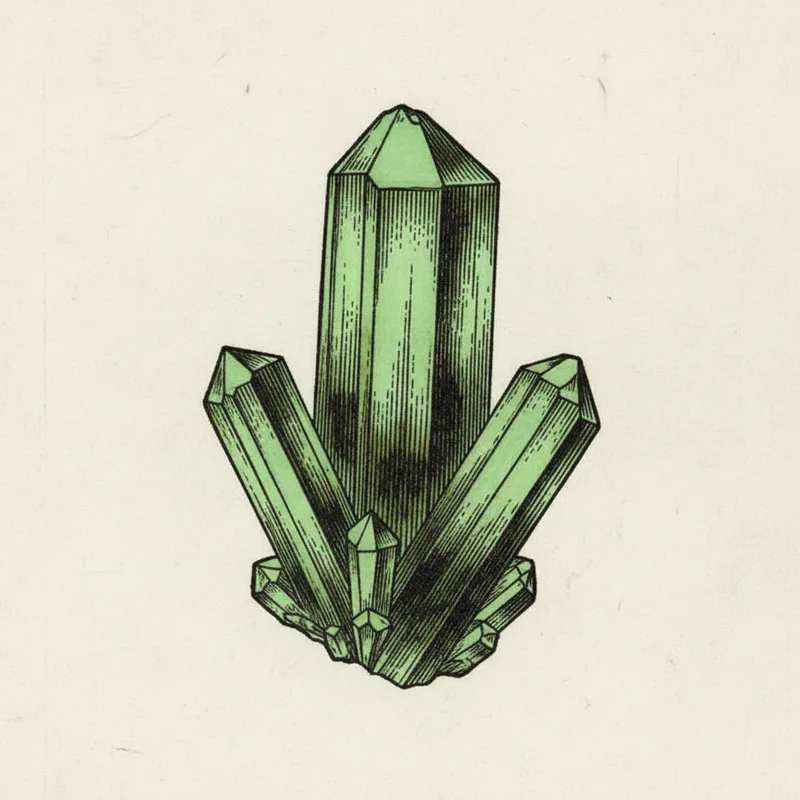
Epidote
The Stone of Increase
Affiliate links. We may earn a commission, at no cost to you.
Quick Facts
Formation & Origin
Epidote is a calcium aluminum iron silicate that forms in regional and contact metamorphic rocks, particularly in greenschist facies conditions. Its name comes from the Greek 'epidosis' meaning 'increase' - referring to the crystal's base having one side longer than the other.
Epidote's distinctive pistachio to dark olive green color comes from iron (Fe³⁺) in its structure. The more iron present, the darker the green - the finest gem-quality specimens are deeply colored but still translucent. Austrian specimens from the Knappenwand locality in the Hohe Tauern mountains are considered among the finest epidote crystals ever found.
Epidote is geologically important as a key indicator mineral in metamorphic petrology. Its presence tells geologists about the pressure, temperature, and chemistry of the metamorphic event that formed the rock. It's also the green component in unakite (epidote + pink feldspar + quartz).
Identification Guide
Epidote is identified by its distinctive pistachio-to-olive green color, monoclinic prismatic crystals with a characteristic elongated habit, and hardness of 6-7. The green is distinctly different from the greens of tourmaline, emerald, or jade.
Distinguish from green tourmaline (different crystal cross-section), actinolite (fibrous habit, different crystal system), and olivine (orthorhombic, different green tone). Epidote's one-sided elongation and specific pistachio green are diagnostic.
Spotting Fakes
Epidote is a collector mineral not commonly sold in the general crystal market, so faking isn't an issue. The main identification challenge is distinguishing it from other green metamorphic minerals in hand specimen. The distinctive pistachio color, prismatic habit, and hardness provide good diagnostics.
Some links in this post go to Amazon and Etsy. Crystal Almanac earns a commission from qualifying purchases at no extra cost to you. Tools recommended here are ones we would use ourselves to run the tests described - the recommendation comes first, the link is downstream of it.
Cultural & Metaphysical Traditions
Presented as cultural traditions, not scientific evidence
The 'increase' etymology has been embraced by crystal practitioners who associate epidote with amplifying whatever energy is present - positive or negative. This makes it unusual in the crystal healing world: practitioners warn that epidote will increase negative patterns as readily as positive ones, making it a stone that requires self-awareness. It's associated with personal growth, truth-facing, and releasing patterns that no longer serve.
Metaphysical and “healing” associations are cultural traditions, not medical advice or scientific fact. Crystals are not a substitute for professional medical care.
Where It's Found
World-class crystal specimens, classic locality
Fine transparent crystals
Good quality dark green crystals
Good specimens from metamorphic terrain
Price Guide
Good to Know
Scratch test: At hardness 6.5, Epidote resists scratching from a knife but can be scratched by quartz. Best for pendants and earrings rather than rings.
Global supply: Found in 4 notable locations worldwide, from Austria to United States.
Heft test: Epidote has average mineral density (3.45). It feels about as heavy as you'd expect from a stone its size.
Common Questions
What is the chemical formula of Epidote?
The chemical formula of Epidote is Ca₂(Al,Fe)₃(SiO₄)(Si₂O₇)O(OH).
What is Epidote's Mohs hardness?
Epidote has a Mohs hardness of 6.5 on the 1 to 10 Mohs scale, hard enough to scratch glass but softer than quartz.
Is Epidote a mineral?
Yes. Epidote is a naturally occurring mineral (Sorosilicate Group) with a definite chemical composition and an ordered crystal structure.
Care & Safety
The water, salt, and sunlight questions people actually ask before cleansing or displaying epidote, answered from its hardness (Mohs 6.5) and chemistry (Ca₂(Al,Fe)₃(SiO₄)(Si₂O₇)O(OH)).
Can Epidote go in water?
Not recommended. Epidote can react with water, draw in moisture, or break down when it gets wet, so skip the rinse. Wipe it with a dry or barely damp cloth and dry it right away.
Can Epidote go in salt water?
No. Epidote is best kept away from water altogether, and salt water is the harsher version of that problem: the dissolved salt is corrosive while the stone is wet, then leaves gritty crystals behind in cracks and crevices as it dries. Epidote's iron content also makes rust staining likely if salt residue sits on the surface.
Sources & References
The mineralogical and gemological data on this page is drawn from and can be cross-checked against these external references.
- WikipediaEpidote on Wikipedia
- WebmineralEpidote mineral data (Webmineral)
- Handbook of MineralogyEpidote (Handbook of Mineralogy, PDF)
Related Minerals
Rock containing epidote + feldspar + quartz
Often found together in metamorphic rocks
Low-iron endmember of the epidote group
Manganese-rich epidote variety (red), in dragon blood jasper
Explore More
Save This Stone

Keep this epidote reference handy. Save the card to a Pinterest board and the profile is one tap away.
Save to PinterestNewsletter
Something shiny, now and then
A stone worth knowing, or a fake worth spotting, every so often. No spam.