Papagoite
The Blue Ghost in Quartz
Affiliate links. We may earn a commission, at no cost to you.
Quick Facts
Formation & Origin
Papagoite is a rare calcium copper aluminum silicate mineral, best known as the vivid blue inclusions it forms within clear quartz. Papagoite forms in the oxidized zones of copper sulfide deposits. When copper-bearing sulfide minerals weather at or near the surface, acidic groundwater mobilizes copper, calcium, aluminum, and silica, which then recombine into rare hydrous silicates as conditions change. It was first described in 1960 from the New Cornelia mine at Ajo, Arizona, where it appears as thin coatings and microcrystals on fracture surfaces in the oxidized ore.
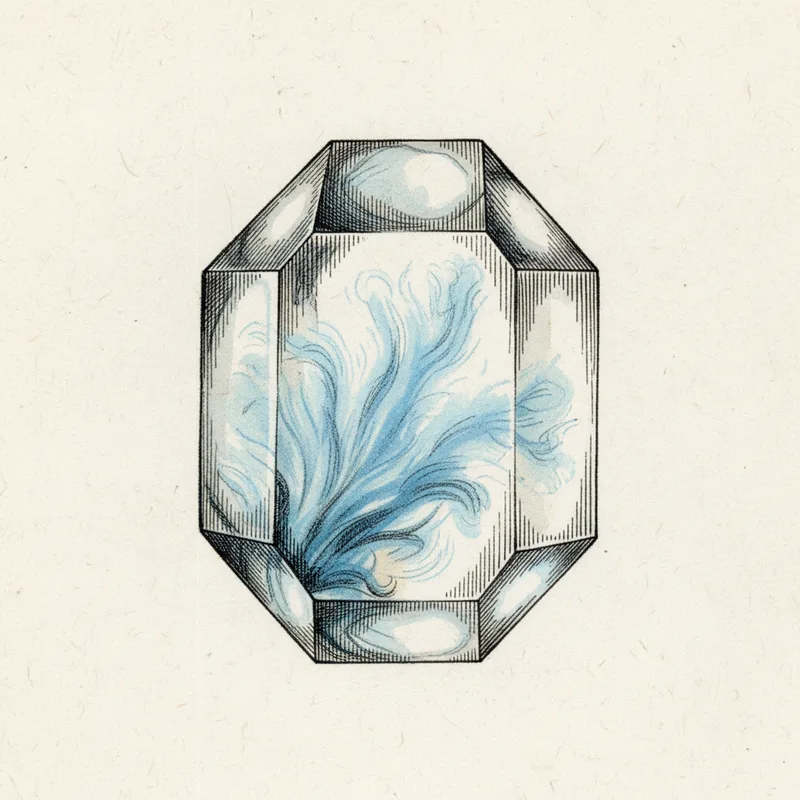
Most gem material sold as papagoite is actually papagoite plus ajoite, a related copper aluminum silicate, locked inside clear quartz crystals from the Musina mine in Limpopo Province, South Africa. Those quartz crystals grew in low-temperature hydrothermal veins cutting through copper-bearing country rock. Late in the growth sequence, fluids carrying copper and aluminum migrated into the vein system and deposited fine blue platelets inside the quartz, which then continued to grow, sealing the inclusions inside.
The result is a clear or slightly smoky quartz crystal with soft, cloud-like blue patterns suspended in its interior. The Musina mine closed in the 1990s, so all current material circulates from old collector stockpiles. Loose crystals of papagoite on its own, without a quartz host, remain among the rarest copper silicate specimens in the world.
Identification Guide
Loose papagoite is almost never seen outside of museum collections. In the field it appears as tiny bladed or platy crystals and soft blue crusts on fracture surfaces, with a pale blue streak and a hardness around 4 to 5. Specific gravity near 3.25 reflects its copper content.
Most collectors encounter papagoite only as inclusions in quartz. Those inclusions look like diffuse blue mist, phantom zones, or feather-like clouds floating inside an otherwise clear crystal. Color ranges from soft sky blue to deep cornflower, sometimes grading into blue-green where ajoite is mixed in. The host quartz has a glassy luster and hardness of 7, so the overall gem behaves as quartz when tested.
Under magnification the inclusions resolve into fine platy crystals rather than dye or liquid. Diffuse, slightly wispy edges are the diagnostic signature of natural Musina material.
Spotting Fakes
Dyed blue quartz is the most common imitation. An acetone swab on a polished surface will usually transfer color if the piece is dyed. Blue glass with suspended colorants is also sold online as papagoite quartz, but glass shows conchoidal fracture, bubbles, and no crystalline structure under a loupe.
Sharp, geometric blue inclusions with hard edges are a red flag. Genuine Musina papagoite appears as soft, diffuse clouds or feathery phantoms, never as crisp angular inclusions. Sharply bounded inclusions usually indicate synthetic hydrothermal quartz grown with a colored seed.
Because the Musina mine is closed, provenance matters more than almost any other factor. Documented old stock from the 1980s and early 1990s, especially with photos of the parent specimen, is worth the premium. Unlabeled lots of bright blue quartz from unknown sources should be treated with caution. Ajoite in quartz, which is chemically similar and often grows alongside papagoite, is frequently mislabeled as pure papagoite, so expect some overlap in what dealers call the material.
Some links in this post go to Amazon and Etsy. Crystal Almanac earns a commission from qualifying purchases at no extra cost to you. Tools recommended here are ones we would use ourselves to run the tests described - the recommendation comes first, the link is downstream of it.
Cultural & Metaphysical Traditions
Presented as cultural traditions, not scientific evidence
Papagoite was only described by science in 1960 and carries no ancient cultural lore. Modern crystal practitioners, drawing on its soft blue color and quartz host, associate it with gentle communication, emotional clarity, and meditative focus. Because of its rarity and the closure of the original South African source, collectors often treat fine papagoite in quartz as a heritage piece rather than a daily working stone.
Metaphysical and “healing” associations are cultural traditions, not medical advice or scientific fact. Crystals are not a substitute for professional medical care.
Where It's Found
Type locality, New Cornelia mine, thin coatings and microcrystals in oxidized copper ore
Famous host for microscopic inclusions in clear quartz, mine now closed
Minor occurrences in the oxidized copper zone
Rare reports from copper belt oxidation zones
Price Guide
Good to Know
Scratch test: At hardness 5, Papagoite resists scratching from a knife but can be scratched by quartz. Best for pendants and earrings rather than rings.
Global supply: Found in 4 notable locations worldwide, from United States to Democratic Republic of Congo.
Heft test: Papagoite has average mineral density (3.25). It feels about as heavy as you'd expect from a stone its size.
Common Questions
What is the chemical formula of Papagoite?
The chemical formula of Papagoite is CaCuAlSi₂O₆(OH)₃.
What is Papagoite's Mohs hardness?
Papagoite has a Mohs hardness of 5 on the 1 to 10 Mohs scale, which a steel knife will scratch.
Is Papagoite a mineral?
Yes. Papagoite is a naturally occurring mineral (Calcium Copper Aluminum Silicate) with a definite chemical composition and an ordered crystal structure.
Care & Safety
The water, salt, and sunlight questions people actually ask before cleansing or displaying papagoite, answered from its hardness (Mohs 5) and chemistry (CaCuAlSi₂O₆(OH)₃).
Can Papagoite go in water?
Only briefly. A quick rinse under running water is fine for papagoite, but do not let it soak or sit submerged. At Mohs 5 it is tough enough for a rinse but not for a long soak. Dry it thoroughly afterward.
Can Papagoite go in salt water?
No. Papagoite can take a brief fresh-water rinse and nothing more, and salt water is harder on it both ways: corrosive while wet, then abrasive as the salt dries into crystals. Salt also accelerates corrosion of copper-bearing minerals like papagoite. If it does meet salt water, rinse it with fresh water and dry it promptly.
Sources & References
The mineralogical and gemological data on this page is drawn from and can be cross-checked against these external references.
- WikipediaPapagoite on Wikipedia
- WebmineralPapagoite mineral data (Webmineral)
- Handbook of MineralogyPapagoite (Handbook of Mineralogy, PDF)
Related Minerals
Often intergrown with papagoite in Musina quartz, bluer green color
Another rare copper silicate from oxidized copper zones
Hydrous copper silicate found alongside papagoite at some localities
Far more common copper silicate with similar blue color, softer
Save This Stone

Keep this papagoite reference handy. Save the card to a Pinterest board and the profile is one tap away.
Save to PinterestNewsletter
Something shiny, now and then
A stone worth knowing, or a fake worth spotting, every so often. No spam.