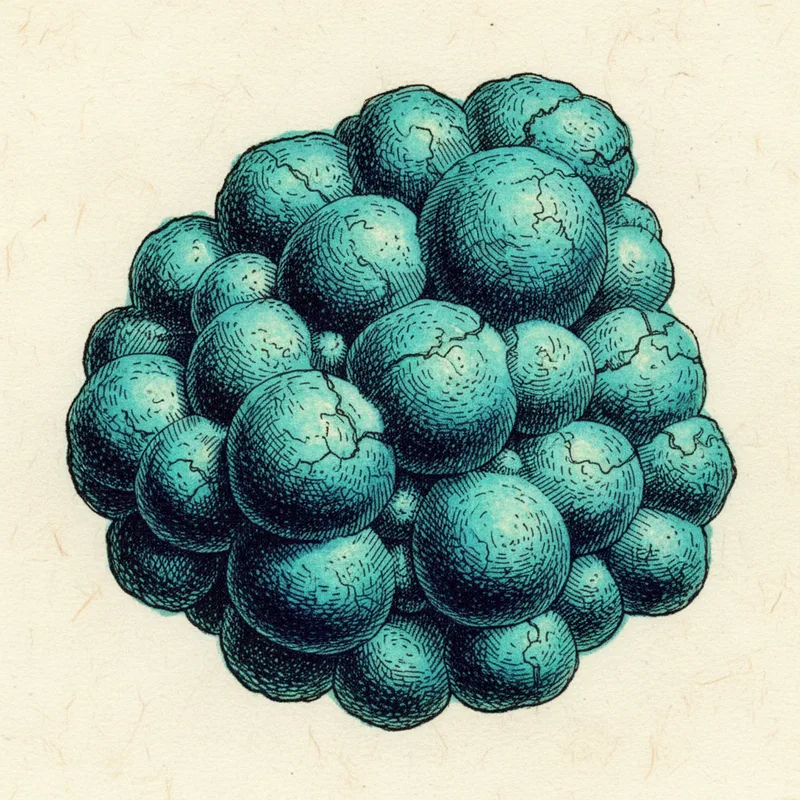
Shattuckite
The Copper Prophet
Affiliate links. We may earn a commission, at no cost to you.
Quick Facts
Formation & Origin
Shattuckite is a relatively rare copper silicate that forms in the oxidation zone of copper ore deposits. It develops when copper-bearing solutions react with pre-existing silicate minerals, sometimes replacing chrysocolla or other copper silicates atom by atom (pseudomorphism).
The vivid blue color comes from copper in the crystal structure. Shattuckite's blue is typically deeper and more saturated than chrysocolla and lacks the turquoise-green tones of most other copper silicates.
The mineral was discovered in 1915 and named after the Shattuck Mine in Bisbee, Arizona. The finest gem-quality material comes from Namibia, where shattuckite forms mixed with chrysocolla, malachite, and quartz in spectacular multi-colored specimens. These Namibian pieces, sometimes called 'quantum quattro,' combine four or more copper minerals in a single stone.
Identification Guide
Shattuckite is identified by its vivid deep blue color, association with other copper minerals, and silky to vitreous luster. Acicular (needle-like) crystal habit is typical, often forming fibrous masses or replacing other minerals.
Distinguish from chrysocolla (softer, more green-blue, amorphous), azurite (effervesces in acid, different blue), and sodalite (not associated with copper ores). Shattuckite doesn't effervesce in acid (it's a silicate, not a carbonate), which separates it from azurite.
Spotting Fakes
Some material sold as shattuckite is actually chrysocolla, which is more common and less valuable. Shattuckite typically has a deeper, more intense blue and often shows fibrous crystal structure under magnification. Mixed specimens (shattuckite with chrysocolla, malachite, and quartz) are genuine and valued for their multi-mineral beauty. Very uniform, vivid blue pieces at low prices may be dyed chrysocolla.
Some links in this post go to Amazon and Etsy. Crystal Almanac earns a commission from qualifying purchases at no extra cost to you. Tools recommended here are ones we would use ourselves to run the tests described - the recommendation comes first, the link is downstream of it.
Cultural & Metaphysical Traditions
Presented as cultural traditions, not scientific evidence
Shattuckite is considered one of the most powerful communication and psychic development stones. Practitioners associate it with channeling, mediumship, and receiving clear spiritual messages. The deep blue connects it to truthful expression and the ability to articulate spiritual experiences. Some traditions use it specifically for developing clairaudience (psychic hearing).
Metaphysical and “healing” associations are cultural traditions, not medical advice or scientific fact. Crystals are not a substitute for professional medical care.
Where It's Found
Finest gem-quality material
Type locality, named after the mine
Good specimens from copper mines
Fine crystallized specimens
Price Guide
Good to Know
Scratch test: At hardness 3.5, Shattuckite can be scratched with a copper coin. Handle gently and keep away from harder stones in your collection.
Global supply: Found in 4 notable locations worldwide, from Namibia to Greece.
Heft test: Shattuckite has a specific gravity of 3.8-4.1 - noticeably heavier than quartz. You'll feel the density when you pick it up.
Common Questions
What is the chemical formula of Shattuckite?
The chemical formula of Shattuckite is Cu₅(SiO₃)₄(OH)₂.
What is Shattuckite's Mohs hardness?
Shattuckite has a Mohs hardness of 3.5 on the 1 to 10 Mohs scale, soft enough to scratch with a copper coin.
Is Shattuckite a mineral?
Yes. Shattuckite is a naturally occurring mineral (Silicate Mineral (Inosilicate)) with a definite chemical composition and an ordered crystal structure.
Care & Safety
The water, salt, and sunlight questions people actually ask before cleansing or displaying shattuckite, answered from its hardness (Mohs 3.5) and chemistry (Cu₅(SiO₃)₄(OH)₂).
Can Shattuckite go in water?
Not recommended. Shattuckite can react with water, draw in moisture, or break down when it gets wet, so skip the rinse. Wipe it with a dry or barely damp cloth and dry it right away.
Can Shattuckite go in salt water?
No. Shattuckite is best kept away from water altogether, and salt water is the harsher version of that problem: the dissolved salt is corrosive while the stone is wet, then leaves gritty crystals behind in cracks and crevices as it dries. Salt also accelerates corrosion of copper-bearing minerals like shattuckite.
Sources & References
The mineralogical and gemological data on this page is drawn from and can be cross-checked against these external references.
- WikipediaShattuckite on Wikipedia
- WebmineralShattuckite mineral data (Webmineral)
- Handbook of MineralogyShattuckite (Handbook of Mineralogy, PDF)
Explore More
Pyroxene & Amphibole
The Communication Collection
Named after Arizona's Shattuck Mine. One of the deepest blue copper silicates. Associated with channeling, mediumship, and receiving clear spiritual messages for articulation.
Mohs Hardness Scale
See where Shattuckite sits on the scale
Crystal Care Guide
Water safety, sunlight, and handling tips
Save This Stone

Keep this shattuckite reference handy. Save the card to a Pinterest board and the profile is one tap away.
Save to PinterestNewsletter
Something shiny, now and then
A stone worth knowing, or a fake worth spotting, every so often. No spam.