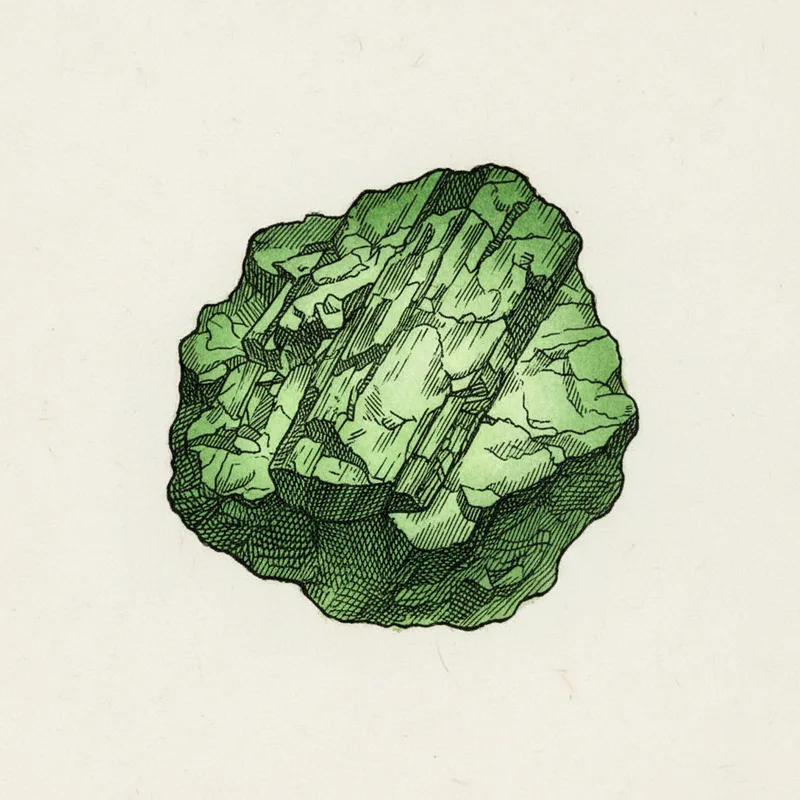
Nephrite
The Original Jade
Affiliate links. We may earn a commission, at no cost to you.
Quick Facts
Formation & Origin
Nephrite is a variety of actinolite-tremolite composed of densely interlocking microscopic fibers. This interlocking structure gives nephrite its extraordinary toughness, making it the toughest natural material known (tougher even than steel in terms of resistance to breaking).
It forms through metasomatic alteration of serpentinite or dolomitic marble. When silica-rich fluids interact with magnesium-rich ultramafic rocks or carbonate rocks, the resulting chemical reactions produce amphibole minerals that grow as tightly interwoven fibers. Iron content determines color: more iron produces darker greens and blacks, while iron-poor nephrite can be nearly white.
The white 'mutton fat' nephrite from Hotan, China has been prized for over 7,000 years and remains among the most valuable jade varieties. In Chinese culture, nephrite was jade for millennia before jadeite (the other jade mineral) was imported from Myanmar in the 18th century.
Identification Guide
Nephrite is identified by its waxy to greasy luster, exceptional toughness (it's very difficult to break), and characteristic colors. Under magnification, the fibrous structure is visible. Specific gravity of 2.90-3.03 is lower than jadeite (3.30-3.38).
Distinguish from jadeite (higher SG, more vitreous luster, often more translucent), serpentine (softer at 3-5, lower SG), and aventurine (sparkly inclusions, quartz family). A simple test: nephrite is so tough that it's virtually impossible to break by hand.
Spotting Fakes
The jade market is rife with imitations. Serpentine ('new jade'), dyed quartzite, glass, and plastic are all sold as jade. For nephrite specifically: check specific gravity (2.90-3.03), look for fibrous structure under magnification, and test toughness (genuine nephrite resists scratching and chipping). Dyed material can be detected with a Chelsea color filter or by checking for dye concentration in fractures. B-jade (acid-bleached and polymer-impregnated) is an issue primarily with jadeite rather than nephrite.
Some links in this post go to Amazon and Etsy. Crystal Almanac earns a commission from qualifying purchases at no extra cost to you. Tools recommended here are ones we would use ourselves to run the tests described - the recommendation comes first, the link is downstream of it.
Cultural & Metaphysical Traditions
Presented as cultural traditions, not scientific evidence
Nephrite jade has been revered in Chinese culture for thousands of years as the 'stone of heaven,' associated with wisdom, purity, and moral integrity. The Maori of New Zealand consider pounamu (nephrite) a taonga (treasure) with deep spiritual significance. In Western crystal healing, nephrite is connected to the heart chakra, emotional balance, and protection.
Metaphysical and “healing” associations are cultural traditions, not medical advice or scientific fact. Crystals are not a substitute for professional medical care.
Where It's Found
Prized white 'mutton fat' nephrite, imperial jade source
Sacred Maori greenstone, legally protected
World's largest modern producer by volume
Fine spinach-green nephrite
Price Guide
Good to Know
Scratch test: At hardness 6, Nephrite resists scratching from a knife but can be scratched by quartz. Best for pendants and earrings rather than rings.
Global supply: Found in 4 notable locations worldwide, from China to Russia.
Heft test: Nephrite has average mineral density (2.90-3.03). It feels about as heavy as you'd expect from a stone its size.
Common Questions
What is the chemical formula of Nephrite?
The chemical formula of Nephrite is Ca₂(Mg,Fe)₅Si₈O₂₂(OH)₂.
What is Nephrite's Mohs hardness?
Nephrite has a Mohs hardness of 6 on the 1 to 10 Mohs scale, hard enough to scratch glass but softer than quartz.
Is Nephrite a mineral?
Yes. Nephrite is a naturally occurring mineral (Amphibole Group (Silicate)) with a definite chemical composition and an ordered crystal structure.
Care & Safety
The water, salt, and sunlight questions people actually ask before cleansing or displaying nephrite, answered from its hardness (Mohs 6) and chemistry (Ca₂(Mg,Fe)₅Si₈O₂₂(OH)₂).
Can Nephrite go in water?
Yes. Nephrite is not water-soluble and durable enough (Mohs 6), so a rinse or a quick wash with mild soap is no problem, cleanse it in water freely if that is your practice. A long soak does nothing for it either way, so skip that, and dry the stone afterward.
Can Nephrite go in salt water?
Not recommended, even though nephrite itself is hard and not water-soluble. Salt is both corrosive and mildly abrasive: it can dull a polished surface, attack metal settings, and crystallize inside small fractures as the stone dries. Nephrite's iron content also makes rust staining likely if salt residue sits on the surface. A quick dip will not destroy nephrite, but rinse it with fresh water afterward and dry it. For routine cleaning, plain water is the kinder choice.
Sources & References
The mineralogical and gemological data on this page is drawn from and can be cross-checked against these external references.
- WikipediaNephrite on Wikipedia
- WebmineralTremolite mineral data (Webmineral)
- Handbook of MineralogyTremolite (Handbook of Mineralogy, PDF)
Explore More
Pyroxene & Amphibole
The Protection Collection
Called the 'stone of heaven' in Chinese culture for over 5,000 years. The toughest natural material, used as protective amulets and ceremonial objects across Chinese, Maori, and Mesoamerican civilizations.
Is It a Mineral? Obsidian, Amber, Pearl, and Opal
How to Identify a Crystal by Its Mineral Group
Crystal Hardness Chart: What Mohs Means for You
Mohs Hardness Scale
See where Nephrite sits on the scale
Crystal Care Guide
Water safety, sunlight, and handling tips
Save This Stone

Keep this nephrite reference handy. Save the card to a Pinterest board and the profile is one tap away.
Save to PinterestNewsletter
Something shiny, now and then
A stone worth knowing, or a fake worth spotting, every so often. No spam.