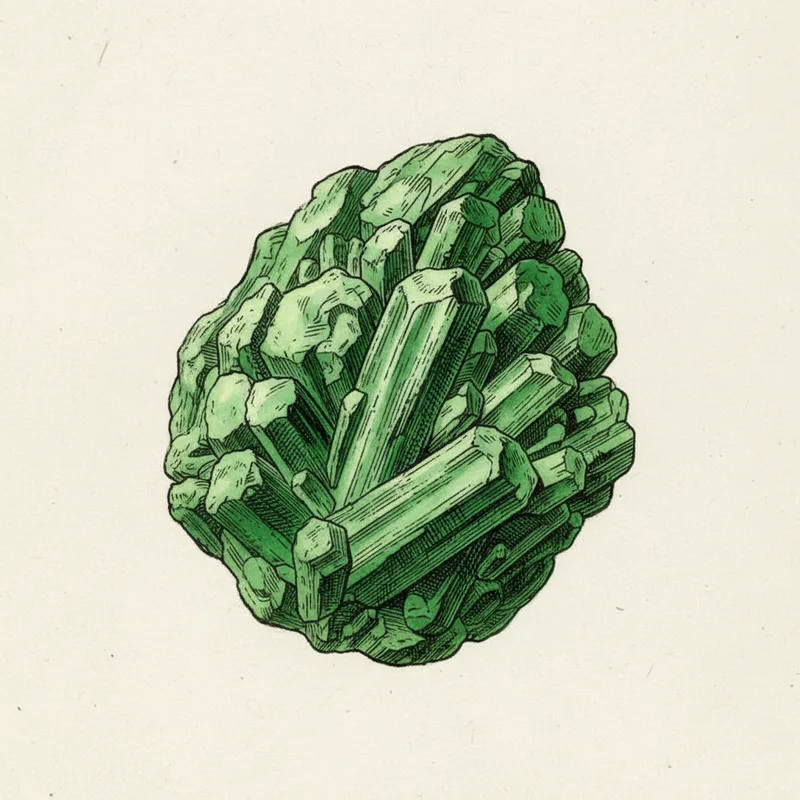
Jade
The Dream Stone
Affiliate links. We may earn a commission, at no cost to you.
Quick Facts
Formation & Origin
What we call 'jade' is actually two completely different minerals that happen to look similar: jadeite (a pyroxene) and nephrite (an amphibole). They weren't distinguished as separate minerals until 1863.
Nephrite forms in metamorphic environments when calcium and magnesium-rich rocks (like serpentinite) are altered by heat and pressure. Its extraordinary toughness - greater than steel - comes from its microstructure: interlocking bundles of microscopic fibrous crystals that resist fracture the way a rope resists breaking. This is why nephrite was prized for tools and weapons before metallurgy.
Jadeite forms under extreme conditions - high pressure but relatively low temperature - typically in subduction zones where oceanic crust dives beneath continental plates. These conditions are geologically rare, which is why gem-quality jadeite is found in very few places on Earth. The finest 'Imperial jade' - translucent, vivid emerald green, colored by chromium - comes exclusively from Myanmar and commands prices exceeding $3 million per kilogram at auction.
Identification Guide
Jade's most distinctive property is its exceptional toughness - it's harder to break than any common gemstone, including diamond. A genuine jade piece rings when tapped and feels dense and cool in the hand. Jadeite (SG 3.30) is noticeably denser than nephrite (SG 2.95).
Distinguishing jadeite from nephrite without gemological equipment is difficult. Jadeite tends to have a slightly more vitreous, glassy luster and can achieve brighter, more saturated colors, especially green. Nephrite typically has a more oily or waxy luster and appears in more muted tones. The many jade imitations (serpentine, aventurine, chrysoprase, glass) make laboratory testing essential for valuable pieces.
Spotting Fakes
Jade fraud is a massive problem in the market. Common substitutes include serpentine (much softer), aventurine quartz, dyed quartzite, chrysoprase, and glass. 'B jade' is genuine jadeite that has been acid-bleached to remove brown staining and then polymer-impregnated to improve appearance. 'C jade' is dyed. Only 'A jade' is untreated. For any significant purchase, demand a lab report from a recognized gemological laboratory. The scratch test is unreliable - some fakes match jade's hardness. The best field test is density - jade feels heavy for its size.
Some links in this post go to Amazon and Etsy. Crystal Almanac earns a commission from qualifying purchases at no extra cost to you. Tools recommended here are ones we would use ourselves to run the tests described - the recommendation comes first, the link is downstream of it.
Cultural & Metaphysical Traditions
Presented as cultural traditions, not scientific evidence
Chinese civilization has revered jade for over 8,000 years - longer than any other gemstone tradition on Earth. Confucius compared jade's qualities to virtue, and jade burial suits were crafted for Han dynasty royals. Maori carve nephrite (pounamu) into hei-tiki pendants passed down through generations. Maya civilization considered jade more precious than gold. Modern Feng Shui associates jade with prosperity, longevity, and harmony.
Metaphysical and “healing” associations are cultural traditions, not medical advice or scientific fact. Crystals are not a substitute for professional medical care.
Where It's Found
Only significant source of gem-grade jadeite
Nephrite jade, revered for 8,000+ years
Maya jade source, rediscovered in 1974
Pounamu nephrite, sacred to Maori culture
Price Guide
Good to Know
Scratch test: At hardness 6.5, Jade resists scratching from a knife but can be scratched by quartz. Best for pendants and earrings rather than rings.
Global supply: Found in 4 notable locations worldwide, from Myanmar to New Zealand.
Heft test: Jade has average mineral density (3.30 (jadeite) / 2.95 (nephrite)). It feels about as heavy as you'd expect from a stone its size.
Common Questions
What is the chemical formula of Jade?
The chemical formula of Jade is NaAlSi₂O₆ (jadeite) / Ca₂(Mg,Fe)₅Si₈O₂₂(OH)₂ (nephrite).
What is Jade's Mohs hardness?
Jade has a Mohs hardness of 6.5 on the 1 to 10 Mohs scale, hard enough to scratch glass but softer than quartz.
Is Jade a mineral?
Not a single mineral. Jade is a mixture of more than one mineral rather than one mineral species.
Care & Safety
The water, salt, and sunlight questions people actually ask before cleansing or displaying jade, answered from its hardness (Mohs 6.5) and chemistry (NaAlSi₂O₆ (jadeite) / Ca₂(Mg,Fe)₅Si₈O₂₂(OH)₂ (nephrite)).
Can Jade go in water?
Yes. Jade is not water-soluble and durable enough (Mohs 6.5), so a rinse or a quick wash with mild soap is no problem, cleanse it in water freely if that is your practice. A long soak does nothing for it either way, so skip that, and dry the stone afterward.
Can Jade go in salt water?
Not recommended, even though jade itself is hard and not water-soluble. Salt is both corrosive and mildly abrasive: it can dull a polished surface, attack metal settings, and crystallize inside small fractures as the stone dries. Jade's iron content also makes rust staining likely if salt residue sits on the surface. A quick dip will not destroy jade, but rinse it with fresh water afterward and dry it. For routine cleaning, plain water is the kinder choice.
Sources & References
The mineralogical and gemological data on this page is drawn from and can be cross-checked against these external references.
- WikipediaJade on Wikipedia
- WebmineralJadeite mineral data (Webmineral)
- Handbook of MineralogyJadeite (Handbook of Mineralogy, PDF)
- GIAJade in the GIA Gem Encyclopedia
Related Minerals
Common jade imitation, much softer
Green chalcedony, similar color
Sparkly green quartz, common substitute
Related pyroxene, sometimes called 'omphacite jade'
Explore More
Other Silicates & Gems
The Abundance Collection
More valuable than gold in imperial Chinese culture. Associated with prosperity, longevity, and nobility for over 5,000 years.
The Surprisingly Recent History of Crystal Healing
Is It a Mineral? Obsidian, Amber, Pearl, and Opal
How to Identify a Crystal by Its Mineral Group
Mohs Hardness Scale
See where Jade sits on the scale
Crystal Care Guide
Water safety, sunlight, and handling tips
Save This Stone

Keep this jade reference handy. Save the card to a Pinterest board and the profile is one tap away.
Save to PinterestNewsletter
Something shiny, now and then
A stone worth knowing, or a fake worth spotting, every so often. No spam.