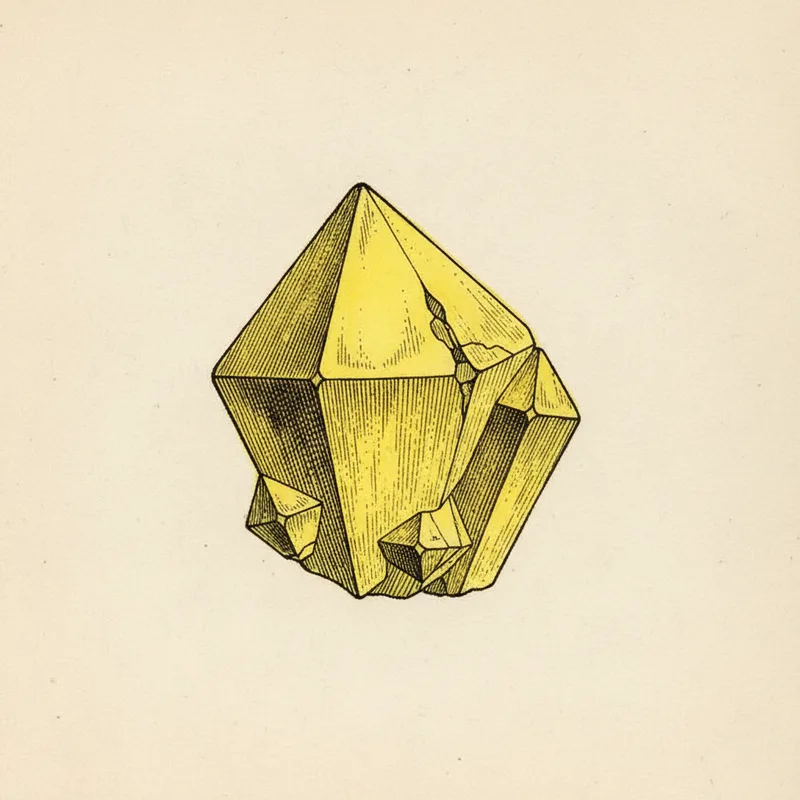
Native Sulfur
The Brimstone
Affiliate links. We may earn a commission, at no cost to you.
Quick Facts
Formation & Origin
Native sulfur is the elemental form of sulfur (S), a native element that crystallizes in vivid yellow masses around volcanic vents and in sedimentary deposits. Native sulfur forms through three main processes. Volcanic sulfur deposits around fumaroles and hot springs, where sulfur-rich gases (H₂S, SO₂) cool and precipitate solid sulfur. Biogenic sulfur forms when anaerobic bacteria reduce sulfate minerals in evaporite deposits, producing elemental sulfur. Salt dome caprock sulfur in Texas and Louisiana formed through this bacterial process over millions of years.
The finest crystal specimens come from Sicily's historic sulfur mines, which operated for centuries and produced museum-quality transparent yellow crystals on celestite and aragonite matrix. These Sicilian specimens are classics of mineral collecting.
At Kawah Ijen in Java, miners still carry baskets of sulfur up from an active volcanic crater using traditional methods. The blue flames of burning sulfur gas at night make it one of the most photographed mineral extraction sites on Earth. Sulfur melts at only 113°C and ignites at 232°C, making it one of the lowest-melting and most flammable minerals.
Identification Guide
Native sulfur is identified by its vivid yellow color, very low hardness (Mohs 2), resinous luster, low specific gravity (2.07, feels very light), and characteristic sulfur smell when scratched or heated. Crystals form distinctive bipyramidal shapes.
Distinguish from orpiment (arsenic sulfide, don't confuse them - orpiment is toxic), citrine (much harder), and yellow calcite (effervesces in acid). Sulfur is so soft you can scratch it with a fingernail, and a scratch will often release a faint rotten-egg smell.
Spotting Fakes
Native sulfur is not faked. The main concerns are handling: sulfur is flammable, melts easily, and releases toxic SO₂ gas when burned. Store away from heat sources. Sulfur specimens are also fragile and can crack from thermal shock (even the warmth of your hand on a cold specimen). The finest Sicilian crystal specimens are genuinely valuable collectibles, with large transparent crystals commanding serious prices.
Some links in this post go to Amazon and Etsy. Crystal Almanac earns a commission from qualifying purchases at no extra cost to you. Tools recommended here are ones we would use ourselves to run the tests described - the recommendation comes first, the link is downstream of it.
Cultural & Metaphysical Traditions
Presented as cultural traditions, not scientific evidence
Sulfur has been associated with purification and banishing since antiquity. The biblical 'brimstone' (burning stone) is sulfur, used in religious texts as a purifying fire. Ancient civilizations burned sulfur to fumigate homes and temples. In crystal healing, sulfur is associated with willpower, personal boundaries, and clearing negative energy. SAFETY: Flammable. Do not heat. Store away from flame. Wash hands after handling.
Metaphysical and “healing” associations are cultural traditions, not medical advice or scientific fact. Crystals are not a substitute for professional medical care.
Where It's Found
Historic world source, spectacular museum crystals
Active volcanic fumaroles, traditional mining
Fine crystal specimens from volcanic deposits
Industrial extraction via Frasch process
Price Guide
Good to Know
Scratch test: At hardness 2, Native Sulfur can be scratched with a fingernail. This is a display specimen, not a wearable stone.
Global supply: Found in 4 notable locations worldwide, from Italy to United States.
Heft test: With a specific gravity of 2.07, Native Sulfur feels lighter than most minerals. This lightness can help identify it.
Common Questions
What is the chemical formula of Native Sulfur?
The chemical formula of Native Sulfur is S.
What is Native Sulfur's Mohs hardness?
Native Sulfur has a Mohs hardness of 2 on the 1 to 10 Mohs scale, soft enough to scratch with a fingernail.
Is Native Sulfur a mineral?
Yes. Native Sulfur is a naturally occurring mineral (Native Element) with a definite chemical composition and an ordered crystal structure.
Care & Safety
The water, salt, and sunlight questions people actually ask before cleansing or displaying native sulfur, answered from its hardness (Mohs 2) and chemistry (S).
Can Native Sulfur go in water?
Not recommended. At Mohs 2, native sulfur is soft enough that water can slowly dull, etch, or wear down the surface, so a water cleanse does more harm than good here. Reach for a dry cloth instead.
Can Native Sulfur go in salt water?
No. Native Sulfur is best kept away from water altogether, and salt water is the harsher version of that problem: the dissolved salt is corrosive while the stone is wet, then leaves gritty crystals behind in cracks and crevices as it dries.
Sources & References
The mineralogical and gemological data on this page is drawn from and can be cross-checked against these external references.
- WikipediaSulfur on Wikipedia
- WebmineralSulfur mineral data (Webmineral)
Explore More
Save This Stone
.%20Meaning%2C%20properties%20%26%20how%20to%20spot%20fakes%20at%20Crystal%20Almanac.)
Keep this native sulfur reference handy. Save the card to a Pinterest board and the profile is one tap away.
Save to PinterestNewsletter
Something shiny, now and then
A stone worth knowing, or a fake worth spotting, every so often. No spam.