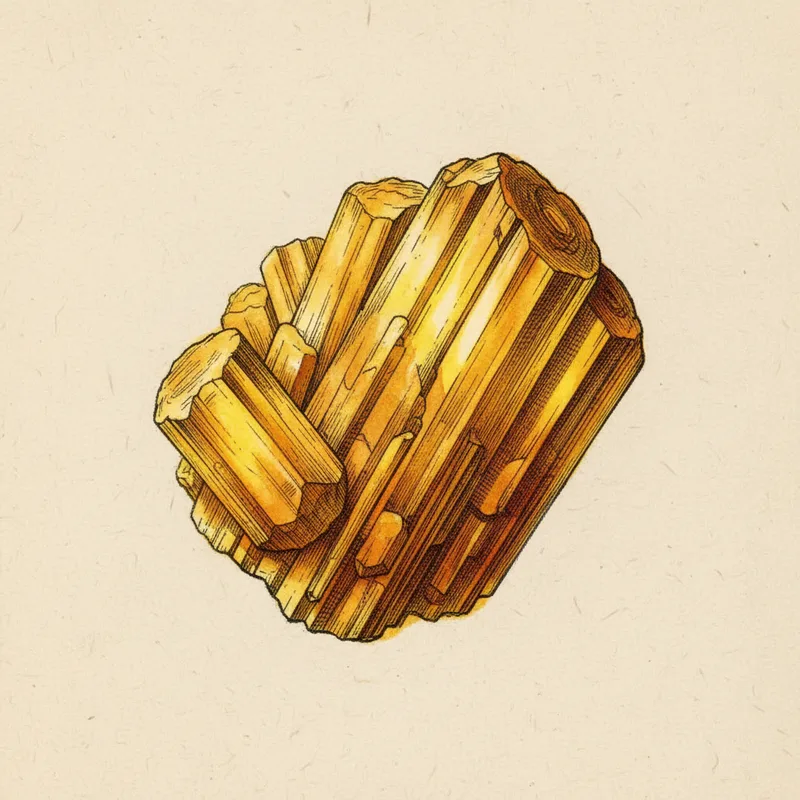
Orpiment
The Golden Arsenic
Affiliate links. We may earn a commission, at no cost to you.
Quick Facts
Formation & Origin
Orpiment is an arsenic sulfide mineral (As₂S₃), the golden-yellow companion to its red relative realgar. Orpiment forms in the same geological environments as realgar: low-temperature hydrothermal veins, hot springs, and volcanic fumaroles. It's the arsenic trisulfide to realgar's arsenic tetrasulfide. Where you find one, you almost always find the other.
Orpiment's perfect basal cleavage produces thin, flexible sheets with a pearly luster on the cleavage surface. This property, combined with its brilliant golden-yellow color, made it historically important as a pigment. The name 'orpiment' comes from the Latin 'auripigmentum' (gold pigment). Ancient Roman and Egyptian artists used it despite its toxicity.
Alchermists called orpiment 'king's yellow' and valued it for its resemblance to gold. They believed the arsenic sulfides were close to gold in nature's hierarchy of matter, leading to extensive (and dangerous) experiments attempting to transform them into actual gold.
Identification Guide
Orpiment is identified by its vivid lemon to golden-yellow color, very low hardness (1.5), perfect cleavage producing flexible sheets, and pearly luster on cleavage surfaces. The combination of yellow color and extreme softness narrows identification significantly.
Distinguish from sulfur (lighter yellow, different crystal habit, melts easily), yellow calcite (much harder, effervesces in acid), and gold (metallic luster, much heavier, malleable). SAFETY: Contains arsenic. Handle carefully and wash hands after.
Spotting Fakes
Orpiment is not commonly faked. Like realgar, it can degrade with light exposure, though orpiment is somewhat more stable. Fresh specimens have vivid golden-yellow color. Oxidized or degraded material may appear pale or whitish. Specimens should be stored away from strong light. The association with realgar (red) on the same specimen is common and adds visual interest and collector value.
Some links in this post go to Amazon and Etsy. Crystal Almanac earns a commission from qualifying purchases at no extra cost to you. Tools recommended here are ones we would use ourselves to run the tests described - the recommendation comes first, the link is downstream of it.
Cultural & Metaphysical Traditions
Presented as cultural traditions, not scientific evidence
Orpiment's connection to alchemy and its gold-like color give it associations with transformation, wealth, and personal power. Like realgar, it was used in Chinese traditional practices for protection and purification. IMPORTANT: Handle with care. Do not make gem elixirs. Contains arsenic. Display only, do not carry or sleep with this mineral.
Metaphysical and “healing” associations are cultural traditions, not medical advice or scientific fact. Crystals are not a substitute for professional medical care.
Where It's Found
World-class crystal specimens alongside realgar
Excellent crystal groups
Historic source of pigment material
Volcanic sublimate specimens
Price Guide
Good to Know
Scratch test: At hardness 1.5, Orpiment can be scratched with a fingernail. This is a display specimen, not a wearable stone.
Global supply: Found in 4 notable locations worldwide, from China to Russia.
Heft test: Orpiment has average mineral density (3.49). It feels about as heavy as you'd expect from a stone its size.
Common Questions
What is the chemical formula of Orpiment?
The chemical formula of Orpiment is As₂S₃.
What is Orpiment's Mohs hardness?
Orpiment has a Mohs hardness of 1.5 on the 1 to 10 Mohs scale, soft enough to scratch with a fingernail.
Is Orpiment a mineral?
Yes. Orpiment is a naturally occurring mineral (Sulfide Mineral) with a definite chemical composition and an ordered crystal structure.
Care & Safety
The water, salt, and sunlight questions people actually ask before cleansing or displaying orpiment, answered from its hardness (Mohs 1.5) and chemistry (As₂S₃).
Can Orpiment go in water?
Not recommended. TOXIC. Arsenic sulfide. Same warnings as realgar. Never expose to water.
Can Orpiment go in salt water?
No. Orpiment is best kept away from water altogether, and salt water is the harsher version of that problem: the dissolved salt is corrosive while the stone is wet, then leaves gritty crystals behind in cracks and crevices as it dries.
Is sunlight safe for Orpiment?
No. Orpiment (As₂S₃) is light-sensitive and deteriorates with prolonged exposure, and it is an arsenic mineral. Store it away from sunlight in an enclosed display, handle it as little as possible, and wash your hands after contact.
Sources & References
The mineralogical and gemological data on this page is drawn from and can be cross-checked against these external references.
- WikipediaOrpiment on Wikipedia
- WebmineralOrpiment mineral data (Webmineral)
- Handbook of MineralogyOrpiment (Handbook of Mineralogy, PDF)
Explore More
Sulfide Minerals
Toxic Crystals: The Complete Safety Guide
Best Crystals for Pregnancy and New Motherhood
How to Store and Display Your Crystal Collection
Mohs Hardness Scale
See where Orpiment sits on the scale
Crystal Care Guide
Water safety, sunlight, and handling tips
Save This Stone

Keep this orpiment reference handy. Save the card to a Pinterest board and the profile is one tap away.
Save to PinterestNewsletter
Something shiny, now and then
A stone worth knowing, or a fake worth spotting, every so often. No spam.