Moldavite
The Stone from the Stars
Affiliate links. We may earn a commission, at no cost to you.
Quick Facts
Formation & Origin
Moldavite is not a mineral - it's a natural glass formed approximately 14.7 million years ago when a large asteroid struck what is now the Ries crater in southern Germany. The impact's energy was so enormous that it melted surface rocks and ejected molten material high into the atmosphere. This molten glass cooled and solidified as it fell back to Earth, landing hundreds of kilometers away in what is now the Czech Republic.
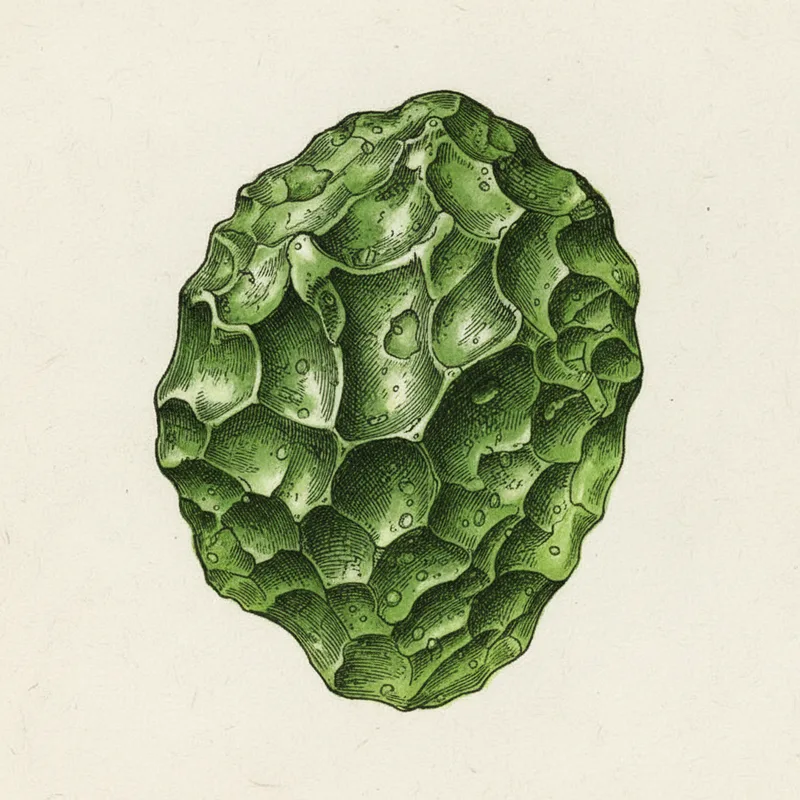
The distinctive sculpted, wrinkled surface texture (called sculpturing) formed through two processes: aerodynamic shaping during flight through the atmosphere, and chemical etching by soil acids during the millions of years moldavite spent buried in sedimentary deposits.
Moldavite is found only in a limited area of the Czech Republic - nowhere else on Earth. The total supply is finite and diminishing as deposits are worked out. This genuine scarcity, combined with a social media-driven popularity surge in 2020-2022, pushed prices to historically high levels. The market has since cooled somewhat, but moldavite remains one of the most counterfeited stones in the crystal world.
Identification Guide
Genuine moldavite has a distinctive wrinkled, sculpted surface texture that's difficult to replicate convincingly. The color ranges from forest green to olive green, and pieces are typically translucent when held up to light. Inside, you may see elongated bubbles (lechatelierite - fused quartz tubes) and flow structures - these are diagnostic.
At hardness 5.5, moldavite can be scratched by quartz but not by a knife. It feels lighter than you'd expect for glass (SG 2.35, lower than window glass at 2.5). Genuine moldavite always has some surface texture - perfectly smooth, polished pieces have been worked and should be priced accordingly.
Spotting Fakes
Moldavite has one of the worst fake-to-real ratios in the crystal market. Most fakes are green bottle glass from China, often cast in molds to simulate the sculpted surface. Key tells: fake moldavite often has a brighter, more vivid green than genuine (which tends toward olive). The surface texture on fakes looks stamped or repetitive, while genuine sculpturing is random and organic. Genuine moldavite's bubbles are elongated (stretched during flight); glass fakes have round bubbles. Buy only from established dealers who can provide locality information, and consider a lab report for pieces over $100.
Some links in this post go to Amazon and Etsy. Crystal Almanac earns a commission from qualifying purchases at no extra cost to you. Tools recommended here are ones we would use ourselves to run the tests described - the recommendation comes first, the link is downstream of it.
Cultural & Metaphysical Traditions
Presented as cultural traditions, not scientific evidence
Moldavite's extraterrestrial origin (formed by an asteroid impact) has made it one of the most sought-after stones in the crystal healing community. Practitioners describe a 'moldavite flush' - a sensation of warmth or tingling when first handling it. Some believe it accelerates personal transformation and spiritual growth. The 2020 TikTok-driven moldavite trend created unprecedented demand and a flood of fakes. Historically, moldavite was used as a talisman in Central Europe and was found in the Venus of Willendorf archaeological site (25,000 years old).
Metaphysical and “healing” associations are cultural traditions, not medical advice or scientific fact. Crystals are not a substitute for professional medical care.
Where It's Found
The only source - formed by the Ries impact 14.7 million years ago
Price Guide
Good to Know
Scratch test: At hardness 5.5, Moldavite resists scratching from a knife but can be scratched by quartz. Best for pendants and earrings rather than rings.
Global supply: Found at only one location on Earth - Czech Republic. Supply is inherently limited.
Heft test: With a specific gravity of 2.35, Moldavite feels lighter than most minerals. This lightness can help identify it.
Common Questions
What is the chemical formula of Moldavite?
The chemical formula of Moldavite is SiO₂ + Al₂O₃ (variable).
What is Moldavite's Mohs hardness?
Moldavite has a Mohs hardness of 5.5 on the 1 to 10 Mohs scale, hard enough to scratch glass but softer than quartz.
Is Moldavite a mineral?
No. Moldavite is a natural glass (a mineraloid), not a true mineral, because it cooled too fast to develop the ordered crystal structure that defines a mineral.
Care & Safety
The water, salt, and sunlight questions people actually ask before cleansing or displaying moldavite, answered from its hardness (Mohs 5.5) and chemistry (SiO₂ + Al₂O₃ (variable)).
Can Moldavite go in water?
Not recommended. Moldavite can react with water, draw in moisture, or break down when it gets wet, so skip the rinse. Wipe it with a dry or barely damp cloth and dry it right away.
Can Moldavite go in salt water?
No. Moldavite is a natural glass (a tektite), and while glass resists dissolving, salt crystals forming in its characteristic surface sculpturing and bubbles abrade it as the water dries. A brief fresh-water rinse is the most moldavite should see.
Sources & References
The mineralogical and gemological data on this page is drawn from and can be cross-checked against these external references.
- WikipediaMoldavite on Wikipedia
Explore More
Volcanic & Impact Glass
The Manifestation Collection
The 15-million-year-old meteorite glass. Associated with rapid, intense transformation - practitioners consider it the most powerful manifestation accelerator in the crystal world.
Is It a Mineral? Obsidian, Amber, Pearl, and Opal
Selenite vs Satin Spar: What's the Difference?
How Crystals Form: Pegmatite, Hydrothermal, Sedimentary
Mohs Hardness Scale
See where Moldavite sits on the scale
Crystal Care Guide
Water safety, sunlight, and handling tips
Save This Stone

Keep this moldavite reference handy. Save the card to a Pinterest board and the profile is one tap away.
Save to PinterestNewsletter
Something shiny, now and then
A stone worth knowing, or a fake worth spotting, every so often. No spam.