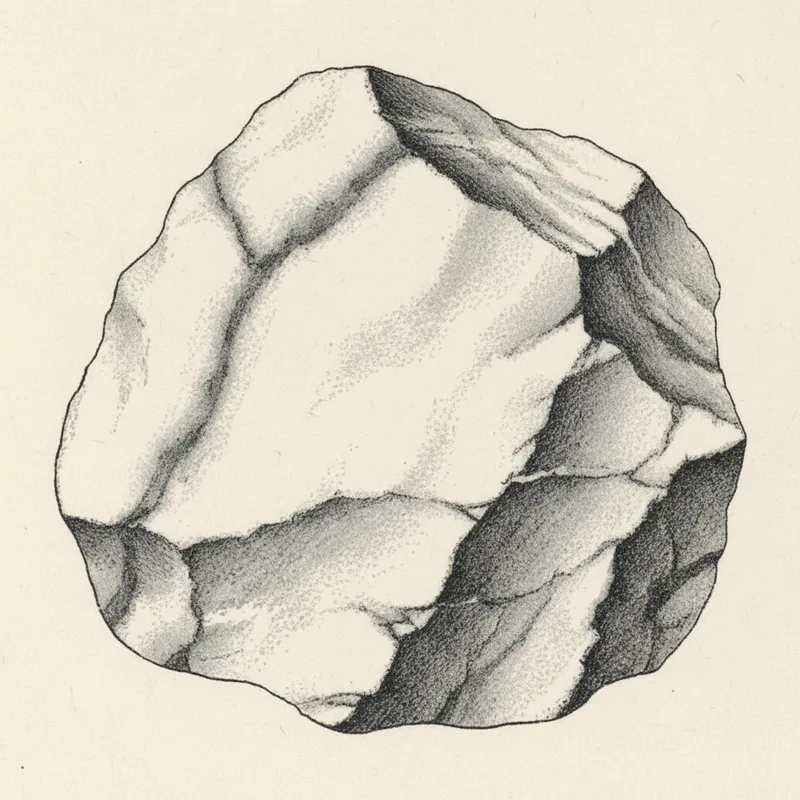
Marble
The Sculptor's Canvas
Affiliate links. We may earn a commission, at no cost to you.
Quick Facts
Formation & Origin
Marble is limestone that has been metamorphosed by heat and pressure. The original calcite crystals in the limestone recrystallize into larger, interlocking grains, transforming soft, fossiliferous sedimentary rock into a dense, polishable metamorphic one.
Pure marble is white. The famous Carrara marble that Michelangelo used for David and the Pietà is nearly pure calcite. Colors come from impurities: iron oxides create pink and red, chlorite and serpentine produce green, graphite makes gray to black, and limonite creates yellow.
The characteristic veining in marble forms when mineral-rich fluids flow through fractures during metamorphism, depositing contrasting minerals along the cracks. Each vein pattern is unique, which is why marble has been prized for decorative use for over 5,000 years. The translucency of fine marble in thin slabs gives sculptures a subtle warm glow that no other stone can match.
Identification Guide
Marble is identified by its crystalline sugary texture (visible interlocking calcite grains), ability to take a high polish, and effervescence in dilute hydrochloric acid. The hardness is only 3, so it scratches easily with a knife.
Distinguish from quartzite (much harder, no acid reaction), limestone (finer-grained, may contain fossils), and alabaster (even softer, gypsum-based). The acid test instantly separates marble from quartzite: marble fizzes, quartzite doesn't.
Spotting Fakes
In the building trade, some 'marble' is actually limestone that hasn't been fully metamorphosed, or dolomite marble (which reacts more slowly with acid). Cultured marble is a manufactured product of crusite resin mixed with marble dust. For decorative purposes these distinctions are minor, but genuine Carrara, Calacatta, and Statuario marbles command premium prices.
Some links in this post go to Amazon and Etsy. Crystal Almanac earns a commission from qualifying purchases at no extra cost to you. Tools recommended here are ones we would use ourselves to run the tests described - the recommendation comes first, the link is downstream of it.
Cultural & Metaphysical Traditions
Presented as cultural traditions, not scientific evidence
Marble has been associated with purity, immortality, and divine beauty since antiquity. Greek temples were built from marble to honor the gods. The translucent quality of fine marble was believed to hold inner light. In crystal healing, marble is connected to clarity of purpose, inner peace, and transformation from ordinary to extraordinary.
Metaphysical and “healing” associations are cultural traditions, not medical advice or scientific fact. Crystals are not a substitute for professional medical care.
Where It's Found
The world's most famous marble, used by Michelangelo
Ancient quarries supplied the Parthenon and Venus de Milo
Major modern producer
Source marble for the Taj Mahal
Price Guide
Good to Know
Scratch test: At hardness 3, Marble can be scratched with a copper coin. Handle gently and keep away from harder stones in your collection.
Global supply: Found in 4 notable locations worldwide, from Italy to India.
Heft test: Marble has average mineral density (2.71). It feels about as heavy as you'd expect from a stone its size.
Common Questions
What is the chemical formula of Marble?
The chemical formula of Marble is CaCO₃ (recrystallized calcite or dolomite).
What is Marble's Mohs hardness?
Marble has a Mohs hardness of 3 on the 1 to 10 Mohs scale, soft enough to scratch with a copper coin.
Is Marble a mineral?
Not quite. Marble is a rock (a naturally occurring mixture of minerals), not a single mineral species.
Care & Safety
The water, salt, and sunlight questions people actually ask before cleansing or displaying marble, answered from its hardness (Mohs 3) and chemistry (CaCO₃ (recrystallized calcite or dolomite)).
Can Marble go in water?
Not recommended. At Mohs 3, marble is soft enough that water can slowly dull, etch, or wear down the surface, so a water cleanse does more harm than good here. Reach for a dry cloth instead.
Can Marble go in salt water?
No. Marble is best kept away from water altogether, and salt water is the harsher version of that problem: the dissolved salt is corrosive while the stone is wet, then leaves gritty crystals behind in cracks and crevices as it dries.
Sources & References
The mineralogical and gemological data on this page is drawn from and can be cross-checked against these external references.
- WikipediaMarble on Wikipedia
Related Minerals
The mineral that marble is made of
Marble's parent rock before metamorphism
Another decorative calcium carbonate stone
Explore More
Rocks & Multi-Mineral Composites
Is It a Mineral? Obsidian, Amber, Pearl, and Opal
July Birthstone: Ruby Meaning, Value & Spotting Fakes
Expensive-Looking Crystals You Can Actually Afford
Mohs Hardness Scale
See where Marble sits on the scale
Crystal Care Guide
Water safety, sunlight, and handling tips
Save This Stone

Keep this marble reference handy. Save the card to a Pinterest board and the profile is one tap away.
Save to PinterestNewsletter
Something shiny, now and then
A stone worth knowing, or a fake worth spotting, every so often. No spam.