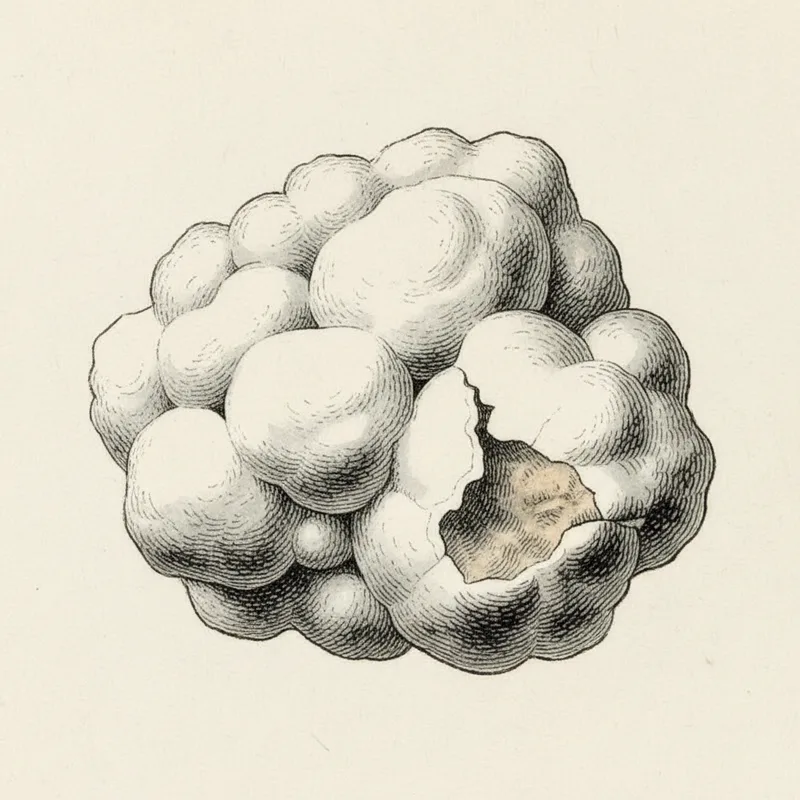
Magnesite
The Brain Stone
Affiliate links. We may earn a commission, at no cost to you.
Quick Facts
Formation & Origin
Magnesite is the magnesium carbonate, forming through two main processes. Crystalline magnesite forms in hydrothermal veins and metamorphic rocks where magnesium-rich solutions precipitate carbonate minerals. Massive, nodular magnesite (the 'brain stone' form) typically forms through the weathering of serpentinite and other magnesium-rich rocks.
The brain-like nodular form is the most recognizable variety. These rounded, cauliflower-textured masses have brown veining patterns from iron oxide infiltration that create a remarkably brain-like appearance. This massive form is the material most commonly sold in the crystal market.
Magnesite is an important industrial mineral, used as a refractory material in steelmaking and as a source of magnesium oxide. The gem and crystal market represents a tiny fraction of total production.
Identification Guide
Massive magnesite is identified by its white, porcelain-like appearance with brown veining and brain-like surface texture. It's softer than howlite (which it closely resembles) and effervesces in warm hydrochloric acid (slowly in cold acid).
Distinguish from howlite (similar appearance, howlite is a borosilicate not a carbonate), white turquoise (marketing name for howlite or magnesite), and dolomite (harder to distinguish without acid test). Magnesite's effervescence in acid separates it from howlite.
Spotting Fakes
Magnesite is commonly dyed to imitate turquoise, lapis lazuli, and other blue stones. The veining pattern absorbs dye differently than the main mineral, creating patterns that mimic turquoise matrix. Natural magnesite is white to cream with brown veining. Any blue, green, or vivid colored 'magnesite' has been dyed. Also, magnesite itself is sometimes sold as howlite or vice versa, as the two are very difficult to distinguish without testing.
Some links in this post go to Amazon and Etsy. Crystal Almanac earns a commission from qualifying purchases at no extra cost to you. Tools recommended here are ones we would use ourselves to run the tests described - the recommendation comes first, the link is downstream of it.
Cultural & Metaphysical Traditions
Presented as cultural traditions, not scientific evidence
Magnesite is associated with calming, mental clarity, and accessing deeper states of meditation. The brain-like appearance has reinforced associations with intellectual development and creative visualization. Practitioners use it for quieting an overactive mind and developing psychic vision. Its calming properties are sometimes compared to lepidolite.
Metaphysical and “healing” associations are cultural traditions, not medical advice or scientific fact. Crystals are not a substitute for professional medical care.
Where It's Found
Large nodular specimens with brain-like texture
Classic crystallized specimens
Commercial massive material
Significant deposits
Price Guide
Good to Know
Scratch test: At hardness 4, Magnesite can be scratched with a copper coin. Handle gently and keep away from harder stones in your collection.
Global supply: Found in 4 notable locations worldwide, from Brazil to Australia.
Heft test: Magnesite has average mineral density (3.0-3.12). It feels about as heavy as you'd expect from a stone its size.
Common Questions
What is the chemical formula of Magnesite?
The chemical formula of Magnesite is MgCO₃.
What is Magnesite's Mohs hardness?
Magnesite has a Mohs hardness of 4 on the 1 to 10 Mohs scale, which a steel knife will scratch.
Is Magnesite a mineral?
Yes. Magnesite is a naturally occurring mineral (Carbonate Mineral) with a definite chemical composition and an ordered crystal structure.
Care & Safety
The water, salt, and sunlight questions people actually ask before cleansing or displaying magnesite, answered from its hardness (Mohs 4) and chemistry (MgCO₃).
Can Magnesite go in water?
Only briefly. A quick rinse under running water is fine for magnesite, but do not let it soak or sit submerged. At Mohs 4 it is tough enough for a rinse but not for a long soak. Dry it thoroughly afterward.
Can Magnesite go in salt water?
No. Magnesite can take a brief fresh-water rinse and nothing more, and salt water is harder on it both ways: corrosive while wet, then abrasive as the salt dries into crystals. If it does meet salt water, rinse it with fresh water and dry it promptly.
Sources & References
The mineralogical and gemological data on this page is drawn from and can be cross-checked against these external references.
- WikipediaMagnesite on Wikipedia
- WebmineralMagnesite mineral data (Webmineral)
- Handbook of MineralogyMagnesite (Handbook of Mineralogy, PDF)
Explore More
Carbonate Minerals
Is My Turquoise Real? Spot Howlite and Plastic Fakes
Best Crystals to Carry While Traveling for Protection
Turquoise vs Chrysocolla: The Copper Mineral Mix-Up
Mohs Hardness Scale
See where Magnesite sits on the scale
Crystal Care Guide
Water safety, sunlight, and handling tips
Save This Stone

Keep this magnesite reference handy. Save the card to a Pinterest board and the profile is one tap away.
Save to PinterestNewsletter
Something shiny, now and then
A stone worth knowing, or a fake worth spotting, every so often. No spam.