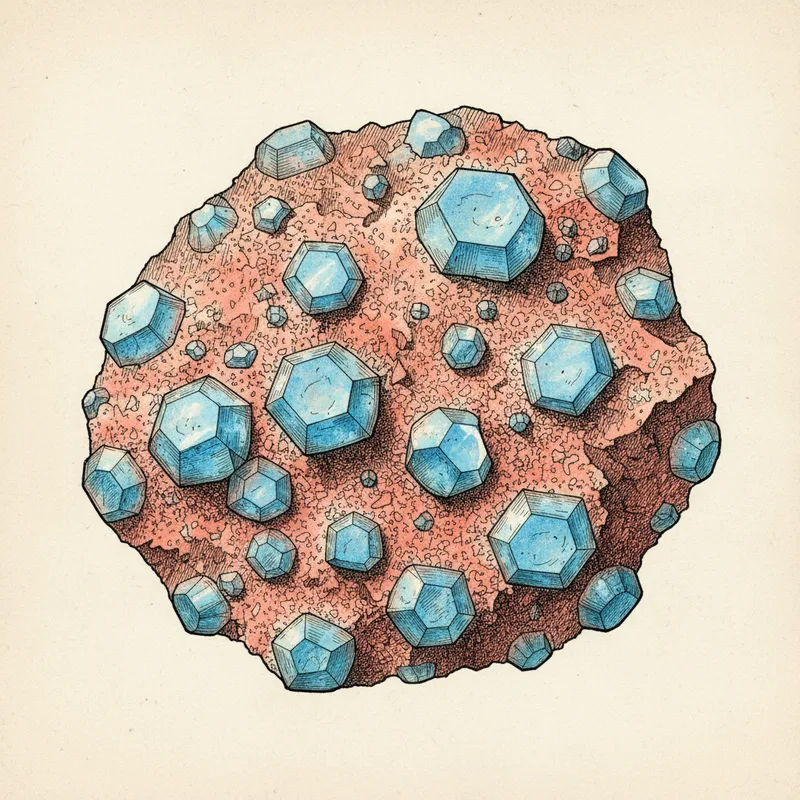
Llanite
Blue-quartz rhyolite, Llano Uplift
Affiliate links. We may earn a commission, at no cost to you.
Quick Facts
Formation & Origin
Llanite is a rhyolite porphyry, an extrusive to shallow intrusive igneous rock with two very different crystal populations in the same sample. It formed around 1.1 billion years ago during the Mesoproterozoic, when silica-rich magma intruded shallow crust in what is now the Llano Uplift of central Texas. The rock records a two-stage cooling history. At depth and under slow cooling, large phenocrysts of blue quartz and pink microcline feldspar grew to visible size. The remaining magma then rose into shallower crust, where it cooled rapidly and froze into a fine-grained matrix of quartz, microcline, and minor biotite and iron oxides that surrounds the larger crystals.
The blue quartz is the feature that makes llanite unusual. Its color is not produced by a trace chromophore such as iron or titanium. Instead, submicroscopic inclusions of ilmenite scatter short-wavelength light preferentially, producing a steely blue by Tyndall scattering. Blue quartz itself occurs in a handful of Proterozoic terranes around the world, but rhyolite porphyries carrying blue quartz as abundant hexagonal phenocrysts are rare, with only about twenty known localities globally. The pink color of the microcline matrix comes from trace lead and iron in the feldspar structure, similar in mechanism to amazonite although typically less saturated.
Llanite is quarried commercially near Llano, Texas for cut slabs, spheres, and lapidary material. Its appeal is almost entirely visual and geological rather than gemological. Collectors prize it as a textbook example of a porphyritic texture and as a rare window into Precambrian silicic volcanism in North America.
Identification Guide
Llanite is unmistakable once seen. It shows rounded to sharply hexagonal blue quartz phenocrysts, typically 1 to 5 millimeters across, set in a fine pink to salmon matrix dominated by microcline feldspar. Smaller gray or clear quartz grains appear in the matrix as well. The blue phenocrysts often display clear hexagonal cross sections when the slab cuts perpendicular to the crystal's c-axis, a signature that rules out most imitations.
As an aggregate, llanite's effective hardness is around 6.5, reflecting the mix of quartz at 7 and microcline at 6. Specific gravity sits close to granite and standard rhyolite at about 2.65. There is no cleavage at the rock scale, though individual microcline grains may show cleavage surfaces when broken. A hand lens reveals the sharp boundary between the glassy blue quartz phenocrysts and the finer pink groundmass, a feature diagnostic of porphyritic texture.
Spotting Fakes
Outright fakes are uncommon because llanite is affordable enough that synthesis is not economical. The most frequent confusion is with other porphyritic rocks that also carry colored phenocrysts. Unakite, for instance, combines pink feldspar with green epidote rather than blue quartz and has no hexagonal outlines in the colored grains. Some Scandinavian rhomb porphyries show pink feldspar phenocrysts in a dark matrix and are sometimes mislabeled.
Look for true hexagonal cross sections of the blue grains, a matrix that is pink rather than dark gray or green, and the consistent small size range of the phenocrysts. If the blue inclusions are round, irregular, or obviously dyed, the piece is not genuine llanite. Provenance is also a reasonable check, since the Llano County quarries are the dominant source and reputable dealers will cite them.
Some links in this post go to Amazon and Etsy. Crystal Almanac earns a commission from qualifying purchases at no extra cost to you. Tools recommended here are ones we would use ourselves to run the tests described - the recommendation comes first, the link is downstream of it.
Cultural & Metaphysical Traditions
Presented as cultural traditions, not scientific evidence
Llanite has no deep traditional lore, since it was only described and marketed in the 20th century. Modern Texas-based crystal practitioners have associated it with grounded communication, long-term thinking, and a sense of deep time, drawing on its roughly 1.1 billion year age as a symbolic anchor. These associations are contemporary rather than historical.
Metaphysical and “healing” associations are cultural traditions, not medical advice or scientific fact. Crystals are not a substitute for professional medical care.
Where It's Found
Type locality and primary world source, quarried from the Llano Uplift
Related exposures within the same Precambrian rhyolite province
Price Guide
Good to Know
Scratch test: At hardness 6.5, Llanite resists scratching from a knife but can be scratched by quartz. Best for pendants and earrings rather than rings.
Global supply: Found in 2 notable locations worldwide, from United States to United States.
Heft test: Llanite has average mineral density (2.65). It feels about as heavy as you'd expect from a stone its size.
Common Questions
What is the chemical formula of Llanite?
The chemical formula of Llanite is Variable (rhyolite).
What is Llanite's Mohs hardness?
Llanite has a Mohs hardness of 6.5 on the 1 to 10 Mohs scale, hard enough to scratch glass but softer than quartz.
Is Llanite a mineral?
Not quite. Llanite is a rock (a naturally occurring mixture of minerals), not a single mineral species.
Care & Safety
The water, salt, and sunlight questions people actually ask before cleansing or displaying llanite, answered from its hardness (Mohs 6.5) and chemistry (Variable (rhyolite)).
Can Llanite go in water?
Yes. Llanite is not water-soluble and durable enough (Mohs 6.5), so a rinse or a quick wash with mild soap is no problem, cleanse it in water freely if that is your practice. A long soak does nothing for it either way, so skip that, and dry the stone afterward.
Can Llanite go in salt water?
Not recommended, even though llanite itself is hard and not water-soluble. Salt is both corrosive and mildly abrasive: it can dull a polished surface, attack metal settings, and crystallize inside small fractures as the stone dries. A quick dip will not destroy llanite, but rinse it with fresh water afterward and dry it. For routine cleaning, plain water is the kinder choice.
Sources & References
The mineralogical and gemological data on this page is drawn from and can be cross-checked against these external references.
- WikipediaLlanite on Wikipedia
Related Minerals
Pink feldspar forming the fine matrix of llanite
Diagnostic phenocryst, colored by Tyndall scattering from ilmenite
Other pink and colored porphyritic rock, uses epidote instead of blue quartz
Parent rock type, llanite is a specific blue-quartz-bearing variety
Explore More
Save This Stone

Keep this llanite reference handy. Save the card to a Pinterest board and the profile is one tap away.
Save to PinterestNewsletter
Something shiny, now and then
A stone worth knowing, or a fake worth spotting, every so often. No spam.