Unakite
The Stone of Vision
Affiliate links. We may earn a commission, at no cost to you.
Quick Facts
Formation & Origin
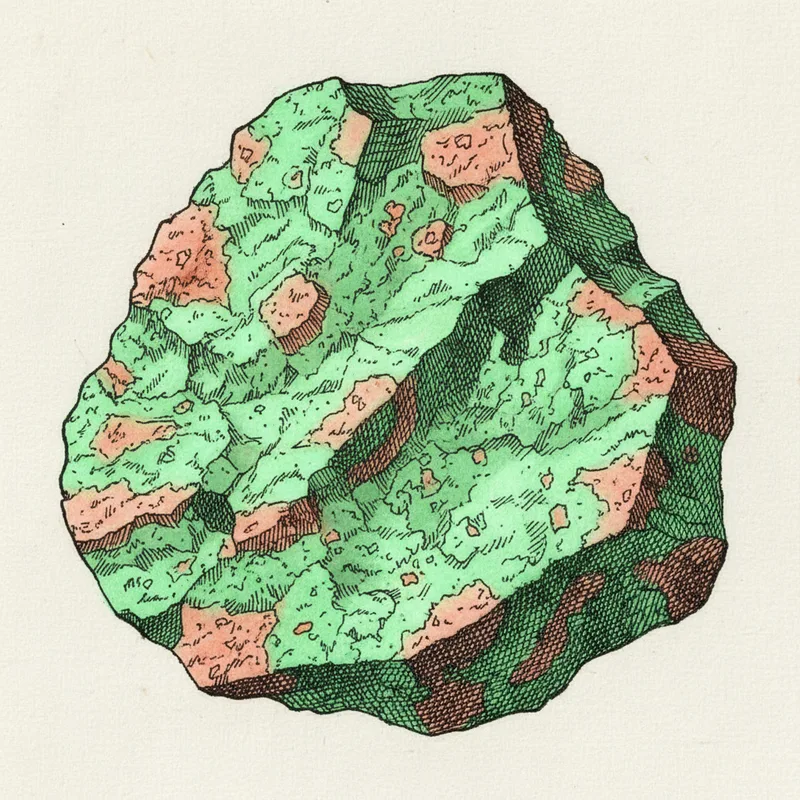
Unakite is not a single mineral - it's an altered granite composed of three main components: green epidote, pink orthoclase feldspar, and clear to milky quartz. It forms when granite undergoes hydrothermal alteration - hot, mineral-rich fluids circulate through the granite, transforming some of the original minerals into epidote while leaving the feldspar and quartz largely intact.
The result is a mottled green-and-pink stone that's technically a metamorphic rock rather than a mineral. The green patches are epidote (a calcium aluminum iron silicate), the pink patches are orthoclase feldspar, and the grayish areas are quartz.
Unakite is named after the Unaka Mountains on the Tennessee-North Carolina border, where it was first described. It's abundant, durable (hardness 6-7 depending on the specific mineral being tested), and takes a good polish, making it popular for both collecting and jewelry.
Identification Guide
Unakite is one of the easiest rocks to identify - the mottled combination of pistachio green and salmon pink is unique and unmistakable. No other common rock shows this specific color combination.
The green patches will be slightly harder and glassier (epidote, hardness 6-7) than the pink patches (feldspar, hardness 6). Quartz areas (hardness 7) may also be visible as gray or translucent patches. Distinguish from rhodonite (uniform pink with black veining, no green) and ruby in zoisite (vivid red and deeper green, contains actual ruby crystals).
Spotting Fakes
Unakite is so abundant and inexpensive that faking would be pointless. The only potential confusion is with other green-and-pink rocks, but unakite's specific color combination (pistachio green + salmon pink) is diagnostic. Some very low-quality material may lack strong color contrast and look muddy - this isn't fake, just poor-grade unakite.
Some links in this post go to Amazon and Etsy. Crystal Almanac earns a commission from qualifying purchases at no extra cost to you. Tools recommended here are ones we would use ourselves to run the tests described - the recommendation comes first, the link is downstream of it.
Cultural & Metaphysical Traditions
Presented as cultural traditions, not scientific evidence
Unakite has no ancient traditions (it wasn't described as a distinct material until relatively recently). Modern crystal practitioners associate it with emotional balance - the green representing growth and the pink representing love. It's commonly used in fertility-related crystal work and is considered a grounding stone for emotional healing. Its dual-color nature makes it a popular choice for practitioners working with heart-mind integration.
Metaphysical and “healing” associations are cultural traditions, not medical advice or scientific fact. Crystals are not a substitute for professional medical care.
Where It's Found
Type locality, named for these mountains
Good commercial-grade material
Major producer of tumbled and carved unakite
Available in commercial quantities
Price Guide
Good to Know
Scratch test: At hardness 6.5, Unakite resists scratching from a knife but can be scratched by quartz. Best for pendants and earrings rather than rings.
Global supply: Found in 4 notable locations worldwide, from United States to Brazil.
Heft test: Unakite has average mineral density (2.85-3.20). It feels about as heavy as you'd expect from a stone its size.
Common Questions
What is the chemical formula of Unakite?
The chemical formula of Unakite is Variable (epidote + feldspar + quartz).
What is Unakite's Mohs hardness?
Unakite has a Mohs hardness of 6.5 on the 1 to 10 Mohs scale, hard enough to scratch glass but softer than quartz.
Is Unakite a mineral?
Not quite. Unakite is a rock (a naturally occurring mixture of minerals), not a single mineral species.
Care & Safety
The water, salt, and sunlight questions people actually ask before cleansing or displaying unakite, answered from its hardness (Mohs 6.5) and chemistry (Variable (epidote + feldspar + quartz)).
Can Unakite go in water?
Yes. Unakite is not water-soluble and durable enough (Mohs 6.5), so a rinse or a quick wash with mild soap is no problem, cleanse it in water freely if that is your practice. A long soak does nothing for it either way, so skip that, and dry the stone afterward.
Can Unakite go in salt water?
Not recommended, even though unakite itself is hard and not water-soluble. Salt is both corrosive and mildly abrasive: it can dull a polished surface, attack metal settings, and crystallize inside small fractures as the stone dries. A quick dip will not destroy unakite, but rinse it with fresh water afterward and dry it. For routine cleaning, plain water is the kinder choice.
Sources & References
The mineralogical and gemological data on this page is drawn from and can be cross-checked against these external references.
- WikipediaUnakite on Wikipedia
Explore More
Rocks & Multi-Mineral Composites
The Love Collection
Green epidote + pink feldspar. Used in fertility-related traditions and for balancing giving and receiving in relationships.
Best Crystals for Pregnancy and New Motherhood
Mohs Hardness Scale
See where Unakite sits on the scale
Crystal Care Guide
Water safety, sunlight, and handling tips
Save This Stone

Keep this unakite reference handy. Save the card to a Pinterest board and the profile is one tap away.
Save to PinterestNewsletter
Something shiny, now and then
A stone worth knowing, or a fake worth spotting, every so often. No spam.