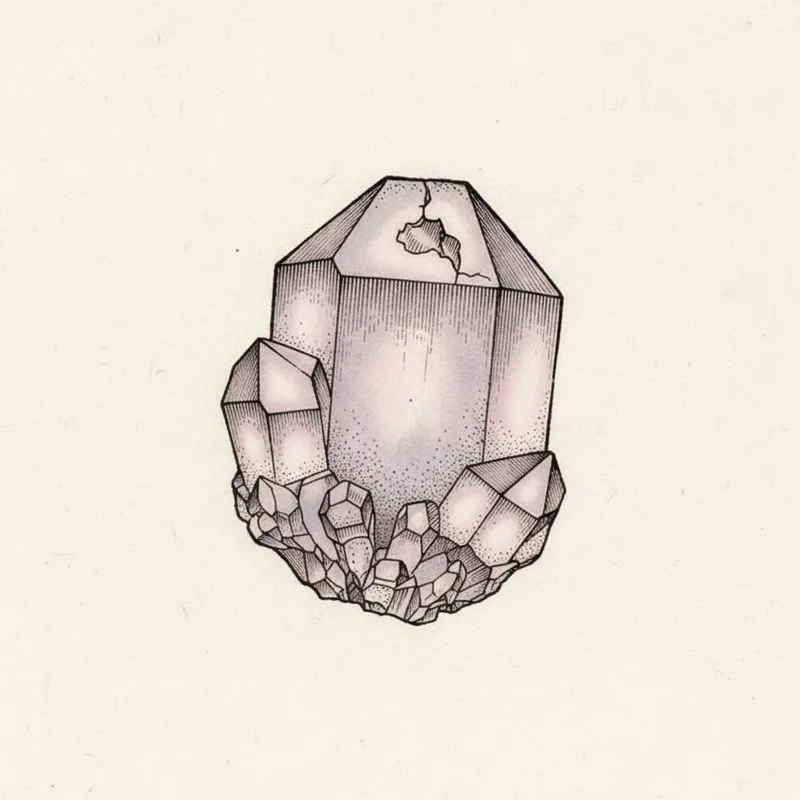
Lithium Quartz
The Balancing Crystal
Affiliate links. We may earn a commission, at no cost to you.
Quick Facts
Formation & Origin
Lithium quartz is clear to milky quartz that contains inclusions of lithium-bearing minerals, primarily lepidolite (lithium mica) and/or lithium-bearing tourmaline. These inclusions give the crystal a distinctive mauve, pink, or lavender hue that permeates the interior.
The lithium minerals formed alongside the quartz in lithium-rich pegmatite environments. As the quartz crystals grew, they trapped tiny particles of lepidolite or lithium tourmaline within their structure. The amount and distribution of these inclusions determines the intensity of the pink-purple color.
Brazil's Minas Gerais region, particularly around Araçuaí, is the primary source. The same pegmatite systems that produce lepidolite, kunzite, and tourmaline also create the lithium-rich environment needed for lithium quartz to form.
Identification Guide
Lithium quartz is identified as a quartz crystal with a pervasive mauve, lavender, or pink-purple coloration caused by visible lithium mineral inclusions. Under magnification, you can often see tiny flakes or needles of lepidolite or tourmaline distributed through the crystal.
Distinguish from amethyst (color from iron, not inclusions), rose quartz (pink from dumortierite fibers, different mechanism), and spirit quartz (druzy coating rather than internal inclusions). The visible lithium mineral inclusions within a quartz matrix are the key identifier.
Spotting Fakes
Some sellers label any pale purple quartz as 'lithium quartz.' Genuine lithium quartz should show visible mineral inclusions (often appearing as tiny mauve flecks or wisps) within the crystal rather than uniform coloration. If the crystal looks like clean amethyst with no visible inclusions, it's probably amethyst, not lithium quartz. The color should have a distinctly mauve or lavender tone rather than the violet of amethyst.
Some links in this post go to Amazon and Etsy. Crystal Almanac earns a commission from qualifying purchases at no extra cost to you. Tools recommended here are ones we would use ourselves to run the tests described - the recommendation comes first, the link is downstream of it.
Cultural & Metaphysical Traditions
Presented as cultural traditions, not scientific evidence
Lithium quartz is one of the most popular calming stones in crystal healing, prized for emotional balance and stress relief. The lithium content connects it to themes of mood stability (lithium is used in psychiatric medication, though the mineral form isn't bioavailable through handling). Practitioners use it for meditation, anxiety relief, and releasing deep emotional patterns.
Metaphysical and “healing” associations are cultural traditions, not medical advice or scientific fact. Crystals are not a substitute for professional medical care.
Where It's Found
Primary source, fine mauve-pink crystals
Some specimens available
Price Guide
Good to Know
Scratch test: At hardness 7, Lithium Quartz can scratch glass and steel. It's durable enough for any type of jewelry.
Global supply: Found in 2 notable locations worldwide, from Brazil to Madagascar.
Heft test: Lithium Quartz has average mineral density (2.65). It feels about as heavy as you'd expect from a stone its size.
Common Questions
What is the chemical formula of Lithium Quartz?
The chemical formula of Lithium Quartz is SiO₂ (with lithium-bearing inclusions).
What is Lithium Quartz's Mohs hardness?
Lithium Quartz has a Mohs hardness of 7 on the 1 to 10 Mohs scale, hard enough to scratch glass and stand up to daily wear.
Is Lithium Quartz a mineral?
Yes. Lithium Quartz is a naturally occurring mineral (Quartz Family) with a definite chemical composition and an ordered crystal structure.
Care & Safety
The water, salt, and sunlight questions people actually ask before cleansing or displaying lithium quartz, answered from its hardness (Mohs 7) and chemistry (SiO₂ (with lithium-bearing inclusions)).
Can Lithium Quartz go in water?
Yes. Lithium Quartz is hard (Mohs 7) and chemically stable, so a rinse or a quick wash with mild soap is no problem, cleanse it in water freely if that is your practice. A long soak does nothing for it either way, so skip that, and dry the stone afterward.
Can Lithium Quartz go in salt water?
Not recommended, even though lithium quartz itself is hard and not water-soluble. Salt is both corrosive and mildly abrasive: it can dull a polished surface, attack metal settings, and crystallize inside small fractures as the stone dries. A quick dip will not destroy lithium quartz, but rinse it with fresh water afterward and dry it. For routine cleaning, plain water is the kinder choice.
Sources & References
The mineralogical and gemological data on this page is drawn from and can be cross-checked against these external references.
- WikipediaQuartz on Wikipedia
- WebmineralQuartz mineral data (Webmineral)
- Handbook of MineralogyQuartz (Handbook of Mineralogy, PDF)
Explore More
Quartz & Chalcedony
The Calming Collection
Contains visible lithium mica inclusions. The lithium connection and soft mauve color make it one of the most popular calming stones for emotional balance and stress relief.
Mohs Hardness Scale
See where Lithium Quartz sits on the scale
Crystal Care Guide
Water safety, sunlight, and handling tips
Save This Stone

Keep this lithium quartz reference handy. Save the card to a Pinterest board and the profile is one tap away.
Save to PinterestNewsletter
Something shiny, now and then
A stone worth knowing, or a fake worth spotting, every so often. No spam.