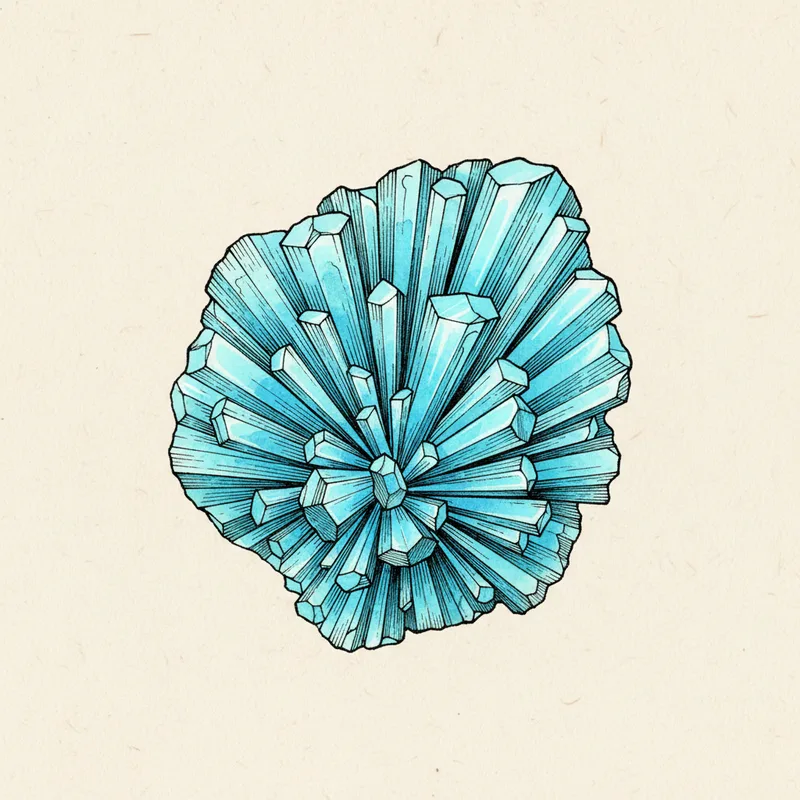
Hemimorphite
The Light Blue Fan
Affiliate links. We may earn a commission, at no cost to you.
Quick Facts
Formation & Origin
Hemimorphite is a zinc sorosilicate that forms in the oxidized zone of zinc ore deposits. Its name comes from 'hemi' (half) and 'morphe' (shape) - each crystal is terminated differently at each end, a property called hemimorphism. One end shows a sharp pyramidal point while the other is flat and pedion-like.
The most popular hemimorphite specimens in today's market are the sky-blue botryoidal (bubbly) crusts from China. These formed when zinc-rich solutions deposited hemimorphite as rounded, grape-like surfaces in cavities, creating stunning displays of vivid blue that resemble a miniature frozen ocean.
Hemimorphite is also pyroelectric and piezoelectric - it generates electrical charge when heated or compressed. This property was known long before it was scientifically explained and contributed to hemimorphite's reputation as an energetically active mineral.
Identification Guide
Hemimorphite is identified by its sky-blue color (in the botryoidal variety), hemimorphic crystal habit (different terminations on each end), and zinc-deposit associations. At hardness 5, it can be scratched with a knife.
Distinguish from chrysocolla (similar blue-green, softer, amorphous), smithsonite (zinc carbonate, different crystal forms), and turquoise (harder, different structure). Blue botryoidal hemimorphite's vivid color and bubbly texture are distinctive.
Spotting Fakes
Chinese blue hemimorphite is abundant and affordable in its common forms. Some specimens are enhanced with dye to intensify the blue. Natural hemimorphite ranges from pale to medium blue - anything vivid or saturated should be examined skeptically. Genuine botryoidal hemimorphite has a natural, slightly uneven texture with crystalline surfaces visible under magnification.
Some links in this post go to Amazon and Etsy. Crystal Almanac earns a commission from qualifying purchases at no extra cost to you. Tools recommended here are ones we would use ourselves to run the tests described - the recommendation comes first, the link is downstream of it.
Cultural & Metaphysical Traditions
Presented as cultural traditions, not scientific evidence
Hemimorphite's pyroelectric properties gave it a reputation as an energetically active stone before modern mineralogy explained the phenomenon. Modern practitioners associate it with communication, emotional expression, and self-development. The sky-blue color connects it to throat chakra work. Its hemimorphic nature - different at each end - is interpreted as representing the balance between physical and spiritual growth.
Metaphysical and “healing” associations are cultural traditions, not medical advice or scientific fact. Crystals are not a substitute for professional medical care.
Where It's Found
Stunning sky-blue botryoidal specimens
Fine crystalline specimens
Blue botryoidal material
Classic American localities
Price Guide
Good to Know
Scratch test: At hardness 5, Hemimorphite resists scratching from a knife but can be scratched by quartz. Best for pendants and earrings rather than rings.
Global supply: Found in 4 notable locations worldwide, from China to United States.
Heft test: Hemimorphite has average mineral density (3.45). It feels about as heavy as you'd expect from a stone its size.
Common Questions
What is the chemical formula of Hemimorphite?
The chemical formula of Hemimorphite is Zn₄Si₂O₇(OH)₂·H₂O.
What is Hemimorphite's Mohs hardness?
Hemimorphite has a Mohs hardness of 5 on the 1 to 10 Mohs scale, which a steel knife will scratch.
Is Hemimorphite a mineral?
Yes. Hemimorphite is a naturally occurring mineral (Sorosilicate Group) with a definite chemical composition and an ordered crystal structure.
Care & Safety
The water, salt, and sunlight questions people actually ask before cleansing or displaying hemimorphite, answered from its hardness (Mohs 5) and chemistry (Zn₄Si₂O₇(OH)₂·H₂O).
Can Hemimorphite go in water?
Only briefly. A quick rinse under running water is fine for hemimorphite, but do not let it soak or sit submerged. At Mohs 5 it is tough enough for a rinse but not for a long soak. Dry it thoroughly afterward.
Can Hemimorphite go in salt water?
No. Hemimorphite can take a brief fresh-water rinse and nothing more, and salt water is harder on it both ways: corrosive while wet, then abrasive as the salt dries into crystals. If it does meet salt water, rinse it with fresh water and dry it promptly.
Sources & References
The mineralogical and gemological data on this page is drawn from and can be cross-checked against these external references.
- WikipediaHemimorphite on Wikipedia
- WebmineralHemimorphite mineral data (Webmineral)
- Handbook of MineralogyHemimorphite (Handbook of Mineralogy, PDF)
Explore More
Save This Stone

Keep this hemimorphite reference handy. Save the card to a Pinterest board and the profile is one tap away.
Save to PinterestNewsletter
Something shiny, now and then
A stone worth knowing, or a fake worth spotting, every so often. No spam.