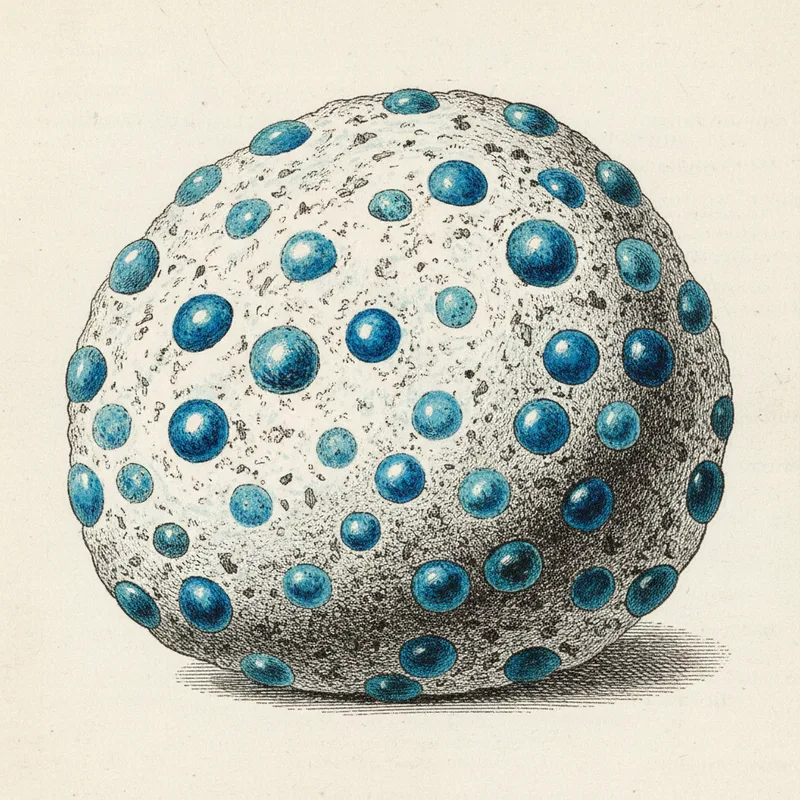
K2 Stone
The Mountain Stone
Affiliate links. We may earn a commission, at no cost to you.
Quick Facts
Formation & Origin
K2 stone is white granite containing vivid blue azurite spheres - found at the base of K2, the world's second-highest mountain, in the Karakorum Range of northern Pakistan. The granite formed as a plutonic intrusion, and the azurite spots developed later when copper-bearing hydrothermal fluids infiltrated the granite along micro-fractures, depositing copper carbonate in spherical concentrations.
The combination is geologically unusual - azurite in granite is rare because the chemical environments that produce each are quite different. The specific conditions at K2's base (copper-rich fluids from nearby ore deposits meeting the granite) created this unique material.
The extreme altitude and remoteness of the source area (the Karakorum Range includes some of the most rugged terrain on Earth) limits supply. Collection requires arduous overland travel in one of the world's most dangerous mountain regions. This genuine difficulty of access, combined with the stone's striking appearance, has made K2 stone highly sought after in the crystal market.
Identification Guide
K2 stone is identified by its white to pale gray granite matrix containing spherical blue azurite spots ranging from a few millimeters to about 2 centimeters in diameter. The contrast between white granite and vivid blue dots is distinctive.
Distinguish from sodalite in matrix (sodalite is typically in nepheline syenite, not granite), lapis lazuli (different blue mineral, different host rock), and painted granite (blue spots in genuine K2 stone have depth and internal crystal structure visible under magnification). The azurite spots should fizz slightly in dilute acid, confirming carbonate composition.
Spotting Fakes
K2 stone's popularity has led to imitations. The most common fake is white granite with painted blue dots - the paint sits on the surface rather than extending into the stone. Genuine K2 stone's azurite spots have depth and a slightly uneven, natural distribution. Under magnification, genuine azurite shows crystal structure. Some sellers have also marketed blue-spotted feldspar from other localities as 'K2 stone' - the genuine article comes only from Pakistan's Karakorum Range.
Some links in this post go to Amazon and Etsy. Crystal Almanac earns a commission from qualifying purchases at no extra cost to you. Tools recommended here are ones we would use ourselves to run the tests described - the recommendation comes first, the link is downstream of it.
Cultural & Metaphysical Traditions
Presented as cultural traditions, not scientific evidence
K2 stone entered the crystal market around 2014 and has no ancient traditions. Its association with K2 - known as the 'Savage Mountain' for its extreme climbing difficulty - has given it metaphysical associations with overcoming seemingly impossible challenges, reaching new heights, and spiritual ascension. Modern practitioners combine the grounding energy attributed to granite with the intuitive energy attributed to azurite. The rarity and extreme source location add to its perceived power.
Metaphysical and “healing” associations are cultural traditions, not medical advice or scientific fact. Crystals are not a substitute for professional medical care.
Where It's Found
The only known source, extreme altitude
Price Guide
Good to Know
Scratch test: At hardness 6, K2 Stone resists scratching from a knife but can be scratched by quartz. Best for pendants and earrings rather than rings.
Global supply: Found at only one location on Earth - Pakistan. Supply is inherently limited.
Heft test: K2 Stone has average mineral density (2.70). It feels about as heavy as you'd expect from a stone its size.
Common Questions
What is the chemical formula of K2 Stone?
The chemical formula of K2 Stone is Variable (granite + Cu₃(CO₃)₂(OH)₂ azurite).
What is K2 Stone's Mohs hardness?
K2 Stone has a Mohs hardness of 6 on the 1 to 10 Mohs scale, hard enough to scratch glass but softer than quartz.
Is K2 Stone a mineral?
Not quite. K2 Stone is a rock (a naturally occurring mixture of minerals), not a single mineral species.
Care & Safety
The water, salt, and sunlight questions people actually ask before cleansing or displaying k2 stone, answered from its hardness (Mohs 6) and chemistry (Variable (granite + Cu₃(CO₃)₂(OH)₂ azurite)).
Can K2 Stone go in water?
Not recommended. K2 Stone can react with water, draw in moisture, or break down when it gets wet, so skip the rinse. Wipe it with a dry or barely damp cloth and dry it right away.
Can K2 Stone go in salt water?
No. K2 Stone is best kept away from water altogether, and salt water is the harsher version of that problem: the dissolved salt is corrosive while the stone is wet, then leaves gritty crystals behind in cracks and crevices as it dries. Salt also accelerates corrosion of copper-bearing minerals like k2 stone.
Sources & References
The mineralogical and gemological data on this page is drawn from and can be cross-checked against these external references.
- WikipediaGranite on Wikipedia
Explore More
Save This Stone

Keep this k2 stone reference handy. Save the card to a Pinterest board and the profile is one tap away.
Save to PinterestNewsletter
Something shiny, now and then
A stone worth knowing, or a fake worth spotting, every so often. No spam.