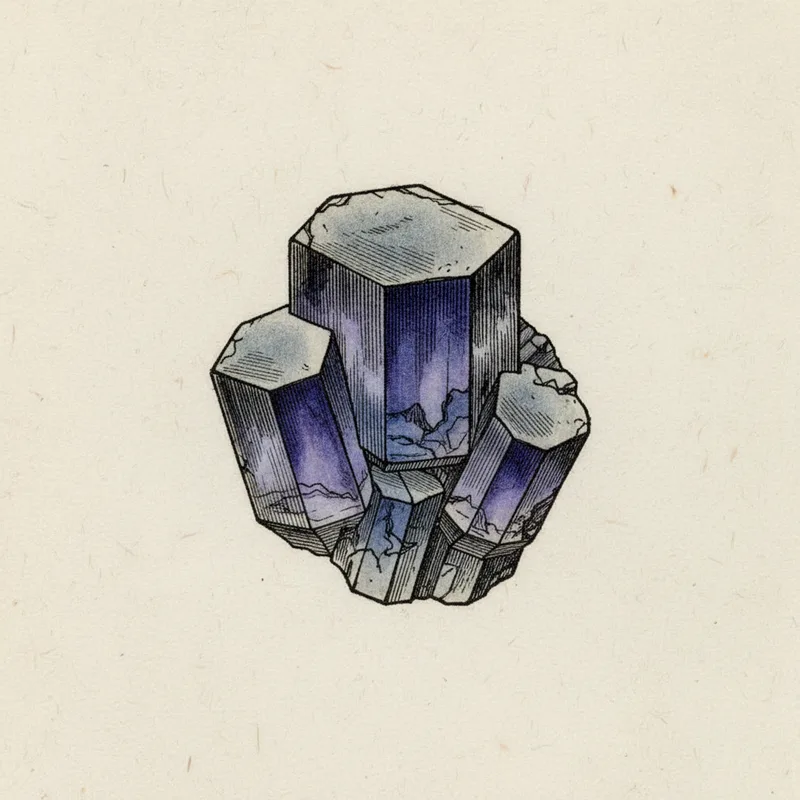
Iolite
The Viking Compass
Affiliate links. We may earn a commission, at no cost to you.
Quick Facts
Formation & Origin
Iolite is the gem variety of cordierite, an aluminum magnesium silicate that forms during metamorphism of aluminum-rich sedimentary rocks. It requires specific pressure and temperature conditions (moderate pressure, moderate-to-high temperature) and is commonly found in gneisses, schists, and hornfels.
Iolite's most remarkable property is its extreme pleochroism - it shows three distinctly different colors depending on the viewing direction: violet-blue, blue-gray, and pale yellow-clear. This trichroism is stronger than in virtually any other gemstone. It's so pronounced that gem cutters must orient the stone very precisely to show the best blue face-up.
The Viking compass legend suggests that Norse seafarers used iolite as a polarizing filter to locate the sun on overcast days, enabling navigation across the open Atlantic. While the historical evidence is debated (calcite may be the actual 'sunstone' referenced in the sagas), iolite does have polarization properties and the story has become inseparable from the gem's marketing.
Identification Guide
Iolite's dramatic pleochroism is its most diagnostic feature. Rotate the stone and watch it shift from violet-blue to pale yellow to gray-blue. No other common gem-quality blue stone shows this degree of color change with direction.
Distinguish from tanzanite (softer at 6.5, different pleochroism axis), blue sapphire (much harder at 9, different SG), and blue tourmaline (different crystal system, less extreme pleochroism). At hardness 7, iolite is durable but has some cleavage that requires care in setting.
Spotting Fakes
Iolite is affordable enough that synthetic production isn't commercially viable. The main risk is confusion with more expensive stones (iolite sold as sapphire or tanzanite) or cheaper substitutes sold as iolite. The trichroic test is definitive - rotating a genuine iolite reveals three distinct colors. Glass and synthetic sapphire lack this specific three-directional color change.
Some links in this post go to Amazon and Etsy. Crystal Almanac earns a commission from qualifying purchases at no extra cost to you. Tools recommended here are ones we would use ourselves to run the tests described - the recommendation comes first, the link is downstream of it.
Cultural & Metaphysical Traditions
Presented as cultural traditions, not scientific evidence
The Viking navigation legend dominates iolite's cultural narrative. Beyond that, iolite has been used since antiquity but was often confused with sapphire - the name 'iolite' (from Greek 'ios' meaning violet) is relatively recent. Leif Erikson supposedly used iolite to navigate to North America. Modern practitioners associate it with inner vision, self-discovery, and finding direction in life - themes that naturally extend from the Viking compass story.
Metaphysical and “healing” associations are cultural traditions, not medical advice or scientific fact. Crystals are not a substitute for professional medical care.
Where It's Found
Primary commercial source
Fine gem quality, alluvial deposits
Good quality material
Significant producer
Price Guide
Good to Know
Scratch test: At hardness 7, Iolite can scratch glass and steel. It's durable enough for any type of jewelry.
Global supply: Found in 4 notable locations worldwide, from India to Madagascar.
Heft test: Iolite has average mineral density (2.61). It feels about as heavy as you'd expect from a stone its size.
Common Questions
What is the chemical formula of Iolite?
The chemical formula of Iolite is Mg₂Al₄Si₅O₁₈.
What is Iolite's Mohs hardness?
Iolite has a Mohs hardness of 7 on the 1 to 10 Mohs scale, hard enough to scratch glass and stand up to daily wear.
Is Iolite a mineral?
Yes. Iolite is a naturally occurring mineral (Cordierite variety) with a definite chemical composition and an ordered crystal structure.
Care & Safety
The water, salt, and sunlight questions people actually ask before cleansing or displaying iolite, answered from its hardness (Mohs 7) and chemistry (Mg₂Al₄Si₅O₁₈).
Can Iolite go in water?
Yes. Iolite is hard (Mohs 7) and chemically stable, so a rinse or a quick wash with mild soap is no problem, cleanse it in water freely if that is your practice. A long soak does nothing for it either way, so skip that, and dry the stone afterward.
Can Iolite go in salt water?
Not recommended, even though iolite itself is hard and not water-soluble. Salt is both corrosive and mildly abrasive: it can dull a polished surface, attack metal settings, and crystallize inside small fractures as the stone dries. A quick dip will not destroy iolite, but rinse it with fresh water afterward and dry it. For routine cleaning, plain water is the kinder choice.
Sources & References
The mineralogical and gemological data on this page is drawn from and can be cross-checked against these external references.
- WikipediaCordierite on Wikipedia
- WebmineralCordierite mineral data (Webmineral)
- Handbook of MineralogyCordierite (Handbook of Mineralogy, PDF)
- GIAIolite in the GIA Gem Encyclopedia
Related Minerals
Similar blue-violet, different mineral
Historically confused, much harder
The parent mineral species of iolite
Another blue metamorphic mineral
Explore More
Other Silicates & Gems
The Manifestation Collection
The Viking compass stone. Norse navigators used iolite to find the sun through cloud cover. Associated with finding your true direction and navigating toward it.
Best Crystals for Men: A Grounded Introduction
Crystal Colors and Their Meanings: A Stone-by-Color Guide
Mohs Hardness Scale
See where Iolite sits on the scale
Crystal Care Guide
Water safety, sunlight, and handling tips
Save This Stone

Keep this iolite reference handy. Save the card to a Pinterest board and the profile is one tap away.
Save to PinterestNewsletter
Something shiny, now and then
A stone worth knowing, or a fake worth spotting, every so often. No spam.