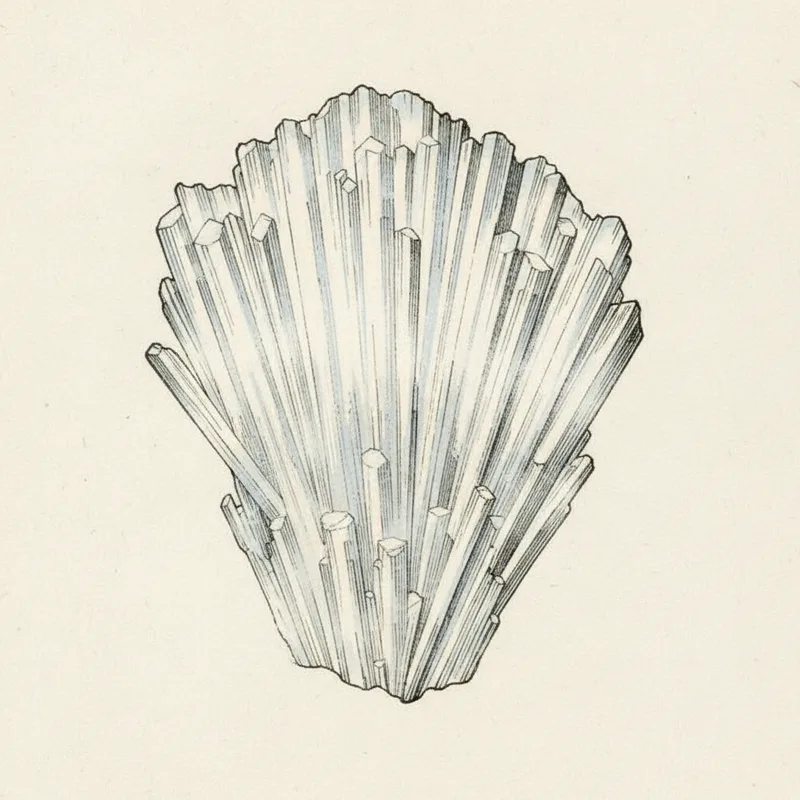
Ulexite
The Television Stone
Affiliate links. We may earn a commission, at no cost to you.
Quick Facts
Formation & Origin
Ulexite is a hydrated sodium calcium borate mineral (NaCaB₅O₆(OH)₆·5H₂O) whose fibrous crystals transmit images along their length, giving it the nickname television stone. Ulexite forms as an evaporite mineral in arid-region playa lakes and borate deposits. When boron-rich water evaporates in closed desert basins, a sequence of borate minerals precipitates out, with ulexite being one of the most common.
The remarkable 'television stone' property occurs in the fibrous variety. Ulexite can grow as parallel bundles of extremely fine fibers, each acting as a natural optical fiber. When a polished slab is placed on text or an image, internal reflection within each fiber transmits the image from the bottom surface to the top, projecting it onto the surface of the stone. This is the same principle used in modern fiber-optic communication.
The cotton-ball variety grows as round, fibrous aggregates that look exactly like tufts of cotton. These form at the surface of evaporating pools where boron-rich water slowly concentrates.
Identification Guide
The fiber-optic property is the definitive identification test. Place a polished ulexite slab on top of printed text. If the text appears projected onto the surface of the stone, it's ulexite. The cotton-ball variety is identified by its soft, white, fibrous aggregates.
Distinguish from gypsum (higher SG, different fiber structure), selenite (similar optical properties but different crystal system), and colemanite (harder, different crystal habit). Ulexite is soft enough to scratch with a fingernail.
Spotting Fakes
The television stone effect is difficult to fake convincingly. Fiber-optic glass could replicate it but would have a different feel and density. The main issue is quality variation rather than fakes. The best specimens project images clearly and sharply. Lower-quality pieces may produce blurry or incomplete image transfer. Cotton-ball ulexite is generally not faked.
Some links in this post go to Amazon and Etsy. Crystal Almanac earns a commission from qualifying purchases at no extra cost to you. Tools recommended here are ones we would use ourselves to run the tests described - the recommendation comes first, the link is downstream of it.
Cultural & Metaphysical Traditions
Presented as cultural traditions, not scientific evidence
Ulexite is associated with vision, clarity, and seeing through illusion in crystal healing traditions. Its natural fiber-optic properties make it a natural symbol for insight and perception. Practitioners use it for meditation focused on gaining clarity on confusing situations and for enhancing creative visualization.
Metaphysical and “healing” associations are cultural traditions, not medical advice or scientific fact. Crystals are not a substitute for professional medical care.
Where It's Found
Major source from borate deposits
Evaporite deposits with borates
Large borate deposits
Andean borate deposits
Price Guide
Good to Know
Scratch test: At hardness 2.5, Ulexite can be scratched with a fingernail. This is a display specimen, not a wearable stone.
Global supply: Found in 4 notable locations worldwide, from United States to Argentina.
Heft test: With a specific gravity of 1.95, Ulexite feels lighter than most minerals. This lightness can help identify it.
Common Questions
What is the chemical formula of Ulexite?
The chemical formula of Ulexite is NaCaB₅O₆(OH)₆·5H₂O.
What is Ulexite's Mohs hardness?
Ulexite has a Mohs hardness of 2.5 on the 1 to 10 Mohs scale, soft enough to scratch with a fingernail.
Is Ulexite a mineral?
Yes. Ulexite is a naturally occurring mineral (Borate Mineral) with a definite chemical composition and an ordered crystal structure.
Care & Safety
The water, salt, and sunlight questions people actually ask before cleansing or displaying ulexite, answered from its hardness (Mohs 2.5) and chemistry (NaCaB₅O₆(OH)₆·5H₂O).
Can Ulexite go in water?
Not recommended. At Mohs 2.5, ulexite is soft enough that water can slowly dull, etch, or wear down the surface, so a water cleanse does more harm than good here. Reach for a dry cloth instead.
Can Ulexite go in salt water?
No. Ulexite is best kept away from water altogether, and salt water is the harsher version of that problem: the dissolved salt is corrosive while the stone is wet, then leaves gritty crystals behind in cracks and crevices as it dries.
Sources & References
The mineralogical and gemological data on this page is drawn from and can be cross-checked against these external references.
- WikipediaUlexite on Wikipedia
- WebmineralUlexite mineral data (Webmineral)
- Handbook of MineralogyUlexite (Handbook of Mineralogy, PDF)
Related Minerals
Fellow borate mineral from same deposits
Common borate mineral, household name
Similar fibrous habit and optical properties
Explore More
Save This Stone

Keep this ulexite reference handy. Save the card to a Pinterest board and the profile is one tap away.
Save to PinterestNewsletter
Something shiny, now and then
A stone worth knowing, or a fake worth spotting, every so often. No spam.