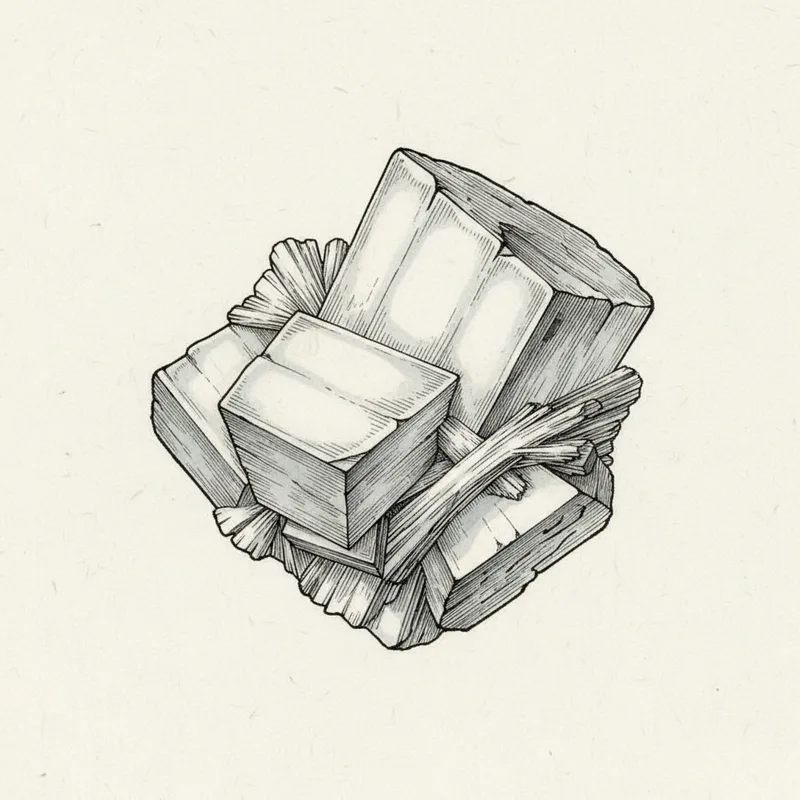
Gypsum
The Crystal Cave Builder
Affiliate links. We may earn a commission, at no cost to you.
Quick Facts
Formation & Origin
Gypsum is one of the most abundant minerals on Earth and defines position 2 on the Mohs hardness scale. It forms primarily through evaporation of saline water: as shallow seas, lakes, or lagoons dry up, dissolved calcium sulfate precipitates as gypsum.
The Naica Mine in Chihuahua, Mexico contains the most spectacular gypsum crystals ever found. The Cueva de los Cristales (Cave of Crystals) holds selenite (transparent gypsum) beams up to 12 meters (39 feet) long and weighing 55 tons. These grew over approximately 500,000 years in a cave filled with mineral-saturated water heated by volcanic activity below.
Gypsum occurs in several named varieties: selenite (transparent crystals), satin spar (fibrous, chatoyant), alabaster (massive, fine-grained, carvable), and desert rose (rosette-shaped clusters formed in sand). All are chemically identical calcium sulfate dihydrate.
Gypsum is the basis of plaster of Paris and modern drywall, making it one of the most commercially important minerals in construction.
Identification Guide
Gypsum is identified by its low hardness (Mohs 2, can be scratched with a fingernail but takes more effort than talc), perfect cleavage in one direction, and characteristic crystal forms. Selenite crystals are unmistakable: clear, flat, blade-like forms.
Distinguish from calcite (harder at 3, effervesces in acid), selenite the mineral vs. 'selenite' lamps (which may actually be halite), and talc (softer at 1, greasier feel).
Spotting Fakes
Gypsum itself is not faked, but 'selenite' products require attention. Some 'selenite' towers and lamps are actually orange halite (salt) or carved marble rather than true gypsum. Real selenite is relatively soft (scratchable with a fingernail), and dissolves slowly in water. If your 'selenite' lamp tastes salty, it's halite. Genuine selenite should not be cleansed with water as it will gradually dissolve.
Some links in this post go to Amazon and Etsy. Crystal Almanac earns a commission from qualifying purchases at no extra cost to you. Tools recommended here are ones we would use ourselves to run the tests described - the recommendation comes first, the link is downstream of it.
Cultural & Metaphysical Traditions
Presented as cultural traditions, not scientific evidence
Selenite (clear gypsum) is one of the most popular crystals in the metaphysical market, used for cleansing other crystals, clearing spaces, and connecting to higher guidance. The Naica crystal cave specimens are considered among the most energetically powerful mineral formations on Earth. Named after Selene, Greek goddess of the Moon.
Metaphysical and “healing” associations are cultural traditions, not medical advice or scientific fact. Crystals are not a substitute for professional medical care.
Where It's Found
Crystal Cave with 12-meter gypsum crystals, the largest on Earth
One of the most common minerals
Fine crystal specimens
White gypsum dune field, 275 sq miles
Price Guide
Good to Know
Scratch test: At hardness 2, Gypsum can be scratched with a fingernail. This is a display specimen, not a wearable stone.
Global supply: Found in 4 notable locations worldwide, from Mexico to United States.
Heft test: With a specific gravity of 2.32, Gypsum feels lighter than most minerals. This lightness can help identify it.
Common Questions
What is the chemical formula of Gypsum?
The chemical formula of Gypsum is CaSO₄·2H₂O.
What is Gypsum's Mohs hardness?
Gypsum has a Mohs hardness of 2 on the 1 to 10 Mohs scale, soft enough to scratch with a fingernail.
Is Gypsum a mineral?
Yes. Gypsum is a naturally occurring mineral (Sulfate Mineral) with a definite chemical composition and an ordered crystal structure.
Care & Safety
The water, salt, and sunlight questions people actually ask before cleansing or displaying gypsum, answered from its hardness (Mohs 2) and chemistry (CaSO₄·2H₂O).
Can Gypsum go in water?
No, never. Water-soluble. This includes selenite towers, satin spar, and desert roses. Never use water for cleaning.
Can Gypsum go in salt water?
No, never. Gypsum (CaSO₄·2H₂O) is water-soluble in any form, including selenite and satin spar. Salt water is even more aggressive than fresh water and will permanently etch the surface.
Sources & References
The mineralogical and gemological data on this page is drawn from and can be cross-checked against these external references.
- WikipediaGypsum on Wikipedia
- WebmineralGypsum mineral data (Webmineral)
- Handbook of MineralogyGypsum (Handbook of Mineralogy, PDF)
Explore More
Sulfate Minerals
Lion's Gate Portal 2026: Crystals for August 8
Selenite vs Satin Spar: What's the Difference?
How to Clean Quartz Crystals (Without Ruining Them)
Mohs Hardness Scale
See where Gypsum sits on the scale
Crystal Care Guide
Water safety, sunlight, and handling tips
Save This Stone

Keep this gypsum reference handy. Save the card to a Pinterest board and the profile is one tap away.
Save to PinterestNewsletter
Something shiny, now and then
A stone worth knowing, or a fake worth spotting, every so often. No spam.