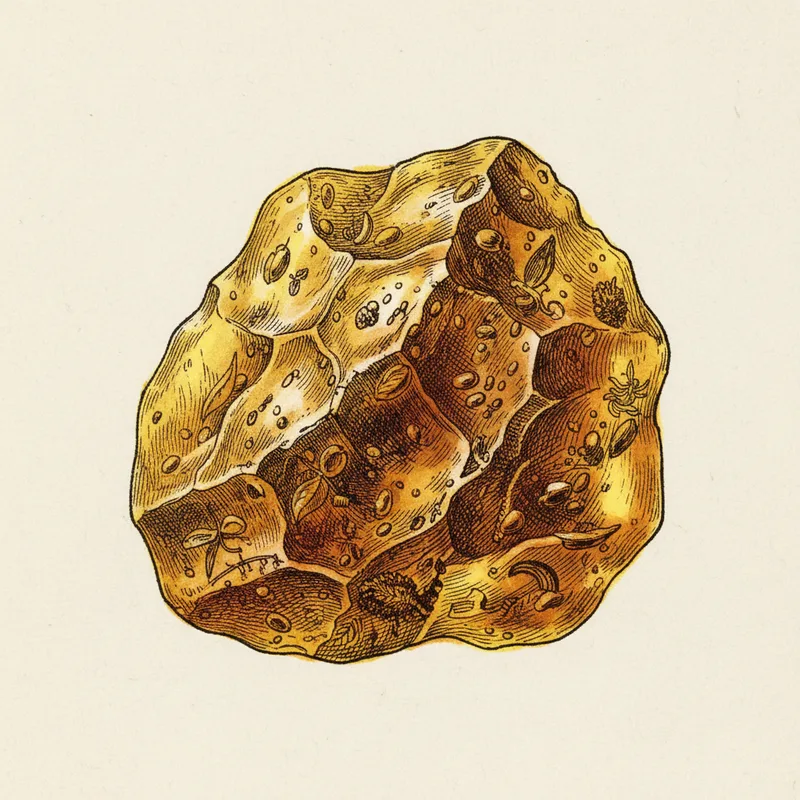
Amber
The Window to Prehistoric Life
Affiliate links. We may earn a commission, at no cost to you.
Quick Facts
Formation & Origin
Amber is not a mineral - it's fossilized tree resin, typically 20-100 million years old. When ancient coniferous trees exuded resin (as a defense against insects and disease), some of that resin became buried in forest sediment. Over millions of years, heat and pressure polymerized the resin through a process called amberization, transforming sticky tree sap into a hard, durable organic gem.
Amber's greatest scientific value is as a preservation medium. Insects, spiders, feathers, plant material, and even small lizards trapped in flowing resin were perfectly preserved in three dimensions - frozen in time with cellular-level detail. Burmese amber (99 million years old) has yielded spectacular Cretaceous inclusions including a dinosaur tail with feathers and the oldest known bee.
Dominican blue amber is one of the rarest gem varieties on Earth. The blue fluorescence (visible in sunlight against a dark background) is caused by aromatic hydrocarbons produced when the original resin from the extinct Hymenaea protera tree polymerized under specific conditions found only in the Dominican Republic.
Identification Guide
Amber is identified by its low density (1.08 - it floats in saturated salt water), warmth to the touch (unlike glass or plastic), and static charge (rubbed amber attracts small pieces of paper). The word 'electricity' comes from 'elektron,' the Greek word for amber.
Distinguish from copal (younger, unfossilized resin - dissolves in acetone, amber doesn't), plastic (doesn't float in salt water, no static), and pressed amber (reconstructed from small pieces - shows flow lines under magnification). The hot needle test releases a pine-like aroma from genuine amber, while plastic smells acrid.
Spotting Fakes
Amber is heavily faked. Copal (young resin, not fully polymerized) is the most common substitute - it dissolves when a drop of acetone is placed on it, while genuine amber resists acetone. Plastic imitations fail the salt water test (amber floats, most plastic sinks). 'Ambroid' or pressed amber (small pieces fused with heat and pressure) is legitimate but should be disclosed. The hot needle test works but damages the specimen. For expensive pieces with inclusions, beware of insects inserted into copal or resin fakes - genuine inclusions show natural positioning and decay patterns.
Some links in this post go to Amazon and Etsy. Crystal Almanac earns a commission from qualifying purchases at no extra cost to you. Tools recommended here are ones we would use ourselves to run the tests described - the recommendation comes first, the link is downstream of it.
Cultural & Metaphysical Traditions
Presented as cultural traditions, not scientific evidence
Baltic peoples considered amber sacred for thousands of years - it was more valuable than gold in some ancient trade networks. The Amber Room, an 18th-century chamber paneled in amber in Russia's Catherine Palace, was called the 'Eighth Wonder of the World' before its disappearance during WWII. In Chinese medicine, amber is called 'hu po' (tiger's soul) and used in traditional preparations. Greek mythology says amber is the tears of Helios's daughters, who wept for their brother Phaethon.
Metaphysical and “healing” associations are cultural traditions, not medical advice or scientific fact. Crystals are not a substitute for professional medical care.
Where It's Found
World's largest deposits, 44 million years old
Rare blue amber, exceptional insect inclusions
Cretaceous amber (99 million years), dinosaur-era inclusions
Fine quality, Miocene age
Price Guide
Good to Know
Scratch test: At hardness 2.5, Amber can be scratched with a fingernail. This is a display specimen, not a wearable stone.
Global supply: Found in 4 notable locations worldwide, from Baltic Region to Mexico.
Heft test: With a specific gravity of 1.08, Amber feels lighter than most minerals. This lightness can help identify it.
Common Questions
What is the chemical formula of Amber?
The chemical formula of Amber is C₁₀H₁₆O (approximate, variable polymer).
What is Amber's Mohs hardness?
Amber has a Mohs hardness of 2.5 on the 1 to 10 Mohs scale, soft enough to scratch with a fingernail.
Is Amber a mineral?
No. Amber is an organic gem, not a mineral, because it forms from once-living material rather than purely geological crystallization.
Care & Safety
The water, salt, and sunlight questions people actually ask before cleansing or displaying amber, answered from its hardness (Mohs 2.5) and chemistry (C₁₀H₁₆O (approximate, variable polymer)).
Can Amber go in water?
Not recommended. Organic gem (fossilized resin). Water will not dissolve it, but prolonged soaking can cause surface cloudiness and cracking.
Can Amber go in salt water?
No. Amber is best kept away from water altogether, and salt water is the harsher version of that problem: the dissolved salt is corrosive while the stone is wet, then leaves gritty crystals behind in cracks and crevices as it dries.
Is sunlight safe for Amber?
Prolonged sun ages it. Amber does not bleach like a colored crystal; instead, extended sunlight and heat oxidize the fossil resin, darkening it and encouraging fine surface cracking over time. Display amber away from direct sun and heat sources.
Sources & References
The mineralogical and gemological data on this page is drawn from and can be cross-checked against these external references.
Related Minerals
Young resin, not fully fossilized, common substitute
Another organic gem, fossilized wood rather than resin
Similar honey color but completely different (quartz)
Another yellow transparent natural glass
Explore More
Organic & Biogenic Gems
The Confidence Collection
Worn by Baltic warriors and Roman gladiators. One of humanity's oldest confidence amulets. The ancient sun trapped in resin - solar courage preserved across millions of years.
The Travel Collection
Baltic amber was traded along ancient European trade routes and carried by merchants as a protective talisman. One of the oldest commercial stones, literally born on the road of trade.
Scorpio Season Crystals 2026: Stones for Transformation
Lion's Gate Portal 2026: Crystals for August 8
How to Protect Crystals from Summer Heat and Sunlight
Mohs Hardness Scale
See where Amber sits on the scale
Crystal Care Guide
Water safety, sunlight, and handling tips
Save This Stone
.%20Meaning%2C%20properties%20%26%20how%20to%20spot%20fakes%20at%20Crystal%20Almanac.)
Keep this amber reference handy. Save the card to a Pinterest board and the profile is one tap away.
Save to PinterestNewsletter
Something shiny, now and then
A stone worth knowing, or a fake worth spotting, every so often. No spam.