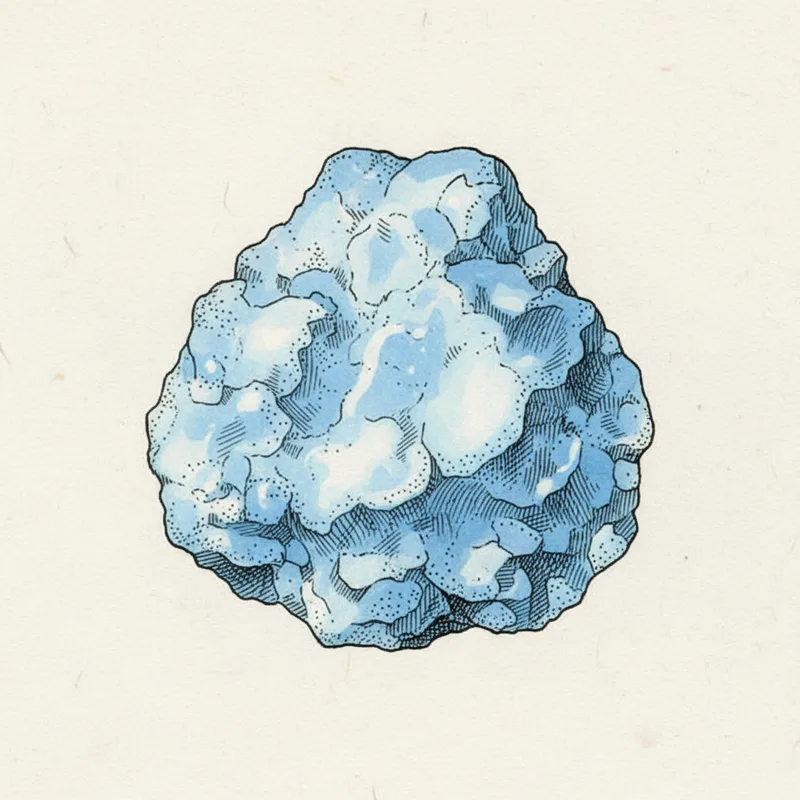
Angelite
The Stone of Awareness
Affiliate links. We may earn a commission, at no cost to you.
Quick Facts
Formation & Origin
Angelite is a trade name for blue anhydrite - the anhydrous (waterless) form of calcium sulfate. Gypsum is the hydrated form (CaSO₄·2H₂O); when gypsum loses its water through burial, heat, or pressure, it converts to anhydrite (CaSO₄). The blue color in angelite comes from trace amounts of strontium or iron impurities.
Anhydrite forms in evaporite deposits alongside gypsum, halite (rock salt), and other evaporite minerals. These deposits represent ancient seas or salt lakes that evaporated, concentrating dissolved minerals. The conversion from gypsum to anhydrite occurs at depths of around 600 meters where temperatures and pressures are sufficient to drive off the crystal water.
Angelite has an important practical quirk: it converts back to gypsum when exposed to water for extended periods. This means angelite should never be cleansed in water, worn in the shower, or left in humid environments - it will gradually soften, whiten, and deteriorate.
Identification Guide
Angelite is identified by its distinctive soft periwinkle-blue color, waxy luster, and low hardness (3.5). It often has a slightly chalky feel and appearance compared to harder blue minerals.
Distinguish from celestite (crystalline rather than massive, higher SG at 3.97), blue calcite (fizzes in acid), and blue lace agate (much harder at 7, banded pattern). Angelite's combination of blue color, low hardness, massive habit, and water sensitivity is diagnostic.
Spotting Fakes
Angelite is inexpensive and rarely faked. The main issue is distinguishing it from blue-dyed stones - genuine angelite has a natural, slightly uneven color distribution. It's sometimes confused with or sold interchangeably as celestite, but they're chemically different (celestite is strontium sulfate). The water sensitivity is both a practical concern and an identification test - genuine angelite will show surface changes if left in water.
Some links in this post go to Amazon and Etsy. Crystal Almanac earns a commission from qualifying purchases at no extra cost to you. Tools recommended here are ones we would use ourselves to run the tests described - the recommendation comes first, the link is downstream of it.
Cultural & Metaphysical Traditions
Presented as cultural traditions, not scientific evidence
The 'angelite' trade name was coined to market blue anhydrite for the crystal healing market, connecting the stone's ethereal blue color to angelic communication. It has no ancient historical associations under this name. Modern practitioners consider it a stone for connecting with spirit guides, enhancing telepathic communication, and promoting compassion. It's often paired with celestite for angelic or spiritual work.
Metaphysical and “healing” associations are cultural traditions, not medical advice or scientific fact. Crystals are not a substitute for professional medical care.
Where It's Found
Primary source of blue gem-quality material
Blue-gray specimens
Classic European anhydrite source
Industrial and specimen-grade material
Price Guide
Good to Know
Scratch test: At hardness 3.5, Angelite can be scratched with a copper coin. Handle gently and keep away from harder stones in your collection.
Global supply: Found in 4 notable locations worldwide, from Peru to Poland.
Heft test: Angelite has average mineral density (2.98). It feels about as heavy as you'd expect from a stone its size.
Common Questions
What is the chemical formula of Angelite?
The chemical formula of Angelite is CaSO₄.
What is Angelite's Mohs hardness?
Angelite has a Mohs hardness of 3.5 on the 1 to 10 Mohs scale, soft enough to scratch with a copper coin.
Is Angelite a mineral?
Yes. Angelite is a naturally occurring mineral (Sulfate Group) with a definite chemical composition and an ordered crystal structure.
Care & Safety
The water, salt, and sunlight questions people actually ask before cleansing or displaying angelite, answered from its hardness (Mohs 3.5) and chemistry (CaSO₄).
Can Angelite go in water?
No, never. Reverts to gypsum when exposed to water. Will lose its blue color and smooth texture permanently.
Can Angelite go in salt water?
No, never. Angelite is anhydrite (CaSO₄), which reverts toward gypsum with water exposure. Salt water accelerates the surface damage and leaves abrasive residue. Keep it dry.
Sources & References
The mineralogical and gemological data on this page is drawn from and can be cross-checked against these external references.
- WikipediaAnhydrite on Wikipedia
- WebmineralAnhydrite mineral data (Webmineral)
- Handbook of MineralogyAnhydrite (Handbook of Mineralogy, PDF)
Explore More
Sulfate Minerals
The Calming Collection
Blue anhydrite associated with gentle, calming energy and angelic connection.
The Sleep Collection
Blue anhydrite associated with peaceful, protected sleep. Its soft powder-blue color is visually restful. Practitioners place it near the bed for gentle, calming energy during rest.
Crystal Hardness Chart: What Mohs Means for You
Best Crystals for Pregnancy and New Motherhood
Mohs Hardness Scale
See where Angelite sits on the scale
Crystal Care Guide
Water safety, sunlight, and handling tips
Save This Stone
.%20Meaning%2C%20properties%20%26%20identification%20at%20Crystal%20Almanac.)
Keep this angelite reference handy. Save the card to a Pinterest board and the profile is one tap away.
Save to PinterestNewsletter
Something shiny, now and then
A stone worth knowing, or a fake worth spotting, every so often. No spam.