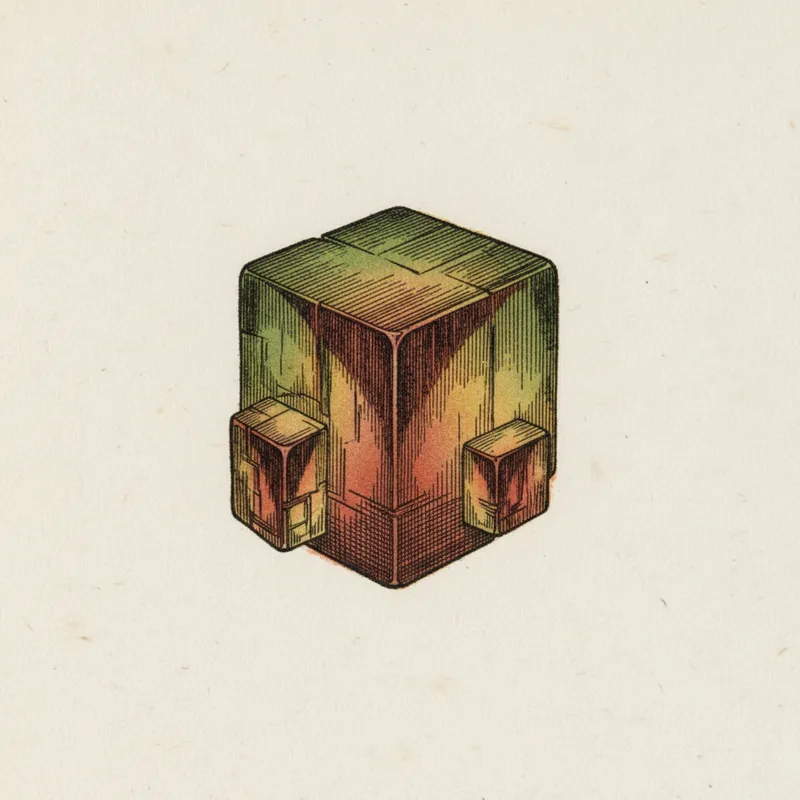
Andalusite
The Poor Man's Alexandrite
Affiliate links. We may earn a commission, at no cost to you.
Quick Facts
Formation & Origin
Andalusite is an aluminum silicate mineral (Al₂SiO₅) and one of three polymorphs of that composition, sharing its chemistry with kyanite and sillimanite. Andalusite belongs to the Al₂SiO₅ polymorph group alongside kyanite and sillimanite. All three share identical chemistry but form under different pressure-temperature conditions during regional metamorphism. Andalusite crystallizes at the low-pressure end of the spectrum, typically below 4 kilobars, in contact metamorphic zones where igneous intrusions bake surrounding aluminous shales and mudstones at temperatures between 400 and 700°C. This low-pressure, moderate-temperature window is why andalusite is found near the margins of granite intrusions rather than in the deeply buried high-pressure rocks where kyanite forms.
The chiastolite variety develops when growing crystals incorporate carbonaceous material from carbon-rich host sediments. As the crystal expands outward, dark inclusions are systematically displaced toward the crystal's center and the midpoints of each face, creating the cruciform pattern visible on cross-section. The cross is not a secondary alteration but a primary growth structure reflecting the orthorhombic symmetry of the expanding crystal and the distribution of organic material in the surrounding rock.
Transparent gem-quality andalusite typically grows in pegmatitic pockets or coarse-grained metamorphic rocks where slower crystallization allows larger, clearer crystals to develop. Brazil's Minas Gerais produces the finest examples, where aluminous schists underwent contact metamorphism at ideal pressure-temperature conditions for transparency.
Identification Guide
The defining property is strong trichroic pleochroism: viewed along different crystallographic axes, andalusite shifts through red-orange, olive green, and yellow-brown all under the same light source. Rotate a faceted stone between your fingers and you can watch all three colors emerge. A dichroscope placed against the stone confirms the effect immediately. This is mechanistically distinct from alexandrite's color change, which requires different light sources to trigger chromium's absorption shift. Andalusite's multiple colors are always present simultaneously - it is the viewing angle, not the light source, that reveals them.
The chiastolite variety is unmistakable on cross-section: a charcoal-gray or black cross in a buff to clay-colored matrix, with arms aligning to the crystal's orthorhombic faces. No common mineral produces this exact pattern. In massive or opaque specimens, specific gravity of 3.16-3.20 and hardness around 7 distinguish andalusite from feldspar (lower SG, softer), topaz (similar hardness, higher SG at 3.5), and epidote (similar color range, higher SG).
Spotting Fakes
Andalusite is rarely counterfeited outright, but is frequently misrepresented as an alexandrite alternative. The distinction is testable: alexandrite changes color based on light source while viewed from the same angle - green in daylight, red under incandescent light. Andalusite's color shift happens when you rotate the stone under a single unchanged light source. If rotating reveals the color shifts, it is pleochroism consistent with andalusite. If the color shifts only when you change the light source without rotating, that is genuine color change. Chiastolite is occasionally replicated in resin casts - genuine specimens feel noticeably heavy for their size (SG 3.16+), and the cross pattern runs through the full depth of the crystal rather than appearing only on the cut surface.
Some links in this post go to Amazon and Etsy. Crystal Almanac earns a commission from qualifying purchases at no extra cost to you. Tools recommended here are ones we would use ourselves to run the tests described - the recommendation comes first, the link is downstream of it.
Cultural & Metaphysical Traditions
Presented as cultural traditions, not scientific evidence
The chiastolite variety was used as a protective amulet in medieval Christian Europe, particularly in Spain, where pilgrims on the Camino de Santiago carried pieces as shields against illness and misfortune. The cross was interpreted as a sacred mark formed by nature itself rather than human hand. In contemporary traditions, andalusite is associated with perspective and balance - its simultaneous display of multiple colors read as a metaphor for seeing all sides of a situation before forming judgment.
Metaphysical and “healing” associations are cultural traditions, not medical advice or scientific fact. Crystals are not a substitute for professional medical care.
Where It's Found
World's premier source of gem-quality transparent crystals with the strongest pleochroism
The type locality that named the mineral. Classic source of the chiastolite cross variety
Large chiastolite crystals with well-defined cross patterns in schist
Alluvial gem-quality crystals found alongside sapphire and spinel in river gravels
Price Guide
Good to Know
Scratch test: At hardness 7, Andalusite can scratch glass and steel. It's durable enough for any type of jewelry.
Global supply: Found in 4 notable locations worldwide, from Minas Gerais to Sri Lanka.
Heft test: Andalusite has average mineral density (3.16-3.20). It feels about as heavy as you'd expect from a stone its size.
Common Questions
What is the chemical formula of Andalusite?
The chemical formula of Andalusite is Al₂SiO₅.
What is Andalusite's Mohs hardness?
Andalusite has a Mohs hardness of 7 on the 1 to 10 Mohs scale, hard enough to scratch glass and stand up to daily wear.
Is Andalusite a mineral?
Yes. Andalusite is a naturally occurring mineral (Aluminum Silicate) with a definite chemical composition and an ordered crystal structure.
Care & Safety
The water, salt, and sunlight questions people actually ask before cleansing or displaying andalusite, answered from its hardness (Mohs 7) and chemistry (Al₂SiO₅).
Can Andalusite go in water?
Yes. Andalusite is hard (Mohs 7) and chemically stable, so a rinse or a quick wash with mild soap is no problem, cleanse it in water freely if that is your practice. A long soak does nothing for it either way, so skip that, and dry the stone afterward.
Can Andalusite go in salt water?
Not recommended, even though andalusite itself is hard and not water-soluble. Salt is both corrosive and mildly abrasive: it can dull a polished surface, attack metal settings, and crystallize inside small fractures as the stone dries. A quick dip will not destroy andalusite, but rinse it with fresh water afterward and dry it. For routine cleaning, plain water is the kinder choice.
Sources & References
The mineralogical and gemological data on this page is drawn from and can be cross-checked against these external references.
- WikipediaAndalusite on Wikipedia
- WebmineralAndalusite mineral data (Webmineral)
- Handbook of MineralogyAndalusite (Handbook of Mineralogy, PDF)
Related Minerals
Same Al₂SiO₅ formula, forms at high pressure, blue color
Third Al₂SiO₅ polymorph, high-temperature formation, fibrous habit
The true color-change chrysoberyl it is most often compared to
Explore More
Save This Stone

Keep this andalusite reference handy. Save the card to a Pinterest board and the profile is one tap away.
Save to PinterestNewsletter
Something shiny, now and then
A stone worth knowing, or a fake worth spotting, every so often. No spam.