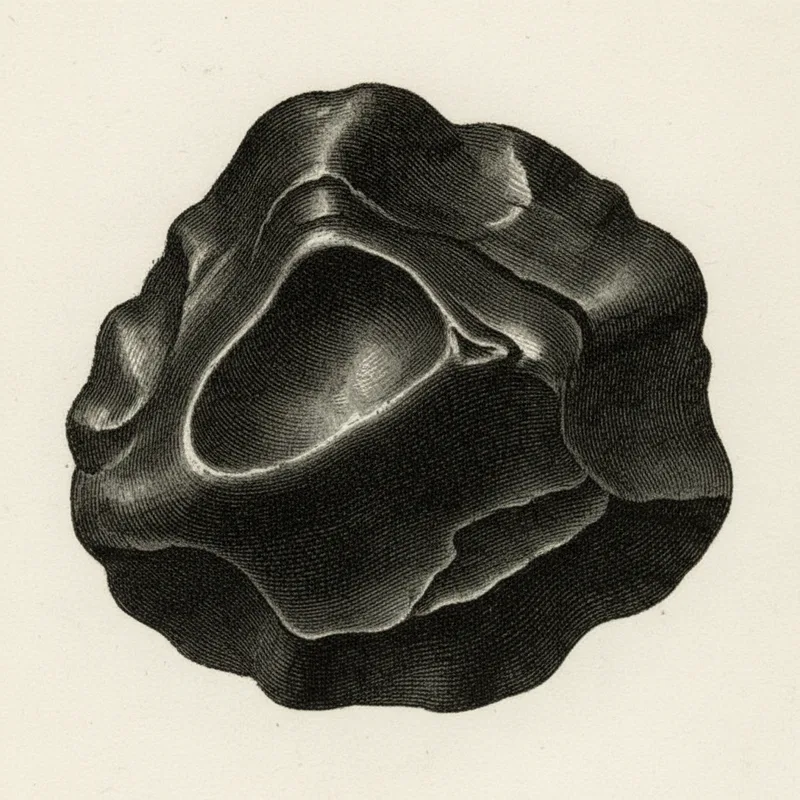
Jet
The Mourning Stone
Affiliate links. We may earn a commission, at no cost to you.
Quick Facts
Formation & Origin
Jet is fossilized wood - specifically, the remains of Araucaria-type coniferous trees that fell into anoxic (oxygen-free) swamp or marine environments during the Jurassic period, roughly 180 million years ago. Under pressure and in the absence of oxygen, the wood underwent a process similar to coal formation but retained more of its original cellular structure.
Jet from Whitby, England, formed from trees that fell into a Jurassic sea and were buried in marine shale. This distinguishes it from 'hard jet' that formed in freshwater environments - the marine Whitby jet is denser and takes a better polish. Whitby has been the world's premier jet source since the Bronze Age.
Jet is extremely lightweight (SG 1.30 - it barely sinks in water), warm to the touch, and generates static electricity when rubbed - properties it shares with amber, another organic gem. Despite being millions of years old, jet retains enough volatile compounds to burn with a smoky flame, which was used historically as an identification test.
Identification Guide
Jet is identified by its intense black color, very low density (feels surprisingly light), warmth to the touch, and ability to generate static charge when rubbed on fabric. The streak is dark brown, not black.
Distinguish from obsidian (much denser, glassy fracture, cold to touch), black onyx (much denser, harder), black tourmaline (crystal faces, much denser), and glass (cold, denser). Jet's extreme lightness is its most practical diagnostic - if a black material feels unexpectedly light, it's likely jet or plastic.
Spotting Fakes
Bakelite, vulcanite (vulcanized rubber), and other black plastics are the most common jet substitutes. The hot needle test helps: jet smells of burning coal, while plastic smells acrid. Jet also generates static electricity when rubbed, which most plastics don't. French jet (black glass) is cold and heavy compared to genuine jet. The weight test is fastest - genuine jet is remarkably lightweight for its appearance. 'Bog oak' (naturally darkened wood) is sometimes sold as jet but is softer and shows visible wood grain.
Some links in this post go to Amazon and Etsy. Crystal Almanac earns a commission from qualifying purchases at no extra cost to you. Tools recommended here are ones we would use ourselves to run the tests described - the recommendation comes first, the link is downstream of it.
Cultural & Metaphysical Traditions
Presented as cultural traditions, not scientific evidence
Jet has been used since the Neolithic period - jet beads have been found in British burial sites dating to 4,000 years ago. The Romans believed jet could detect illness and evil. But jet's most famous cultural role was in Victorian mourning jewelry. After Prince Albert's death in 1861, Queen Victoria wore Whitby jet exclusively, creating a massive demand. Whitby's jet industry employed over 1,500 workers at its peak. Jet became synonymous with mourning and grief across the English-speaking world.
Metaphysical and “healing” associations are cultural traditions, not medical advice or scientific fact. Crystals are not a substitute for professional medical care.
Where It's Found
World's most famous jet, Victorian-era production
Important European source, fine quality
Traditional carving material
Some material available
Price Guide
Good to Know
Scratch test: At hardness 3, Jet can be scratched with a copper coin. Handle gently and keep away from harder stones in your collection.
Global supply: Found in 4 notable locations worldwide, from England to United States.
Heft test: With a specific gravity of 1.30, Jet feels lighter than most minerals. This lightness can help identify it.
Common Questions
What is the chemical formula of Jet?
The chemical formula of Jet is Carbon-rich organic material.
What is Jet's Mohs hardness?
Jet has a Mohs hardness of 3 on the 1 to 10 Mohs scale, soft enough to scratch with a copper coin.
Is Jet a mineral?
No. Jet is an organic gem, not a mineral, because it forms from once-living material rather than purely geological crystallization.
Care & Safety
The water, salt, and sunlight questions people actually ask before cleansing or displaying jet, answered from its hardness (Mohs 3) and chemistry (Carbon-rich organic material).
Can Jet go in water?
Not recommended. At Mohs 3, jet is soft enough that water can slowly dull, etch, or wear down the surface, so a water cleanse does more harm than good here. Reach for a dry cloth instead.
Can Jet go in salt water?
No. Jet is best kept away from water altogether, and salt water is the harsher version of that problem: the dissolved salt is corrosive while the stone is wet, then leaves gritty crystals behind in cracks and crevices as it dries.
Sources & References
The mineralogical and gemological data on this page is drawn from and can be cross-checked against these external references.
- WikipediaJet (gemstone) on Wikipedia
Related Minerals
Another organic gem, fossilized resin vs fossilized wood
Similar black color, completely different origin (volcanic)
Similar appearance, mineral vs organic
Related fossilized plant material, less compact
Explore More
Organic & Biogenic Gems
Scorpio Season Crystals 2026: Stones for Transformation
Is It a Mineral? Obsidian, Amber, Pearl, and Opal
Best Crystals for a Beach Trip: What to Bring
Mohs Hardness Scale
See where Jet sits on the scale
Crystal Care Guide
Water safety, sunlight, and handling tips
Save This Stone
%2C%20and%20other%20black%20plastics%20are%20the%20most%20common%20jet%20substitutes.%20Meaning%2C%20properties%20%26%20how%20to%20spot%20fakes%20at%20Crystal%20Almanac.)
Keep this jet reference handy. Save the card to a Pinterest board and the profile is one tap away.
Save to PinterestNewsletter
Something shiny, now and then
A stone worth knowing, or a fake worth spotting, every so often. No spam.