Sardonyx
The Legionnaire's Stone
Affiliate links. We may earn a commission, at no cost to you.
Quick Facts
Formation & Origin
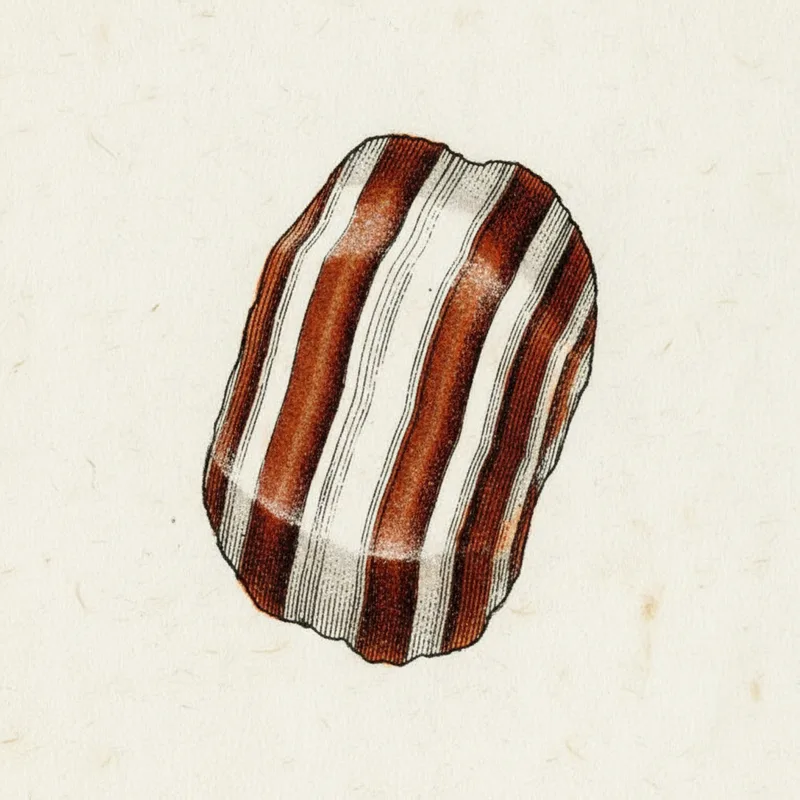
Sardonyx is a banded variety of chalcedony that combines layers of sard (brownish-red chalcedony colored by iron oxide) with layers of onyx (black or white chalcedony). It forms in cavities within volcanic rocks where silica-rich solutions deposit alternating layers over long periods.
Each band represents a change in the chemical composition or conditions of the depositing solution. Iron-rich solutions create the reddish-brown sard layers, while purer silica produces the white or translucent bands. The alternating conditions might reflect seasonal changes in groundwater chemistry or episodic volcanic activity.
Sardonyx has been prized since antiquity. Roman soldiers wore sardonyx rings and talismans carved with images of Mars, believing the stone gave courage in battle. It was one of the most popular stones for cameo and intaglio carving because the contrasting layers allowed artisans to carve figures in white relief against a dark background.
Identification Guide
Sardonyx is identified by its straight, parallel bands of reddish-brown (sard) alternating with white or black layers. The banding is typically more regular and linear than in agate. At 7 on the Mohs scale, it scratches glass easily.
Distinguish from banded agate (curved bands, usually lacking the red-brown sard component), carnelian (uniform color, no banding), and tiger eye (chatoyant, different formation). If the brown bands are more orange than reddish-brown, the stone may be classified as carnelian agate rather than sardonyx.
Spotting Fakes
Much commercial 'sardonyx' is actually dyed agate, especially material from Brazil. Dyed specimens often have unnaturally vivid or uniform banding. Natural sardonyx has subtle color variations within each band. Under magnification, dyed material may show color concentrated along tiny fractures. True sard has a warm, brownish-red tone rather than the bright orange-red of dyed material. Heat treatment is also common to enhance contrast.
Some links in this post go to Amazon and Etsy. Crystal Almanac earns a commission from qualifying purchases at no extra cost to you. Tools recommended here are ones we would use ourselves to run the tests described - the recommendation comes first, the link is downstream of it.
Cultural & Metaphysical Traditions
Presented as cultural traditions, not scientific evidence
Sardonyx is the traditional birthstone for August and has a history of association with strength, courage, and eloquence. Roman orators wore sardonyx believing it would make their speech more persuasive. In the Middle Ages, it was associated with marital happiness. Crystal practitioners today use it for self-discipline, motivation, and strengthening willpower.
Metaphysical and “healing” associations are cultural traditions, not medical advice or scientific fact. Crystals are not a substitute for professional medical care.
Where It's Found
Major commercial source, long history of use
Large deposits, often dyed material
Natural specimens alongside agate deposits
Growing source of natural material
Price Guide
Good to Know
Scratch test: At hardness 7, Sardonyx can scratch glass and steel. It's durable enough for any type of jewelry.
Global supply: Found in 4 notable locations worldwide, from India to Madagascar.
Heft test: Sardonyx has average mineral density (2.58-2.64). It feels about as heavy as you'd expect from a stone its size.
Common Questions
What is the chemical formula of Sardonyx?
The chemical formula of Sardonyx is SiO₂.
What is Sardonyx's Mohs hardness?
Sardonyx has a Mohs hardness of 7 on the 1 to 10 Mohs scale, hard enough to scratch glass and stand up to daily wear.
Is Sardonyx a mineral?
Yes. Sardonyx is a naturally occurring mineral (Chalcedony (Quartz Family)) with a definite chemical composition and an ordered crystal structure.
Care & Safety
The water, salt, and sunlight questions people actually ask before cleansing or displaying sardonyx, answered from its hardness (Mohs 7) and chemistry (SiO₂).
Can Sardonyx go in water?
Yes. Sardonyx is hard (Mohs 7) and chemically stable, so a rinse or a quick wash with mild soap is no problem, cleanse it in water freely if that is your practice. A long soak does nothing for it either way, so skip that, and dry the stone afterward.
Can Sardonyx go in salt water?
Not recommended, even though sardonyx itself is hard and not water-soluble. Salt is both corrosive and mildly abrasive: it can dull a polished surface, attack metal settings, and crystallize inside small fractures as the stone dries. A quick dip will not destroy sardonyx, but rinse it with fresh water afterward and dry it. For routine cleaning, plain water is the kinder choice.
Sources & References
The mineralogical and gemological data on this page is drawn from and can be cross-checked against these external references.
- WikipediaOnyx on Wikipedia
- WebmineralQuartz mineral data (Webmineral)
- Handbook of MineralogyQuartz (Handbook of Mineralogy, PDF)
Explore More
Save This Stone

Keep this sardonyx reference handy. Save the card to a Pinterest board and the profile is one tap away.
Save to PinterestNewsletter
Something shiny, now and then
A stone worth knowing, or a fake worth spotting, every so often. No spam.