Quick Facts
The Story
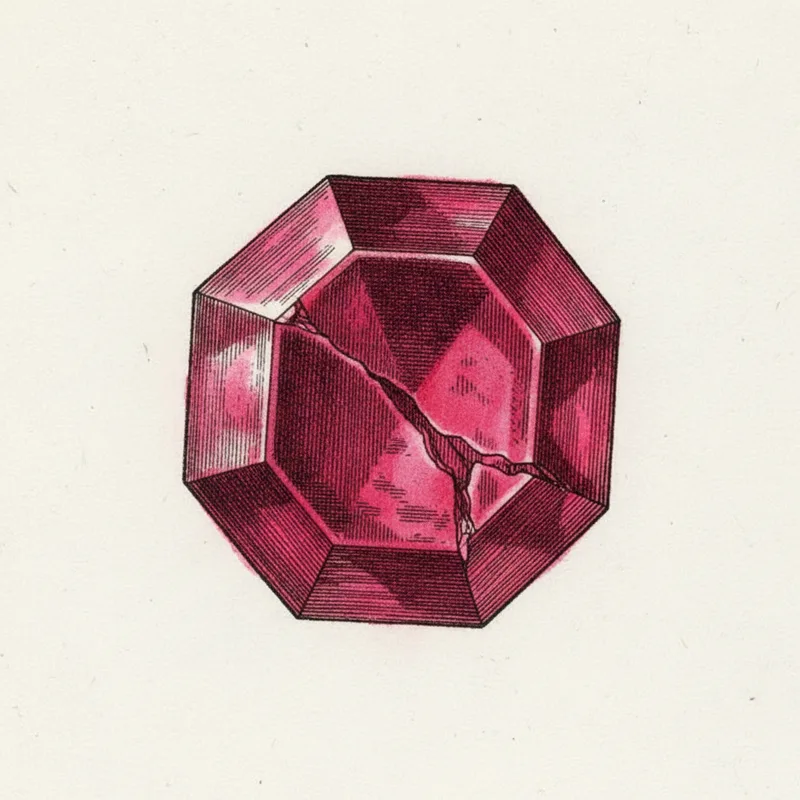
The Timur Ruby is a 352.54 carat polished red spinel, unfaceted and uncut in form, that is part of the British Royal Collection. Like the Black Prince's Ruby, it is not a ruby: it was formally reclassified as a spinel in 1851, decades after chemists first separated the two species. Garrard set it as the centerpiece of a necklace for Queen Victoria in 1853.
The stone carries its provenance on its surface. It is inscribed with the titles of five owners: the Mughal emperors Jahangir (who added the name of his father Akbar the Great), Shah Jahan and Farrukhsiyar, then Nader Shah of Iran, who seized it during his 1739 occupation of Delhi, and Ahmad Shah Durrani of Afghanistan, who obtained it after Nader Shah's assassination in 1747. The earliest documented transfer is a gift from the Safavid ruler Shah Abbas I to Jahangir in 1612.
The traditional story that Timur took the stone during his 1398 invasion of Delhi gave the gem its name, but research published in 1996 indicated it was never owned by Timur. By 1813 the spinel was in the hands of Maharaja Ranjit Singh of the Sikh Empire. The East India Company acquired it from the Lahore treasury in 1849, displayed it at the Great Exhibition in London in 1851, and presented it to Queen Victoria that year.
Common Questions
How many carats is the Timur Ruby?
The Timur Ruby weighs 352.54 carats.
What color is the Timur Ruby?
The Timur Ruby is Red.
Where did the Timur Ruby come from?
The Timur Ruby originates from Central or South Asia (Badakhshan is the principal historical source of large spinels).
Where is the Timur Ruby now?
The Timur Ruby is currently located at Royal Collection, United Kingdom.
Ownership Timeline
to 1612
Shah Abbas I of Persia
Gave the spinel to the Mughal emperor Jahangir in 1612, the earliest documented transfer.
1612-1739
Mughal emperors (Jahangir, Shah Jahan, Farrukhsiyar)
Three Mughal owners had their titles inscribed on the stone.
1739-1747
Nader Shah of Iran
Seized the stone during his occupation of Delhi; his title is inscribed on it.
1747 onward
Ahmad Shah Durrani, Afghanistan
Obtained the spinel after Nader Shah's assassination; the last owner inscribed on the stone.
1813-1849
Maharaja Ranjit Singh, Sikh Empire
Took possession in 1813; the stone remained in the Lahore treasury until the British annexation of Punjab.
1849-1851
East India Company
Acquired from Duleep Singh in 1849 and displayed at the Great Exhibition in London in 1851.
1851-present
Queen Victoria and the Royal Collection
Presented to Queen Victoria by the East India Company after the Great Exhibition; set in a Garrard necklace in 1853.
Notable Events
1612
Gift to the Mughal court
Shah Abbas I of Persia gave the spinel to the Mughal emperor Jahangir, who had his own title and his father Akbar's name inscribed on the stone.
1739
Seized by Nader Shah
Nader Shah of Iran took the stone during his occupation of Delhi, adding his title to the inscriptions.
1851
Great Exhibition and gift to Queen Victoria
The East India Company displayed the stone at the Great Exhibition in London, where it was reclassified as a spinel rather than a ruby, then presented it to Queen Victoria.
Lore & Legend
Documented legend, not historical fact
1398
LoreThe Timur attribution
The stone is named for Timur, who was traditionally believed to have taken it during his invasion of Delhi in 1398. Research published in 1996 indicated the gem was never owned by Timur, making the name itself a piece of lore.
Sources & References
The provenance and facts on this page are drawn from and can be cross-checked against these sources.
The Mineral Behind It
Spinel →
Formation, identification, and fake-spotting
More Famous Spinels
Newsletter
Something shiny, now and then
A stone worth knowing, or a fake worth spotting, every so often. No spam.