Quick Facts
The Story
The Black Prince's Ruby is not a ruby at all. It is a 170 carat irregular cabochon of red spinel, about 4.3 cm long, set in the cross pattee at the front of the Imperial State Crown, directly above the Cullinan II diamond. Spinel was only chemically distinguished from ruby in 1783, long after the stone was named. It is believed to have been mined in Badakhshan, the principal medieval source of large spinels, and is displayed in the Jewel House at the Tower of London.
Its documented history begins in 14th century Spain with Abu Sa'id, a Muslim prince of Granada, who was killed in Seville around 1362 on the orders of Pedro of Castile, after which the stone entered Pedro's possession. In 1367 Pedro gave it to Edward the Black Prince, son of Edward III of England, as payment for military support at the Battle of Najera. The stone then disappears from the records until 1415.
Tradition holds that Henry V wore it in his helmet at Agincourt in 1415 and that Richard III wore it at Bosworth in 1485, though both stories rest on later accounts. The crown jewels were broken up and sold under the Commonwealth; a large ruby bought back for 400 pounds in 1661 may well have been this spinel. Queen Victoria wore it at the front of her new Imperial State Crown at her 1838 coronation, and it has stayed at the front of the crown ever since.
Common Questions
How many carats is the Black Prince's Ruby?
The Black Prince's Ruby weighs 170 carats.
What color is the Black Prince's Ruby?
The Black Prince's Ruby is Red.
Where did the Black Prince's Ruby come from?
The Black Prince's Ruby originates from Believed mined in Badakhshan (present-day Afghanistan/Tajikistan border region).
Where is the Black Prince's Ruby now?
The Black Prince's Ruby is currently located at Jewel House, Tower of London, United Kingdom.
Ownership Timeline
to c. 1362
Abu Sa'id, Prince of Granada
The stone's first recorded owner; killed in Seville, after which the spinel was taken from his possessions.
c. 1362-1367
Pedro of Castile
Acquired the stone after Abu Sa'id's death.
1367
Edward the Black Prince
Received the spinel from Pedro as payment for military support at the Battle of Najera; the stone then vanishes from records until 1415.
1415-1649
English Crown
Associated by tradition with Henry V at Agincourt and Richard III at Bosworth; royal regalia were sold off under the Commonwealth.
1661-present
British Crown
A large ruby bought for 400 pounds at the Restoration in 1661 may well be this stone. Set at the front of Queen Victoria's 1838 Imperial State Crown and at the front of the 1937 crown today.
Notable Events
1367
Given to the Black Prince after Najera
Pedro of Castile gave the spinel to Edward the Black Prince as payment for English military support at the Battle of Najera.
1783
Spinel distinguished from ruby
Chemical analysis separated spinel from ruby as a distinct mineral species, revealing that the famous 'ruby' had been a spinel all along.
1838
Set in Queen Victoria's Imperial State Crown
The spinel was mounted at the front of the new Imperial State Crown made for Victoria's coronation, the position it still occupies on the 1937 crown.
Lore & Legend
Documented legend, not historical fact
1415
LoreHenry V at Agincourt
Tradition says Henry V wore the stone in his gem-encrusted helmet at Agincourt, where he survived a battleaxe blow to the head. The story is documented lore rather than verified fact.
1485
LoreRichard III at Bosworth
Richard III is supposed to have worn the stone in his helmet when he was killed at the Battle of Bosworth. This is tradition, not a verifiable record.
Sources & References
The provenance and facts on this page are drawn from and can be cross-checked against these sources.
- WikipediaBlack Prince's Ruby
- Encyclopaedia BritannicaBlack Prince's ruby
- GIASpinel Journey: the great imposter in Europe's crown jewels
The Mineral Behind It
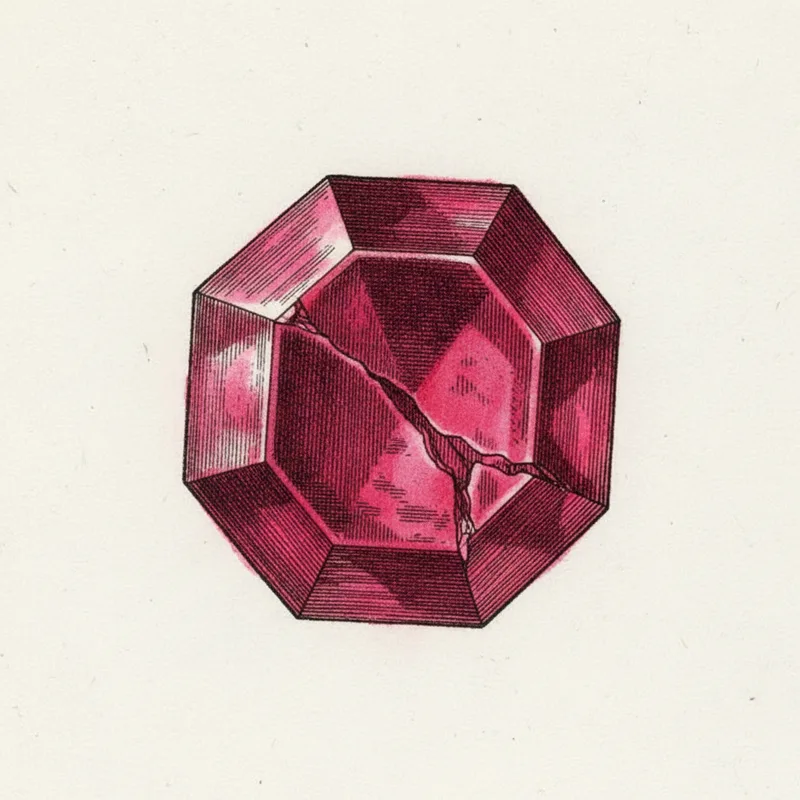
Spinel →
Formation, identification, and fake-spotting
More Famous Spinels
Newsletter
Something shiny, now and then
A stone worth knowing, or a fake worth spotting, every so often. No spam.