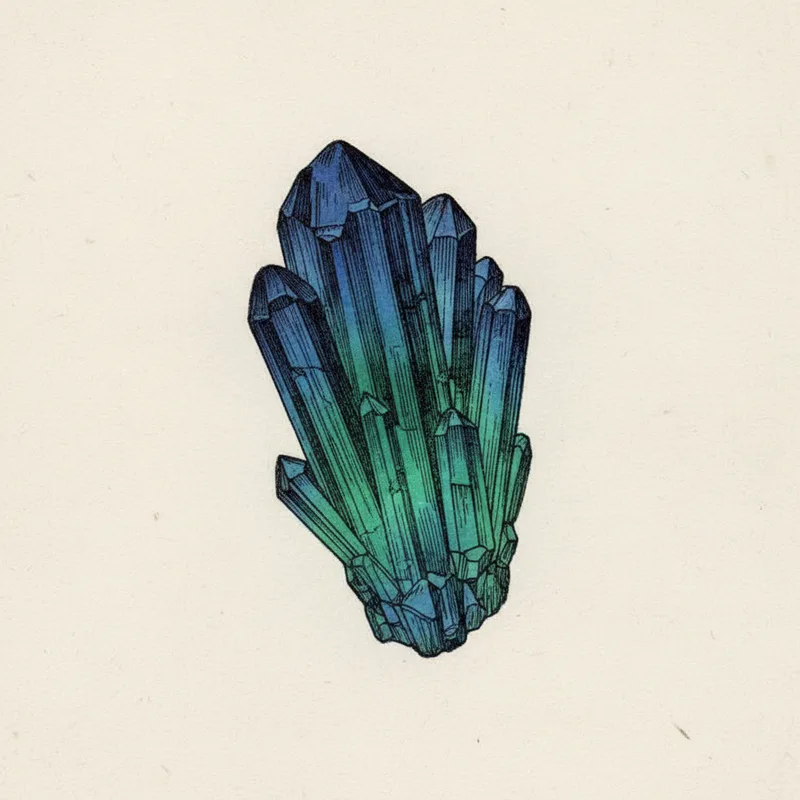
Vivianite
The Ghost Crystal
Affiliate links. We may earn a commission, at no cost to you.
Quick Facts
Formation & Origin
Vivianite is a hydrated iron phosphate with one of the most dramatic color-change behaviors in mineralogy. Freshly mined vivianite is often colorless or pale green. Upon exposure to light, the iron in its structure oxidizes from Fe²⁺ to Fe³⁺, and the crystal turns progressively deeper blue - from pale blue-green to deep indigo to near-black over time. This color change is irreversible.
This photosensitivity means that the most deeply colored vivianite specimens are also the oldest in terms of light exposure. Museum specimens collected decades ago may be nearly opaque dark indigo. Collectors who want to preserve pale color must store vivianite in complete darkness.
Vivianite forms in reducing (oxygen-poor) environments - waterlogged soils, bogs, and fossils. It's frequently found inside fossil bones and shells where phosphorus from the original organism combines with iron in the surrounding sediment. Finding vivianite growing inside a dinosaur bone or a clam fossil is genuinely one of the more remarkable intersections of biology and geology.
Identification Guide
Vivianite is identified by its extreme softness (hardness 2, scratched by a fingernail), perfect cleavage in one direction producing thin, flexible crystal blades, and the diagnostic darkening with light exposure. Fresh vivianite may be nearly colorless; older specimens are deep blue.
Distinguish from lazulite (much harder at 5.5, doesn't darken), azurite (harder, copper-based not iron), and erythrite (cobalt arsenate, pink-red). Vivianite's extreme softness, perfect cleavage, and photosensitive darkening are essentially unique.
Spotting Fakes
Vivianite is a specialist collector mineral rarely faked. The main concern is light damage rather than authenticity. If you acquire vivianite and want to preserve its current color, store it in darkness and handle minimally. Once darkened, the change cannot be reversed. Some sellers keep vivianite under dark covers and only reveal specimens briefly for viewing.
Some links in this post go to Amazon and Etsy. Crystal Almanac earns a commission from qualifying purchases at no extra cost to you. Tools recommended here are ones we would use ourselves to run the tests described - the recommendation comes first, the link is downstream of it.
Cultural & Metaphysical Traditions
Presented as cultural traditions, not scientific evidence
Vivianite is too rare and specialist for extensive metaphysical traditions. Practitioners who work with it associate its light-sensitive nature with themes of transformation through exposure - the idea that growth requires bringing hidden things into the light, even though the process changes you permanently. Its formation inside fossils connects it to ancestral memory and deep time.
Metaphysical and “healing” associations are cultural traditions, not medical advice or scientific fact. Crystals are not a substitute for professional medical care.
Where It's Found
World's finest vivianite crystals, exceptional size
Good crystal specimens
Large crystal groups
Dark blue specimens
Price Guide
Good to Know
Scratch test: At hardness 2, Vivianite can be scratched with a fingernail. This is a display specimen, not a wearable stone.
Global supply: Found in 4 notable locations worldwide, from Bolivia to Ukraine.
Heft test: Vivianite has average mineral density (2.68). It feels about as heavy as you'd expect from a stone its size.
Common Questions
What is the chemical formula of Vivianite?
The chemical formula of Vivianite is Fe₃(PO₄)₂·8H₂O.
What is Vivianite's Mohs hardness?
Vivianite has a Mohs hardness of 2 on the 1 to 10 Mohs scale, soft enough to scratch with a fingernail.
Is Vivianite a mineral?
Yes. Vivianite is a naturally occurring mineral (Phosphate Group) with a definite chemical composition and an ordered crystal structure.
Care & Safety
The water, salt, and sunlight questions people actually ask before cleansing or displaying vivianite, answered from its hardness (Mohs 2) and chemistry (Fe₃(PO₄)₂·8H₂O).
Can Vivianite go in water?
Not recommended. At Mohs 2, vivianite is soft enough that water can slowly dull, etch, or wear down the surface, so a water cleanse does more harm than good here. Reach for a dry cloth instead.
Can Vivianite go in salt water?
No. Vivianite is best kept away from water altogether, and salt water is the harsher version of that problem: the dissolved salt is corrosive while the stone is wet, then leaves gritty crystals behind in cracks and crevices as it dries. Vivianite's iron content also makes rust staining likely if salt residue sits on the surface.
Is sunlight safe for Vivianite?
No. Vivianite oxidizes on exposure to light, darkening irreversibly from pale green through blue toward purplish black. Store it in complete darkness to preserve the original color. It is also very soft and fragile, so handle it as little as possible.
Sources & References
The mineralogical and gemological data on this page is drawn from and can be cross-checked against these external references.
- WikipediaVivianite on Wikipedia
- WebmineralVivianite mineral data (Webmineral)
- Handbook of MineralogyVivianite (Handbook of Mineralogy, PDF)
Related Minerals
Another blue phosphate, much harder
Cobalt arsenate with similar crystal habit, pink
Another phosphate mineral, harder
Aluminum phosphate, green, different properties
Explore More
Save This Stone

Keep this vivianite reference handy. Save the card to a Pinterest board and the profile is one tap away.
Save to PinterestNewsletter
Something shiny, now and then
A stone worth knowing, or a fake worth spotting, every so often. No spam.